
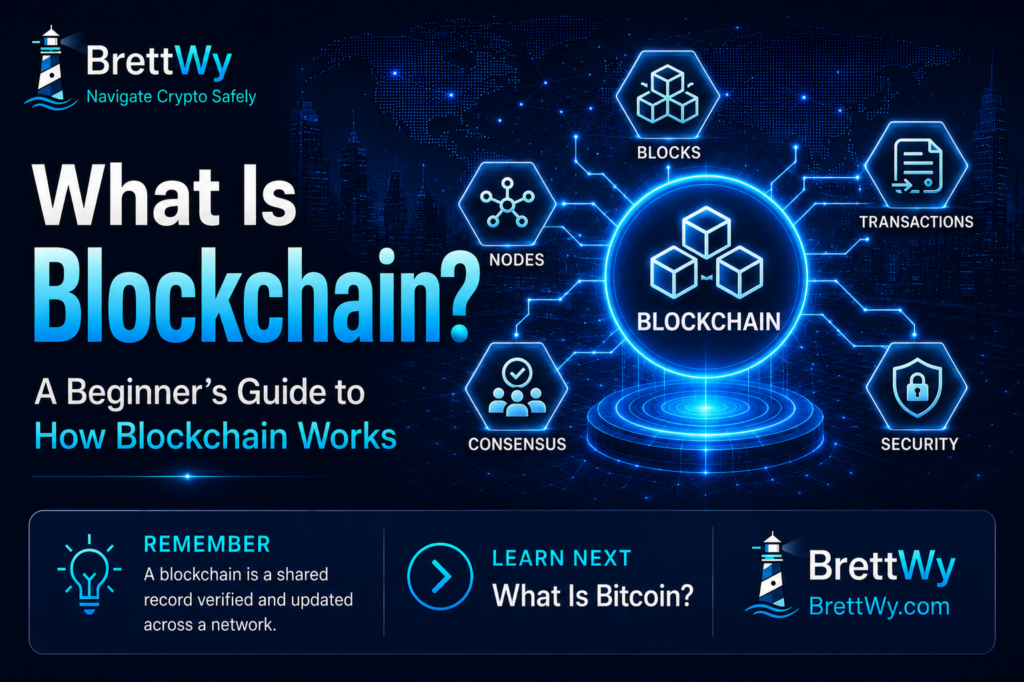
Article Snapshot
Crypto Fundamentals Learning Path
In This Guide, You’ll Learn
- What blockchain is and why it was created
- How transactions move from a request to a confirmed record
- What blocks, nodes, cryptography, and consensus mechanisms do
- Why distributed networks can be difficult to alter
- How blockchains differ from traditional databases
- Where smart contracts and real-world applications fit
- Which advantages, limitations, and misconceptions matter
- Why blockchain and Bitcoin are related but not identical
Introduction
In general, blockchain is one of the core technologies behind cryptocurrency, yet beginners often encounter it through technical language and exaggerated claims. Bitcoin, Ethereum, blockchains, and distributed ledgers are related, but they are not interchangeable terms.
Fortunately, the central idea is straightforward. A blockchain allows a network to maintain an ordered record under shared rules, even when no single participant controls the entire system.
For example, this guide explains that process in plain English. First, you will learn how blocks, nodes, cryptography, and consensus fit together. Then, you will compare blockchain with traditional databases and examine its uses, limitations, and risks.
Importantly, blockchain is a tool—not a guarantee of decentralization, security, privacy, or value. Therefore, understanding who controls the network and what can fail matters as much as understanding how the technology works.
BrettWy Core Lesson: Do not begin with the word “blockchain.” Begin with five questions: What record is being maintained, who can update it, which rules apply, how participants agree, and what could fail?
The BrettWy Blockchain Framework
Use these five questions whenever you evaluate a blockchain network or an application built on one:
- Record: What information does the system store?
- Writers: Who can propose or submit updates?
- Rules: What makes an update valid?
- Agreement: How does the network choose one accepted history?
- Risk: Which technical, operational, governance, or user failures remain?
Table of Contents
- What Is Blockchain?
- Why Was Blockchain Created?
- How Does Blockchain Work?
- What Is a Block?
- What Is a Blockchain Network?
- What Are Consensus Mechanisms?
- Why Is Blockchain Considered Secure?
- Blockchain vs Traditional Databases
- Types of Blockchain
- What Are Smart Contracts?
- Real-World Uses of Blockchain
- Advantages of Blockchain
- Limitations of Blockchain
- Blockchain vs Bitcoin
- Common Beginner Misconceptions
- Key Takeaways
- Frequently Asked Questions
- Test Your Knowledge
- Official Resources
- Final Thoughts
- Continue Your Crypto Education
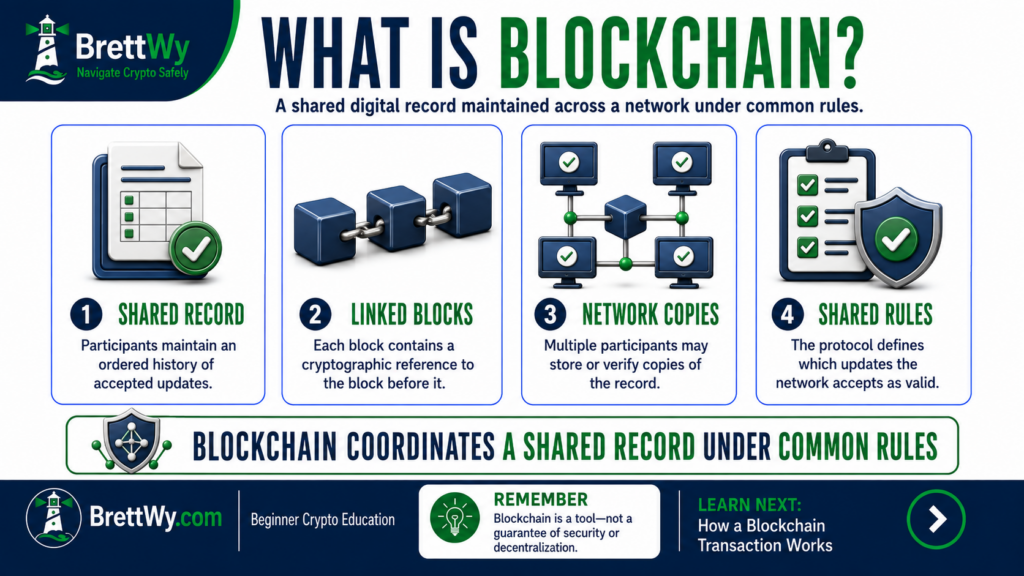
What Is Blockchain?
In practice, it records transactions and other data in groups called blocks. Then, each new block connects to the blocks before it, creating a continuous chain of records.
As a result, that linked structure explains the name.
A Simple Beginner Definition
For example, think of a community scoreboard in a town square.
In addition, in this analogy, everyone can see the scoreboard. When the score changes, many people update their copies at the same time.
As a result, one person cannot easily change the score in secret.
In other words, a distributed ledger works in a similar way.
Instead of one company controlling the records, many computers maintain matching copies.
Why Blockchain Matters
By comparison, traditional digital systems usually place control in the hands of one organization, such as:
- A bank
- A government agency
- A social media company
- A payment processor
By contrast, a shared ledger allows many participants to maintain records together.
Because of that structure, the system can create:
- More transparent records
- Reduced reliance on intermediaries
- Improved resilience
- New ways to transfer value online
Why Is It Called a Blockchain?
First, the system groups information into containers called blocks.
Then, each block includes a reference to the one before it.
Over time, these connected blocks form a chain.
Block + Chain = Blockchain
Why Was Blockchain Created?
Historically, digital payments usually needed trusted intermediaries before Bitcoin.
For example, common intermediaries include:
- Banks
- Credit card companies
- Payment processors
In turn, these organizations maintain records and verify transactions.
The Trust Problem
For example, imagine a school where students track points during the year.
If only one teacher keeps the scorebook, everyone must trust that teacher’s records.
However, if hundreds of students each maintain the same copy, everyone can verify the score independently.
That is the basic trust idea behind a distributed ledger.
The Double-Spending Problem
Normally, digital files can be copied.
Therefore, if digital money could be copied like a photo, people could spend the same money repeatedly.
In other words, this challenge is called the double-spending problem.
A shared transaction history helps solve this issue because everyone can verify whether money has already moved.
The Bitcoin Connection
Historically, this technology first gained widespread attention through Bitcoin.
Specifically, Satoshi Nakamoto published a paper describing a decentralized digital money system in 2008.
Then, Bitcoin became the first successful major use of blockchain technology.
Readers interested in the original vision behind Bitcoin can review Satoshi Nakamoto’s Bitcoin white paper.
How Does Blockchain Work?
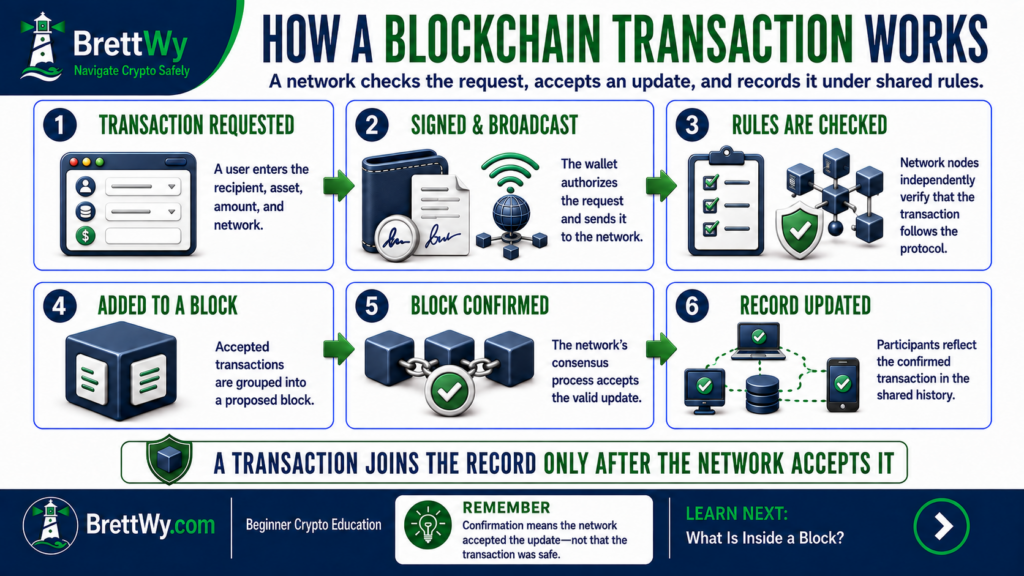
For example, follow a simple transaction from start to finish.
In this example, Sarah wants to send 1 Bitcoin to Alex.
Step 1: A Transaction Is Requested
First, Sarah starts a transaction.
Specifically, the request includes:
- Sender information
- Recipient information
- Amount being transferred
Next, the transaction enters the network.
Step 2: The Transaction Is Broadcast
Next, the network shares the transaction with participating computers.
These computers are called nodes.
What Are Nodes?
In simple terms, a node is a computer that participates in a blockchain network.
Specifically, nodes help:
- Store network data
- Validate transaction requests
- Maintain system integrity
Thousands of nodes may participate in a public network at the same time.
Step 3: The Network Validates the Transaction
Then, nodes check that:
- Sarah owns the Bitcoin
- The Bitcoin has not already moved elsewhere
- The transaction follows the rules
To do this, the system uses cryptography and consensus mechanisms.
What Is Cryptography?
For example, in this context, cryptography uses mathematics to secure information.
For example, it helps ensure:
- Transactions are authentic
- People cannot easily alter records
- The network can verify ownership
Because of this, cryptography forms one of the foundations of secure digital asset networks.
Step 4: The Transaction Enters a Block
In addition, after validation, the network groups transactions together.
In general, this collection forms a block.
Depending on the network, one block may contain hundreds or thousands of transactions.
Step 5: The Block Is Connected to Previous Blocks
Specifically, the new block receives a reference to the block before it.
As a result, the network creates a continuous historical record.
For example, to change one block, someone would also need to change every connected block after it.
That is one reason historical records are difficult to alter.
Step 6: The Transaction Is Confirmed and Recorded
Finally, the network accepts the block and adds it to the chain.
The transaction now appears in the shared record.
In addition, Alex receives the Bitcoin.
Then, the shared ledger updates across participating nodes.
Now that you understand the basic process, the next step is learning how cryptocurrencies use these networks. Our guide on How Cryptocurrency Works walks through the entire process in beginner-friendly language.
What Is a Block?
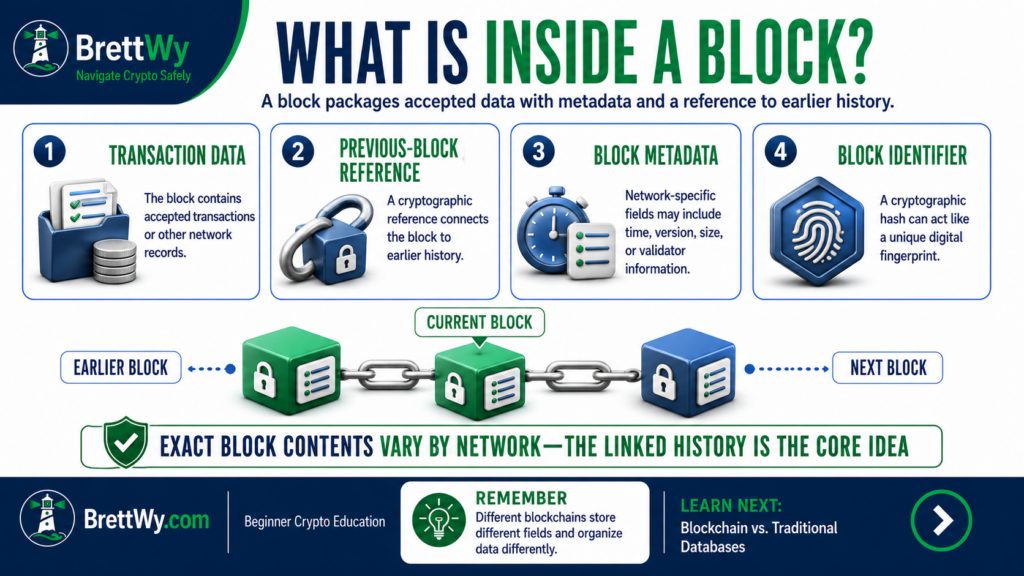
In simple terms, blocks are the building units of the chain.
What Information Does a Block Contain?
In general, most blocks contain:
- Transaction data
- A timestamp
- A reference to the previous block
Transaction Data
For example, this records activity occurring on the network.
For example, it may include:
- Cryptocurrency transfers
- Smart contract activity
- Asset ownership changes
Timestamp
In addition, the timestamp shows when the network created the block.
Therefore, it helps establish the order of events.
Previous Block Reference
Specifically, each block references the block before it.
Because of this reference, the system forms a chain structure.
What Is a Blockchain Network?
No single computer controls the entire system.
Instead, many participants share responsibility.
Distributed Ledger Explained
In general, a distributed ledger is a shared database stored across many computers.
Specifically, each participant maintains a copy.
When updates happen, the network synchronizes those changes across participants.
As a result, this design can provide more resilience than a single-server system.
Why Distributed Systems Matter
For example, if one computer fails:
- The network continues operating
- Records remain available
- The system does not lose the data
Therefore, distributed systems reduce single points of failure.
What Are Consensus Mechanisms?
Without consensus, participants might disagree about transaction history.
Therefore, consensus keeps everyone synchronized.
Proof of Work
In addition, proof of Work is the mechanism Bitcoin uses.
In this system, participants called miners compete to solve mathematical problems.
The winner earns the right to add a new block.
Who Are Miners?
Specifically, miners use computing power to validate transactions and secure certain networks.
In other words, they help maintain system integrity.
Proof of Stake
In general, proof of Stake selects participants based on cryptocurrency holdings committed to network security.
These participants are called validators.
Who Are Validators?
For example, validators help verify transactions and maintain security in Proof of Stake systems.
Many newer networks use this approach because it requires less energy than Proof of Work.
Why Consensus Matters
In addition, consensus mechanisms help ensure:
- Accurate records
- Network security
- Agreement among participants
- Resistance to fraud
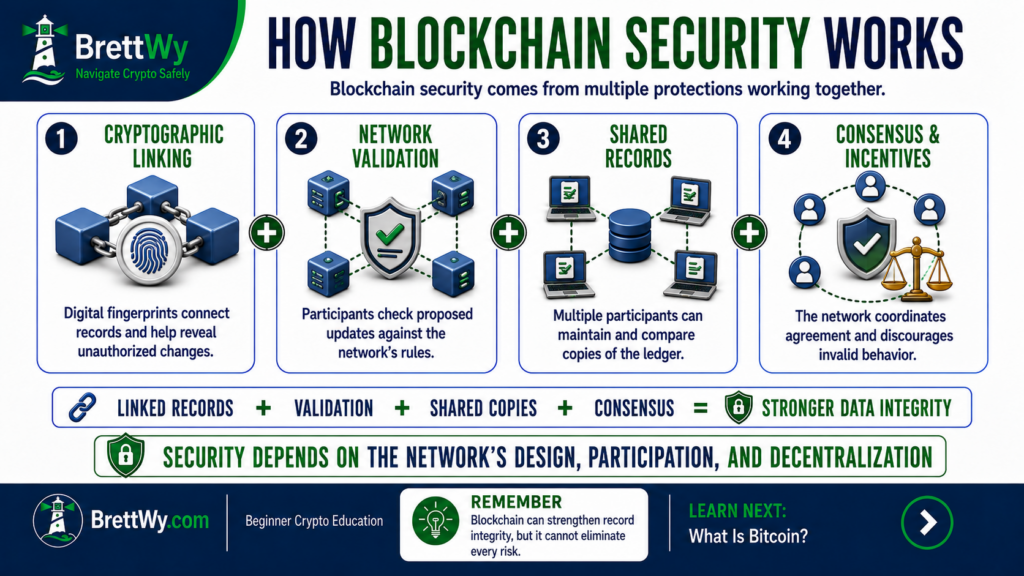
Why Is Blockchain Considered Secure?
No system is perfectly secure. However, this design introduces several protective layers.
For a deeper technical overview of blockchain security concepts, review the NIST Blockchain Technology Overview.
Decentralization
Specifically, decentralization distributes control across many participants instead of concentrating it in one organization.
As a result, the system depends less on a central authority.
If one participant fails, the network can continue functioning.
Cryptography
In general, cryptography helps secure transactions and verify ownership.
For example, only authorized users can initiate transfers from their wallets.
Transparency
For example, many public networks allow anyone to inspect transaction records.
Because of that visibility, participants can verify activity independently.
Immutability
In addition, immutability means records become extremely difficult to alter after confirmation.
To change historical records, an attacker would need to overcome major technical and economic barriers.
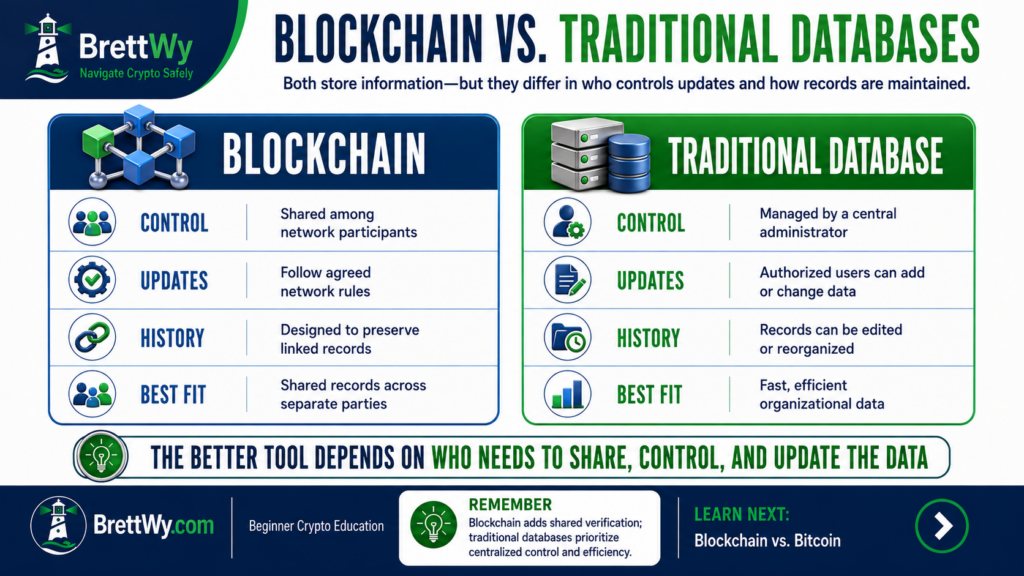
Blockchain vs Traditional Databases
| Feature | Shared Ledger | Traditional Database |
|---|---|---|
| Ownership | Distributed | Usually centralized |
| Control | Shared | One organization controls it |
| Transparency | Often public | Usually private |
| Security Model | Uses consensus | Uses access controls |
| Data Changes | Makes historical changes difficult | Allows easier edits |
| Trust Requirement | Reduces reliance on a central authority | Requires trust in the operator |
Advantages of Traditional Databases
Specifically, traditional databases are often:
- Faster
- Cheaper
- Easier to manage
Therefore, they still work better for many everyday business systems.
Advantages of Shared Ledger Systems
In general, shared ledger systems can offer:
- Independent verification
- Greater transparency
- Reduced single points of failure
- Tamper-resistant records
In other words, each approach serves different purposes.
What Are the Different Types of Blockchain?
Public Blockchains
For example, public networks are open to anyone.
For example, major public networks include:
- Bitcoin
- Ethereum
In general, anyone can:
- View records
- Participate
- Verify transactions
Private Blockchains
In addition, a specific organization controls a private network.
Therefore, access is restricted.
Companies often use these systems in enterprise environments.
Consortium Blockchains
Specifically, multiple organizations manage consortium networks together.
Because of that structure, approved participants share control.
For example, these systems are common in industry collaborations.
What Are Smart Contracts?
They automatically perform actions when predefined conditions are met.
For more detail, readers can explore Ethereum’s official documentation.
Simple Example
In general, imagine a digital ticket.
In addition, once payment is received:
- Ticket ownership transfers automatically
- No manual approval is required
As a result, the program can complete the action without a middleman.
Why They Matter
For example, smart contracts reduce manual processes and enable decentralized applications.
They became especially popular on Ethereum’s programmable blockchain.
The official Ethereum smart contracts guide provides beginner-friendly explanations of smart contracts and decentralized applications.
For a fuller explanation, read our beginner’s guide to smart contracts, including how they work and their limitations.
What Are Real-World Uses of Blockchain?
Because it can create shared, verifiable records, many industries explore practical uses for it.
Cryptocurrency
In addition, the most widely known use case is digital money.
For example, common crypto networks include:
- Bitcoin
- Ethereum
- Stablecoins
Supply Chain Tracking
Specifically, companies can track products as they move through production and delivery.
As a result, supply chains can become easier to audit.
Identity Verification
In general, shared record systems may help people prove identity while reducing fraud risks.
However, these systems still need strong privacy protections.
Voting Systems
For example, some researchers explore distributed ledgers for voting systems to improve auditability.
Even so, voting requires strict security, privacy, and legal safeguards.
Healthcare Records
In addition, the technology could help coordinate medical record sharing while maintaining data integrity.
However, healthcare systems must also protect sensitive personal information.
Business Applications
Specifically, businesses use distributed record systems for:
- Asset tracking
- Auditing
- Compliance
- Cross-border settlements
What Are the Advantages of Blockchain?
Transparency
In general, participants can independently verify information.
Therefore, the system can reduce confusion about shared records.
Security
For example, cryptography and consensus mechanisms help protect records.
In addition, decentralization reduces dependence on one central system.
Reduced Intermediaries
In addition, certain processes can operate with fewer middlemen.
However, that does not mean every middleman disappears.
Global Accessibility
Specifically, many networks operate globally and remain available around the clock.
Because of that, users in different countries can access the same network.
What Are the Limitations of Blockchain?
Scalability
In general, some networks process transactions more slowly than centralized systems.
As a result, fees and delays can increase during busy periods.
Energy Consumption
For example, certain Proof of Work systems consume significant energy.
However, Proof of Stake networks use a different design that can require much less energy.
User Responsibility
In addition, users must protect passwords, recovery phrases, and wallet credentials.
Specifically, in crypto, mistakes can be difficult to reverse.
For more beginner-focused safety guidance, read our Cryptocurrency Security guide.
Regulation
Specifically, legal frameworks continue evolving around digital assets and distributed ledgers.
Therefore, rules can vary depending on the country, platform, and use case.
Adoption Challenges
In general, many applications still face usability and integration hurdles.
For beginners, this can make the technology feel harder than it needs to be.
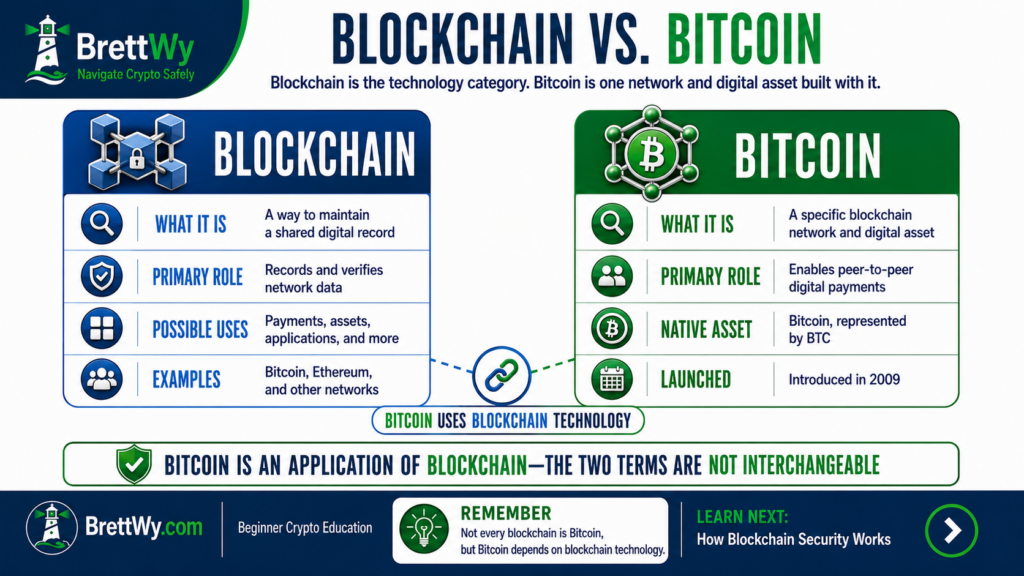
Blockchain vs Bitcoin
In general, a simple analogy:
Imagine a public road system.
For example, the roads are the underlying technology.
The cars traveling on those roads are Bitcoin transactions.
In addition, without roads, the cars cannot travel.
Likewise, without the ledger system, Bitcoin could not operate.
Specifically, many beginners mistakenly use the terms interchangeably.
However, Bitcoin uses blockchain technology, while the same concept has many uses beyond Bitcoin.
To continue learning, read our beginner guide to What Is Bitcoin?.
Where Beginners Get Confused About Blockchain
“Blockchain and Bitcoin Are the Same Thing”
For example, they are related, but they are different.
In general, Bitcoin is a cryptocurrency.
The underlying ledger is the technology that enables Bitcoin to function.
“Blockchain Is Completely Anonymous”
In addition, most public networks are better described as pseudonymous.
In other words, transaction histories may be public even when real names do not appear directly.
“Blockchain Cannot Be Hacked”
Specifically, individual networks may use strong security, but surrounding systems can still have weaknesses. Our safety guide explains crypto security risks beyond the blockchain.
For example, risks can appear in:
- Exchanges
- Wallets
- Applications
- User mistakes
If you plan to use cryptocurrency, our guide to Crypto Wallets Explained is a helpful next step.
“Blockchain Solves Every Problem”
In general, not every database needs a distributed ledger.
For example, sometimes traditional systems are faster and more practical.
“Blockchain Eliminates All Trust”
For example, this technology reduces certain trust requirements.
However, users still trust:
- Software developers
- Infrastructure providers
- Security practices
- Network rules
Key Takeaways
- Blockchain is a shared digital record-keeping system.
- Information is stored in linked blocks.
- The technology was created to help solve trust and double-spending challenges.
- Nodes maintain copies of the shared record.
- Consensus mechanisms help networks agree on valid transactions.
- Bitcoin was the first major application.
- Ethereum expanded the concept through smart contracts.
- Distributed ledgers can offer transparency and security benefits.
- However, they also have limitations and trade-offs.
- Bitcoin and the technology behind it are not the same thing.
Frequently Asked Questions About Blockchain
What is blockchain in simple terms?
In simple terms, blockchain is a shared digital record system that stores information across many computers instead of one central location.
What is a block in blockchain?
In general, a block is a collection of verified data that gets added to the chain.
Why is blockchain important?
As a result, it enables shared record keeping without requiring a single central authority.
Who invented blockchain?
In addition, Satoshi Nakamoto introduced Bitcoin’s blockchain design in 2008, building on earlier work in cryptography and digital timestamping.
Is blockchain the same as Bitcoin?
Specifically, no. Instead, blockchain is the technology, while Bitcoin is a cryptocurrency that uses it.
Can blockchain be hacked?
In general, established blockchain networks use multiple security layers, but no system is risk-free. Attackers may target the network, smart contracts, exchanges, wallets, devices, or individual users.
What are nodes?
In practice, nodes are computers that participate in maintaining and checking shared records.
What is decentralization?
For example, in this context, decentralization means control is distributed among many participants rather than one central organization.
What is Proof of Work?
In addition, proof of Work is the consensus mechanism Bitcoin uses to order transactions and secure its blockchain. Miners compete to propose blocks, while network nodes independently check that those blocks follow the rules.
What is Proof of Stake?
Specifically, proof of Stake is a family of consensus mechanisms in which validators commit assets under network rules instead of competing through Bitcoin-style mining.
What are smart contracts?
In general, smart contracts are self-executing programs stored on a distributed ledger. They automatically perform actions when conditions are met.
Is blockchain only used for cryptocurrency?
For example, no. Organizations have explored blockchain for supply chains, identity systems, record verification, and other uses. However, a traditional database may still be the better choice when shared control is unnecessary.
Test Your Knowledge
- What is the best beginner definition of blockchain?
- What connects one block to the block before it?
- What role does consensus play?
- Is blockchain automatically better than a traditional database?
- Does a secure blockchain make every wallet and application secure?
Check your answers
- A shared digital record maintained under network rules. Bitcoin is one application of blockchain technology.
- A cryptographic reference connects each block to the previous block.
- Consensus helps the network agree on valid updates and an accepted history.
- No. A traditional database may be faster, simpler, or more appropriate when one trusted organization should control the record.
- No. Applications, smart contracts, exchanges, devices, and users create separate security risks.
Official and Educational Resources
- Bitcoin: A Peer-to-Peer Electronic Cash System — the original Bitcoin whitepaper
- NISTIR 8202: Blockchain Technology Overview — a technical overview from the U.S. National Institute of Standards and Technology
- Introduction to Ethereum — official documentation for a programmable blockchain network
- Cryptocurrency Security — the BrettWy beginner safety guide for wallets, transactions, scams, and account protection
Final Thoughts
Blockchain networks combine shared records, cryptographic references, validation rules, and consensus mechanisms so multiple participants can maintain an accepted history. Different networks make different choices about who may participate, how updates are approved, and which trade-offs remain.
The most useful evaluation therefore asks what the system records, who can update it, how participants reach agreement, who controls access, and what can still fail. That mental model prepares you to understand Bitcoin and other blockchain applications more accurately.
You’ve Completed the Blockchain Foundation
At this point, you understand how a blockchain organizes records, how network participants evaluate updates, and why cryptography and consensus matter. You also know that blockchain does not automatically make every project decentralized, private, efficient, or secure.
Next, apply this foundation to Bitcoin—the first major blockchain-based monetary network.
Crypto Fundamentals Path Progress: You have completed the shared-record foundation. Next, learn how Bitcoin combines a blockchain, proof of work, and a fixed issuance policy.
LEARN NEXT
A beginner’s guide to how Bitcoin works, what gives it value, and which risks matter.
Final BrettWy Lesson: A blockchain is only one layer of a system. Always evaluate the asset, network rules, access method, intended action, and remaining risk before relying on it.
About This Content
BrettWy creates beginner-friendly cryptocurrency education with a focus on clear explanations, practical security, and understanding risk. Content is developed with AI assistance, and relevant sources are linked so readers can explore the underlying information.
Crypto products, services, and technical guidance can change. Check current information with the original source before taking action.
Found an error or outdated information? Email info@brettwy.com with the article URL and the detail you believe needs attention. Never include passwords, private keys, or recovery phrases.
Educational and Risk Disclaimer
This article is provided for general educational and informational purposes only. Therefore, it does not constitute financial, investment, legal, tax, accounting, cybersecurity, or other professional advice.
In addition, blockchain networks, digital assets, exchanges, wallets, smart contracts, and decentralized applications involve significant risks. These risks can include software vulnerabilities, fraud, governance failures, regulatory changes, irreversible transactions, loss of access, and permanent financial loss.
Finally, no network architecture or security method can eliminate every risk. Verify information through current official sources and consult qualified professionals when appropriate.