
What Is Bitcoin? A Beginner’s Guide to How Bitcoin Works
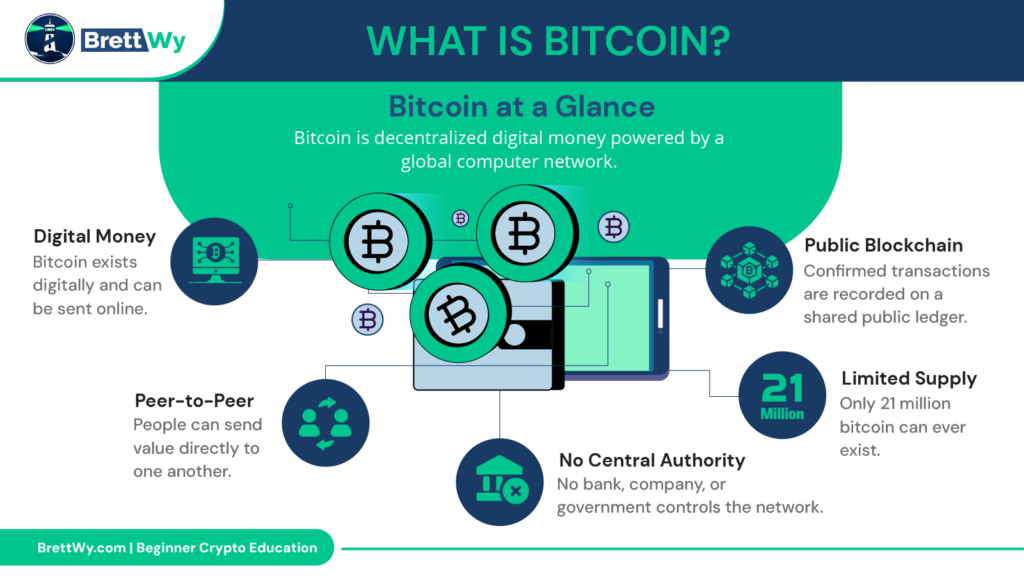
Bitcoin is a decentralized digital currency that lets people send and receive money over the internet without relying on a bank, payment processor, or other central authority. Every transaction is recorded on a public ledger called the blockchain, which a global network of computers maintains instead of a single organization.
If you’ve heard people talking about Bitcoin but aren’t quite sure what it actually is, you’re not alone.
At first, Bitcoin can seem confusing because it introduces unfamiliar ideas, new terminology, and a different way of thinking about money. As a result, many explanations dive straight into technical details, leaving beginners feeling overwhelmed.
This guide takes a different approach.
Instead of assuming you already understand cryptocurrency, we’ll start with the fundamentals and build your knowledge one concept at a time. By the end of this guide, you’ll understand what Bitcoin is, why it was created, how it works, and why it has become one of the most discussed financial technologies in the world.
Whether you simply want to understand the headlines, are curious about cryptocurrency, or are considering purchasing bitcoin in the future, this guide will give you a solid foundation—without requiring any previous experience.
What Exactly Is Bitcoin?
The simplest way to think about Bitcoin is as digital money built specifically for the internet.
Traditional money usually depends on trusted institutions, such as banks, to keep records of ownership, process payments, and prevent fraud.
Bitcoin, however, solves those same problems in a very different way.
Rather than relying on one company or government to maintain a central database, it uses a worldwide network of independent computers that work together to verify transactions and maintain a shared record of ownership.
This shared record is called the blockchain.
Because thousands of computers each maintain a copy of the blockchain, no single organization controls it. Instead, every participant follows the same rules, allowing the network to operate without a central authority.
That decentralized design is one of Bitcoin’s defining characteristics.
A Beginner-Friendly Analogy
Imagine your local library creates a community notebook to track ownership of a limited-edition collection of trading cards.
Instead of locking that notebook behind the librarian’s desk, every branch receives an identical copy.
Whenever someone trades a card, each library receives the update. Before recording the trade, the librarians compare their records to confirm the transaction is valid. Once they reach agreement, every library updates its notebook.
Now imagine this same process happening automatically across thousands of libraries around the world.
That’s similar to how Bitcoin operates.
- The trading cards represent bitcoin.
- The notebook represents the blockchain.
- The librarians represent the computers on the Bitcoin network that verify transactions and keep everyone’s records synchronized.
Although the technology behind Bitcoin is far more sophisticated than this example, the underlying concept remains the same: thousands of independent participants maintain one shared record instead of trusting a single recordkeeper.
Why Was Bitcoin Created?
Bitcoin wasn’t created simply to make digital payments faster.
Instead, it was designed to solve a much deeper problem.
Before Bitcoin existed, sending digital money without a trusted intermediary was extremely difficult. Banks and payment companies acted as central recordkeepers by tracking account balances, approving transactions, and preventing people from spending the same money twice.
That approach works well in many situations, but it also requires trust.
Users must trust that records remain accurate, payments are processed fairly, and the institution stays available whenever they need access to their money.
Bitcoin introduced a different model.
Rather than placing trust in one organization, it distributes trust across a global network of participants who follow transparent rules and open-source software.
As a result, people can transfer value directly to one another through a peer-to-peer network while reducing their dependence on traditional financial intermediaries.
Why Bitcoin Matters
Bitcoin matters because it introduced an entirely new way to think about money.
For the first time, people could transfer digital value directly across the internet without requiring a bank to authorize every payment or maintain the official record of ownership.
Whether it ultimately becomes a widely used payment system, a long-term store of value, or simply a groundbreaking technological innovation, its influence extends well beyond cryptocurrency.
For example, Bitcoin introduced concepts such as decentralized digital ownership, programmable money, and publicly verifiable financial records. Those ideas have since inspired thousands of blockchain projects and continue shaping the future of digital finance.
For beginners, understanding Bitcoin provides the foundation for learning almost every other cryptocurrency concept.
As you continue through this guide, you’ll see how topics such as blockchain, wallets, mining, and cryptography all connect back to Bitcoin’s original design.
Understanding the Problem Bitcoin Solved
Bitcoin was created to solve a long-standing challenge: How can people send digital money directly to one another without relying on a trusted middleman like a bank or payment company?
Its solution allows strangers anywhere in the world to agree on who owns what without giving a single organization control over the records.
To understand why this matters, it’s helpful to set cryptocurrency aside for a moment and consider a much simpler question:
Why do we trust money in the first place?
Whenever you use a debit card, send money through a banking app, or pay with a credit card, someone keeps track of every transaction.
Usually, that responsibility belongs to your bank.
The bank records your balance, verifies that you have enough funds, updates your account, and prevents you from spending the same money twice.
That system works because everyone trusts the bank’s records.
But what if you wanted to send money directly to another person over the internet without asking a bank for permission?
For decades, that question represented one of computer science’s biggest unsolved problems.
The Trust Problem
Digital files are incredibly easy to copy.
You can duplicate a photo, a document, or an email almost instantly.
Money, however, can’t work that way.
Imagine receiving a $20 gift card and emailing identical copies of it to ten different friends.
If every copy worked, the gift card would immediately lose its value because nobody could determine which version was legitimate.
Digital money faces the same challenge.
Any reliable system must prove ownership while also ensuring that the same funds cannot be spent more than once.
Before Bitcoin, solving that problem required a trusted organization to maintain the official record.
Instead, Bitcoin introduced a completely different approach.
Rather than asking people to trust one institution, it allowed everyone to trust the same transparent rules.
Understanding Double Spending
The technical name for this challenge is double spending.
Double spending occurs when someone attempts to spend the same digital money more than once.
Physical cash prevents this naturally.
If you hand a friend a $20 bill, you no longer possess it.
Digital information behaves differently because it can be copied almost effortlessly.
Bitcoin solves this problem by maintaining one shared transaction history that thousands of independent computers verify together.
Once the network confirms that a particular amount of bitcoin has been spent, every participant updates their records to reflect the new owner.
Because everyone agrees on the same history, the same bitcoin cannot be spent twice.
The 2008 Financial Crisis
Bitcoin did not emerge in isolation.
Instead, it appeared shortly after the global financial crisis of 2008, when confidence in many large financial institutions had fallen dramatically.
Banks failed.
Governments introduced emergency rescue programs.
Meanwhile, millions of people began questioning whether the financial system depended too heavily on centralized institutions.
Only a few months later, an anonymous developer published a paper describing a completely different approach to digital money.
Although decades of earlier cryptography research influenced its design, Bitcoin arrived at a moment when many people were actively searching for alternatives to traditional financial systems.
Understanding this historical context helps explain why it attracted so much attention so quickly.
Who Created Bitcoin?
Bitcoin was created by an individual—or possibly a group—using the name Satoshi Nakamoto. Although Satoshi introduced the idea in 2008 and launched the network in 2009, their true identity has never been confirmed.
That mystery remains one of the most fascinating stories in modern technology.
Over the years, researchers, journalists, and enthusiasts have proposed countless theories.
Some believe Satoshi was one person.
Others think the name represented a small team working together.
Despite years of investigation, however, no one has been able to prove who Satoshi Nakamoto really is.
In many ways, that uncertainty no longer matters.
Unlike many technologies, Bitcoin was designed so the network could continue operating even if its creator disappeared.
That’s exactly what happened.
After helping launch the project, Satoshi gradually withdrew from public involvement and eventually stopped communicating altogether.
Even so, the network continued operating because thousands of independent participants around the world kept maintaining it.
Today, Bitcoin belongs to no company, government, or individual.
Instead, it belongs to the network itself.
The Bitcoin Whitepaper
Before launching the network, Satoshi Nakamoto published a short research paper titled Bitcoin: A Peer-to-Peer Electronic Cash System.
Although the document is only nine pages long, it introduced one of the most influential ideas in modern computer science.
Instead of relying on a trusted financial institution to verify every payment, the paper explained how a decentralized network could reach agreement by combining cryptography, mathematics, and shared rules.
Many of the concepts you’ve encountered throughout this guide—including the blockchain, mining, Proof of Work, and network consensus—were brought together in that paper for the first time.
Today, the Bitcoin whitepaper remains one of the foundational documents of the cryptocurrency industry and is freely available for anyone to read.
How Does Bitcoin Work?
Bitcoin works by recording every confirmed transaction on a shared public ledger called the blockchain. Whenever someone sends bitcoin, thousands of independent computers verify the transaction before it becomes a permanent part of the network’s history.
At first, this process can sound intimidating.
Fortunately, the underlying idea is much simpler than many beginners expect. Let’s follow a transaction from beginning to end to see how the system works.
Imagine you want to send bitcoin to your friend, Jordan.
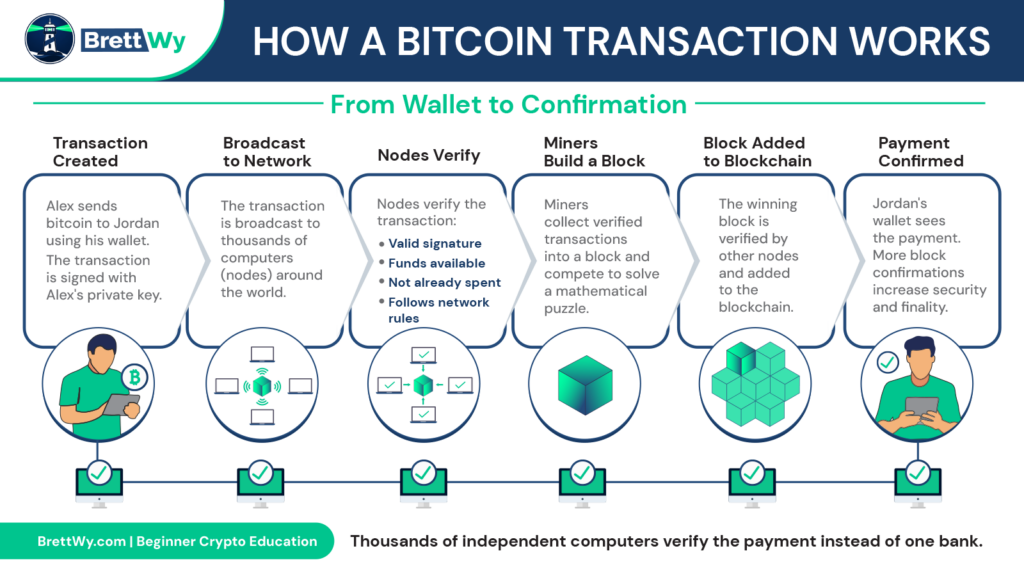
Step 1: Creating the Transaction
Alex opens a Bitcoin wallet and chooses to send bitcoin to Jordan.
The wallet creates a digital transaction containing:
- The amount being sent
- Jordan’s Bitcoin address
- A digital signature proving Alex has permission to spend those bitcoin
That digital signature is created using Alex’s private key.
Think of a private key as the secret key to a highly secure lock.
It proves ownership without revealing the key itself.
Because only Alex controls that private key, only Alex can authorize spending those funds.
Step 2: Broadcasting the Transaction
After Alex signs the transaction, the wallet shares it with the network.
This process is called broadcasting.
Within seconds, computers around the world receive a copy.
These computers are known as nodes.
Rather than trusting the transaction automatically, each node independently verifies that it follows the network’s rules.
Step 3: Nodes Verify the Transaction
Before accepting the transaction, every node performs a series of checks.
For example, each one asks questions like:
- Does Alex actually own these bitcoin?
- Has this bitcoin already been spent?
- Is the digital signature valid?
- Does the transaction follow the network’s rules?
Only transactions that pass every verification continue through the system.
A helpful analogy is airport security.
Every passenger goes through the same screening process before boarding an airplane.
The goal isn’t to slow people down.
Instead, the screening protects everyone using the system.
Bitcoin nodes perform a very similar function by verifying every transaction before allowing it to move forward.
Step 4: Miners Build the Next Block
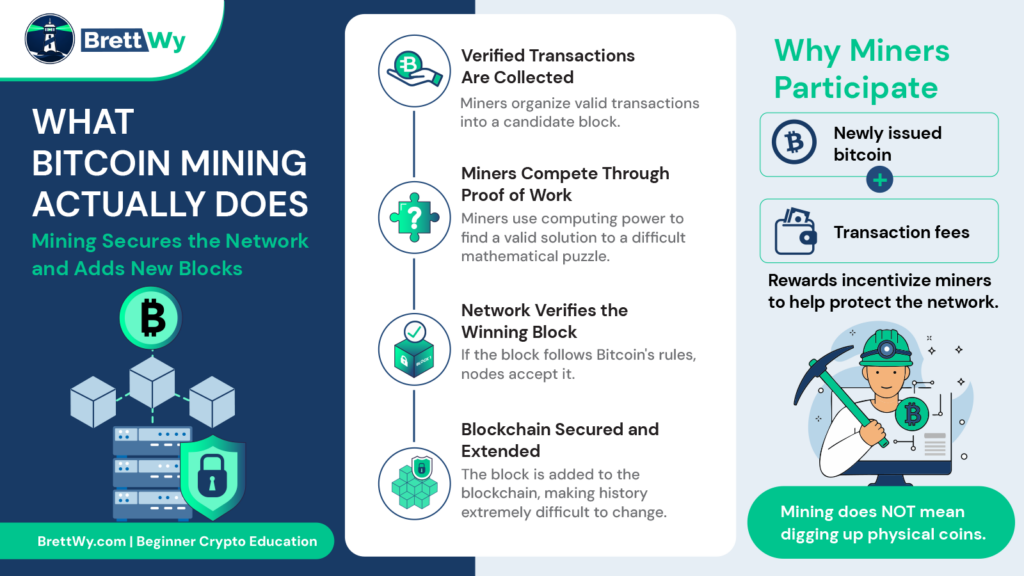
Once nodes verify a transaction, miners collect it with many others into a group called a block.
Next, miners compete for the opportunity to add that block to the blockchain through a process known as Proof of Work.
To do that, they perform enormous amounts of computation while searching for the solution to a mathematical puzzle.
Finding the solution is intentionally difficult.
Verifying the solution, however, takes only moments.
That balance helps keep the network honest because attacks become extremely expensive while legitimate participants can quickly verify the results.
Step 5: The Blockchain Grows
After a miner discovers a valid solution, the proposed block is shared with the rest of the network.
Then, other nodes independently verify it.
If everything follows the protocol’s rules, each node adds the new block to its own copy of the blockchain.
Every confirmed block permanently extends the network’s shared transaction history.
Because thousands of computers maintain matching copies, changing that history later becomes extraordinarily difficult.
Step 6: The Transaction Is Confirmed
Once Alex’s transaction appears in a confirmed block, Jordan’s wallet recognizes that the payment has been received.
As additional blocks are added afterward, confidence continues to increase that the transaction is permanent.
That’s why people often refer to confirmations when discussing Bitcoin payments.
Each additional confirmation makes reversing that transaction increasingly impractical.
Putting It All Together
When many beginners first hear about Bitcoin, they picture one giant computer processing every payment.
In reality, that’s not how the system works.
Instead, thousands of independent computers cooperate.
Some verify transactions.
Others mine new blocks.
Many store complete copies of the blockchain.
Together, they create a payment network that operates without relying on a central organization.
That cooperation between independent participants is what makes Bitcoin unique.
Once you stop thinking of Bitcoin as a company and start thinking of it as a global network that follows one shared set of rules, the entire system becomes much easier to understand.
What Is Bitcoin Mining?
Bitcoin mining is the process that helps verify transactions, secure the network, and add new blocks to the blockchain. Miners compete to solve complex mathematical puzzles, and the first miner to find a valid solution earns the right to add the next block while receiving newly created bitcoin and transaction fees as a reward.
When people hear the word mining, they often picture someone digging precious metals out of the ground.
Bitcoin mining works very differently.
Nothing is physically being dug up.
Instead, specialized computers perform enormous numbers of calculations every second.
Those calculations help the network agree on which transactions are valid and in what order they should become part of the blockchain.
In other words, mining is less about “creating bitcoin” and more about protecting the integrity of the network’s transaction history.
Why Does the Network Need Mining?
Imagine your community keeps a public notebook that records every trade involving limited-edition collectible cards.
Every few minutes, dozens of new trades take place.
Before anyone writes those trades into the notebook, someone needs to verify that:
- Each seller actually owns the card.
- The same card isn’t being sold twice.
- Every trade follows the agreed-upon rules.
The Bitcoin network faces the same challenge.
Every day, thousands of new transactions are broadcast across the network.
Mining organizes those transactions into blocks while preventing anyone from rewriting or manipulating the shared record.
Without mining, participants would have no reliable way to agree on one official version of history.
What Is Proof of Work?
Proof of Work is the system the network uses to determine who earns the right to add the next block.
Imagine a worldwide puzzle competition.
Thousands of participants receive exactly the same puzzle.
Everyone begins solving it at the same time.
The first person to discover the correct answer earns the right to write the next page in the official record book.
Everyone else quickly checks that answer before accepting it.
Mining follows a similar process.
Finding the solution requires substantial computing power.
Verifying the solution takes only moments.
That difference is intentional because it makes cheating extraordinarily expensive while allowing honest participants to confirm results quickly.
What Are Block Rewards?
Mining requires significant investments in specialized hardware and electricity.
To encourage participants to secure the network, successful miners receive rewards.
Each block reward contains:
- Newly created bitcoin
- Transaction fees paid by users whose transactions appear in that block
These rewards serve two important purposes.
First, they introduce new bitcoin into circulation according to a predictable schedule.
Second, they provide miners with an economic incentive to continue protecting the network.
Unlike traditional currencies, whose supply may change through central bank policy, Bitcoin follows a monetary schedule that anyone can inspect.
What Is a Bitcoin Halving?
Approximately every four years, the amount of newly created bitcoin awarded to miners is reduced by half.
This event is called a Bitcoin halving.
Its purpose is straightforward.
Each halving gradually slows the rate at which new bitcoin enters circulation.
Eventually, the network will stop creating new bitcoin altogether.
At that point, miners are expected to rely primarily on transaction fees as compensation.
This predictable issuance schedule is one reason many people consider Bitcoin’s monetary policy unique.
What Is the Bitcoin Network?
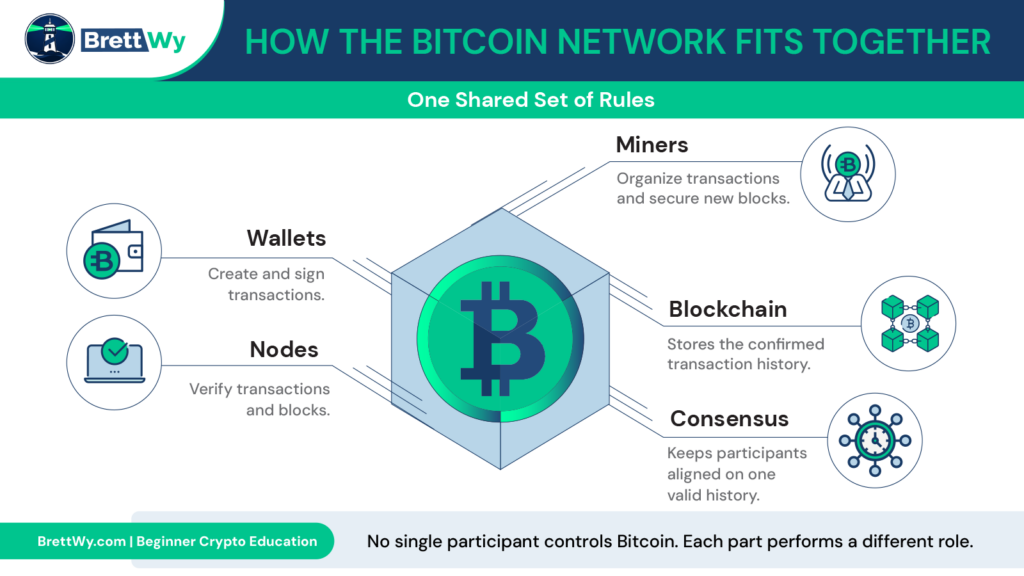
The Bitcoin network is a global collection of independent computers that work together to verify transactions, enforce the protocol’s rules, and maintain identical copies of the blockchain. Instead of depending on a central server, the network operates through cooperation among thousands of participants around the world.
One of the most common misconceptions beginners have is thinking of Bitcoin as a company.
It isn’t.
Instead, it’s much more accurate to think of it as a network.
Just as the internet consists of millions of connected computers, the Bitcoin network consists of thousands of computers that continuously communicate, verify information, and share updates.
Every participant performs a specific role.
Together, those roles create one resilient financial system.
What Are Nodes?
Nodes are computers that run Bitcoin software and independently verify transactions and newly proposed blocks.
Think of each node as an independent fact-checker.
Whenever a new transaction appears, every node asks the same questions:
- Does this transaction follow the protocol’s rules?
- Is the digital signature valid?
- Has this bitcoin already been spent?
- Does this block connect correctly to the blockchain?
Rather than trusting what another computer says, every node verifies the information for itself.
That independent verification is one of the network’s greatest strengths.
Because thousands of nodes perform the same checks, the system doesn’t rely on a single source of truth.
What Is a Peer-to-Peer Network?
Bitcoin is called a peer-to-peer network because participants communicate directly with one another instead of routing every transaction through a central organization.
Imagine calling a friend directly rather than asking a switchboard operator to connect every conversation.
The network works in much the same way.
Information spreads from one computer to another until participants across the world receive and verify it.
Because there is no central server coordinating every interaction, the network remains far more resilient than systems that depend on a single organization.
What Does Decentralization Mean?
Decentralization means no single person, company, or government controls the network.
That doesn’t mean there are no rules.
Instead, every participant follows the same publicly available rules rather than taking instructions from a central authority.
Imagine a neighborhood community garden.
Every volunteer follows the same planting schedule and maintenance guidelines.
No single gardener owns the project, yet the garden continues to thrive because everyone cooperates under the same rulebook.
The Bitcoin network operates in a similar way.
The software defines the rules.
Participants choose to follow them voluntarily.
What Is Consensus?
Consensus is the process that allows thousands of independent computers to agree on one shared version of transaction history.
Whenever a new block is proposed, each node verifies it independently.
If the block follows the protocol’s rules, the node accepts it.
If it doesn’t, the node rejects it.
Consensus is not a vote.
Instead, it is the result of thousands of computers independently reaching the same conclusion by applying identical rules.
That shared agreement allows the blockchain to remain consistent without requiring a central administrator.
Why Is Bitcoin Considered Secure?
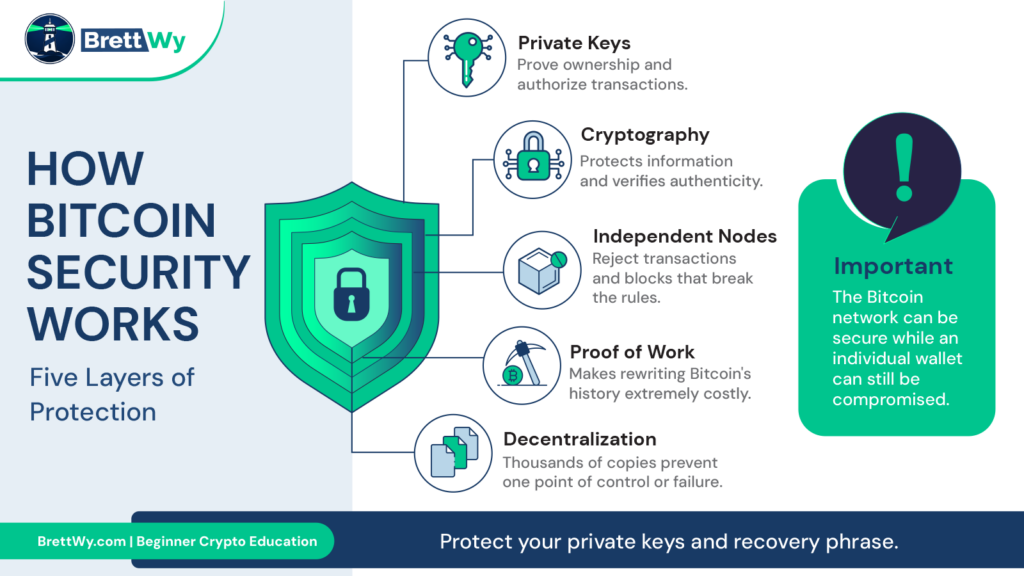
Bitcoin’s security comes from several technologies working together. Cryptography protects ownership, nodes verify transactions, miners secure new blocks, and thousands of independent computers continuously maintain the blockchain. No single component provides security on its own. Instead, the combination of all these layers makes the system remarkably resilient.
When beginners ask whether Bitcoin is secure, they often expect a single explanation.
In reality, security comes from multiple layers working together.
Each layer strengthens the others.
Cryptography
Cryptography uses advanced mathematics to protect information and prove ownership.
Every Bitcoin wallet relies on two important pieces of information:
- A public key
- A private key
Your public key helps generate your Bitcoin address, which you can safely share whenever someone wants to send you bitcoin.
Your private key serves a completely different purpose.
It proves ownership.
Anyone who controls the private key controls the bitcoin associated with it.
Beginner Analogy
Think about your home mailbox.
Anyone can know your mailing address.
Only someone with the mailbox key can open it and remove the mail inside.
Your Bitcoin address works like your mailing address.
Your private key works like the mailbox key.
Keeping that key safe is one of the most important responsibilities every Bitcoin owner has.
Hashing
Hashing is a mathematical process that converts information into a unique digital fingerprint.
Even changing a single letter produces a completely different fingerprint.
The network uses hashing to connect blocks together and support the Proof of Work process.
If someone attempted to secretly change an older transaction, those digital fingerprints would immediately stop matching.
As a result, the network would quickly detect the alteration.
Why Decentralization Improves Security
Traditional databases often rely on one central location to store important information.
If attackers compromise that central database, the entire system may be affected.
Bitcoin uses a very different design.
Thousands of independent computers each maintain their own copy of the blockchain.
Changing one copy accomplishes nothing because every other participant still recognizes the correct version.
That distributed architecture makes large-scale attacks dramatically more difficult.
How Mining Protects the Blockchain
Mining does much more than confirm transactions.
It also protects the blockchain’s history.
Every newly added block builds on the one before it.
To change an older transaction, an attacker would need to rebuild every block that follows while simultaneously producing more computational work than the honest network.
On a network as large as Bitcoin, accomplishing that would require extraordinary computing power, enormous financial resources, and near-perfect coordination.
For that reason, successfully attacking the blockchain becomes increasingly impractical as the network continues to grow.
Putting It All Together
By this point, you’ve learned about wallets, nodes, miners, blocks, cryptography, hashing, consensus, and the blockchain.
At first glance, those topics may seem unrelated.
In reality, they’re all parts of one coordinated system.
Imagine a professional sports league.
Players compete on the field.
Referees enforce the rules.
Scorekeepers record the results.
League officials publish the standings.
Fans watch every game.
Each role is different.
However, every role contributes to one functioning league.
The Bitcoin network operates the same way.
- Wallets allow people to create transactions.
- Nodes verify those transactions.
- Miners organize them into new blocks.
- The blockchain permanently records them.
- Consensus keeps everyone synchronized around one shared history.
No single participant controls the system.
Instead, thousands of independent participants cooperate to maintain a secure, decentralized financial network.
For many beginners, this is the point where everything finally clicks.
Rather than seeing isolated technologies, they begin to recognize how every component supports the others to create one unified system.
Bitcoin vs. Traditional Money
Bitcoin and traditional money both allow people to exchange value, but they operate in fundamentally different ways. Traditional currencies are issued and managed by governments and central banks, whereas Bitcoin runs through software, cryptography, and a decentralized global network.
Understanding these differences doesn’t mean one system is always better than the other.
Instead, each has strengths, trade-offs, and situations where it may be the better choice.
| Feature | Bitcoin | Traditional Money |
|---|---|---|
| Who manages it? | Decentralized network of participants | Governments and central banks |
| Supply | Maximum of 21 million bitcoin | Can expand through monetary policy |
| Availability | Operates 24/7 | Depends on banks and payment providers |
| Transactions | Sent directly across the network | Usually processed through financial institutions |
| Transparency | Public blockchain records | Financial institutions keep records private |
| Security | Protected through cryptography, mining, and decentralization | Protected through banking systems, regulation, and fraud controls |
| International Transfers | Can be sent globally without traditional banking infrastructure | Often require multiple intermediaries and longer settlement times |
The purpose of this comparison isn’t to suggest that one system should completely replace the other.
Rather, it highlights that each follows a different set of rules.
For many people, understanding both systems provides far more value than treating them as direct competitors.
What Gives Bitcoin Value?
Bitcoin has value because people find it useful. That value comes from a combination of scarcity, utility, security, network participation, and the confidence users place in the system.
Many beginners eventually ask:
“If Bitcoin isn’t backed by gold or issued by a government, why does it have value?”
The answer isn’t based on a single characteristic.
Instead, several factors work together.
Scarcity
Only 21 million bitcoin will ever exist.
That limit is written directly into the protocol.
Unlike many traditional currencies, whose supply can change over time, Bitcoin follows a predictable issuance schedule that anyone can verify.
For many supporters, that predictable scarcity is one of the network’s most attractive characteristics.
Utility
A technology becomes valuable when people find it useful.
The network allows users to transfer value directly across the internet without requiring a bank to approve every payment.
For others, its usefulness comes from providing access to a global financial system that operates around the clock.
As more people discover practical uses for the technology, demand may increase.
Network Effects
Many networks become more valuable as participation grows.
The telephone became more useful as more households installed telephones.
Email became more useful as more people created email addresses.
The same principle applies here.
As more individuals, businesses, developers, educators, and financial institutions participate, the overall ecosystem becomes more useful for everyone involved.
Trust Through Transparency
Unlike traditional financial systems, Bitcoin doesn’t require users to trust one company or institution.
Instead, it relies on transparent rules that anyone can inspect.
The software is open source.
Transactions remain publicly verifiable.
Anyone can operate a node and independently verify the blockchain.
For many people, that transparency is an important reason the network has value.
What Can Bitcoin Be Used For?
Bitcoin can be used to transfer money, store value, make international payments, support business transactions, and participate in the broader cryptocurrency ecosystem. Different people use it in different ways depending on their goals and circumstances.
One of the technology’s greatest strengths is its flexibility.
There isn’t one “correct” way to use it.
Sending Payments
Some businesses accept bitcoin as payment for products and services.
Because the network operates globally, users can often transfer value without relying on traditional banking infrastructure.
International Transfers
People can send bitcoin across international borders without requiring multiple financial intermediaries.
Although confirmation times and transaction fees vary, the network provides another option for transferring value globally.
Saving
Some people choose to hold bitcoin for many years rather than spend it immediately.
Others prefer traditional savings accounts or diversified investments.
Neither approach is universally correct.
The most important step is understanding how the technology works before deciding whether it fits your own financial goals.
Store of Value
Some investors believe Bitcoin may serve as a long-term store of value because of its limited supply and predictable issuance schedule.
Others argue that its price volatility still makes it too unpredictable for that role.
Understanding both perspectives gives beginners a more balanced view of the discussion.
Investment
Many people purchase bitcoin as one part of a diversified investment portfolio.
However, its price can fluctuate dramatically over short periods.
Before purchasing any cryptocurrency, take time to understand the technology, the risks involved, and how to protect your assets.
This guide is designed to educate—not provide investment advice.
What Are the Advantages of Bitcoin?
The introduction of Bitcoin changed the way many people think about digital money and decentralized networks.
Some of its most significant advantages include:
- Decentralization — No single organization controls the network.
- Global Accessibility — Anyone with internet access and compatible software can participate.
- Limited Supply — The maximum supply is capped at 21 million bitcoin.
- Transparency — Every confirmed transaction is recorded on the blockchain.
- Security — Multiple technologies work together to protect the network.
- Open Participation — Anyone can run a node, verify transactions, or contribute to the ecosystem.
Together, these characteristics help explain why Bitcoin remains the world’s largest and most widely recognized cryptocurrency.
What Are the Limitations of Bitcoin?
Like every technology, Bitcoin offers important advantages while also presenting trade-offs.
Understanding those limitations is just as important as understanding its strengths.
Price Volatility
Prices can rise or fall dramatically over relatively short periods.
As a result, Bitcoin may not be appropriate for every financial objective or every investor.
Transaction Speed
Transactions are broadcast almost immediately.
However, final confirmation depends on network activity and the creation of new blocks.
For larger transfers, recipients often wait for multiple confirmations before considering a payment final.
Transaction Fees
Sending bitcoin usually requires paying a network fee.
Those fees aren’t fixed.
Instead, they fluctuate depending on overall network demand.
Energy Consumption
Proof of Work requires significant computing power.
Supporters argue that this energy secures one of the world’s most resilient financial networks.
Critics, however, raise concerns about its environmental impact.
Understanding both viewpoints helps beginners evaluate the topic objectively rather than accepting one-sided arguments.
User Responsibility
One of Bitcoin’s greatest strengths is that users control their own assets.
With that control comes additional responsibility.
If someone loses both their private keys and recovery phrase without a backup, access to those funds may be permanently lost.
For that reason, learning proper wallet security should be one of every beginner’s highest priorities.
Bitcoin vs. Cryptocurrency
Bitcoin was the first cryptocurrency, but it represents only one member of a much larger category of digital assets known as cryptocurrencies.
A simple analogy makes this easier to understand.
Imagine visiting a library.
The library represents the entire cryptocurrency ecosystem.
Each book represents a different cryptocurrency.
Bitcoin is the first—and one of the most influential—books on the shelf, but it certainly isn’t the only one.
Since its launch in 2009, developers have created thousands of other cryptocurrencies.
Some focus on smart contracts.
Others specialize in privacy, payments, decentralized finance (DeFi), gaming, or entirely different use cases.
Although every project has its own goals, many build upon ideas first introduced by Bitcoin.
For that reason, learning Bitcoin first provides one of the strongest foundations for understanding the broader cryptocurrency ecosystem.
Where Beginners Get Confused About Bitcoin
Many misconceptions arise because people hear isolated facts without seeing the bigger picture.
Let’s clear up some of the most common misunderstandings.
“Bitcoin and blockchain are the same thing.”
Not quite.
Blockchain is the underlying technology.
Bitcoin is one application built on top of that technology.
You can think of blockchain as the engine and Bitcoin as one vehicle that uses it.
“Bitcoin is completely anonymous.”
This is another common misconception.
Bitcoin is more accurately described as pseudonymous.
Transactions are publicly visible on the blockchain, but they are associated with wallet addresses rather than real names.
“Bitcoin is only used by criminals.”
Like the internet, email, or cash, Bitcoin is simply a technology.
Today, the overwhelming majority of activity involves legitimate users, businesses, developers, researchers, investors, educators, and financial institutions.
While criminals have used it in some cases, that doesn’t define the technology itself.
“Bitcoin has no real value.”
People assign value to many things that are scarce, useful, or widely trusted.
Supporters value Bitcoin for several reasons, including:
- Scarcity
- Utility
- Security
- Transparency
- Global accessibility
Ultimately, value comes from what people collectively find useful—not only from physical objects.
“Someone controls Bitcoin.”
No single individual, company, or government controls the network.
Instead, thousands of independent participants enforce the same publicly available rules by running compatible software.
“Bitcoin is a physical coin.”
It isn’t.
Bitcoin exists only in digital form.
The gold-colored coins often shown in advertisements are simply novelty items designed to represent it visually.
“Bitcoin transactions are always instant.”
Transactions are broadcast almost immediately.
However, final confirmation takes time as miners add new blocks to the blockchain.
For that reason, larger payments often wait for multiple confirmations before recipients consider them final.
Key Takeaways
If you remember only a handful of ideas from this guide, make them these:
- Bitcoin is the world’s first decentralized cryptocurrency.
- It allows people to transfer value without relying on a central authority.
- The blockchain permanently records confirmed transactions.
- Thousands of independent computers verify and secure the network.
- The total supply will never exceed 21 million bitcoin.
- Mining, nodes, cryptography, and consensus work together to protect the system.
- Like every technology, Bitcoin has both advantages and trade-offs.
- Understanding wallets and private keys is essential before owning any cryptocurrency.
- Learning Bitcoin first makes every other cryptocurrency topic easier to understand.
Frequently Asked Questions
What is Bitcoin in simple terms?
Bitcoin is decentralized digital money that allows people to send and receive value directly over the internet without relying on a bank or payment company.
Is Bitcoin legal?
In many countries, yes.
However, regulations differ around the world, so you should always check the laws that apply where you live.
Can I buy less than one bitcoin?
Absolutely.
Bitcoin can be divided into very small units called satoshis, allowing you to purchase only a tiny fraction of one bitcoin.
Who owns the Bitcoin network?
No one.
Instead, thousands of independent participants collectively maintain the network by following the same rules.
Can Bitcoin be hacked?
The Bitcoin protocol itself has operated securely since 2009.
Individual wallets or accounts, however, can still be compromised if users fail to follow good security practices.
What happens if I lose my private key?
If you lose both your private key and your recovery phrase without a backup, you may permanently lose access to your bitcoin.
For that reason, secure backups are extremely important.
Why does Bitcoin’s price change so much?
Like many assets, its market price changes because buyers and sellers continuously determine what they’re willing to pay.
Supply and demand influence those price movements every day.
What is a Bitcoin wallet?
A Bitcoin wallet is software or hardware that manages the cryptographic keys used to access and spend bitcoin recorded on the blockchain.
What is a satoshi?
A satoshi is the smallest unit of Bitcoin.
One bitcoin contains 100 million satoshis.
Should beginners buy Bitcoin?
Only you can decide whether it fits your financial goals and risk tolerance.
Before purchasing any cryptocurrency, take time to understand how it works, how to secure it properly, and the risks involved.
This guide is educational and should not be considered financial advice.
Continue Your Crypto Journey
Congratulations—you’ve taken an important first step toward understanding Bitcoin.
By now, you should understand:
- What Bitcoin is
- Why it was created
- How the network works
- Why it is considered secure
- What gives it value
- How people use it
- The advantages and limitations of the technology
However, this guide is only the beginning.
To continue building your knowledge, explore these beginner-friendly resources next:
- The Complete Beginner’s Guide to Cryptocurrency — Learn how the broader cryptocurrency ecosystem fits together.
- What Is Blockchain? — Discover how blockchain technology records and secures information.
- How Cryptocurrency Works — Follow the journey of a cryptocurrency transaction from start to finish.
- Crypto Wallets Explained — Learn how wallets, private keys, and recovery phrases protect your digital assets.
- How to Buy Bitcoin — Follow a beginner-friendly walkthrough for purchasing your first bitcoin safely.
- Crypto Security Guide — Discover practical strategies for protecting yourself from scams, phishing attacks, and theft.
The more you understand the fundamentals, the easier every new crypto topic becomes.
You don’t need to learn everything at once.
Instead, focus on building one concept at a time.
That’s exactly what BrettWy is here to help you do.