Article Snapshot
| Difficulty | Beginner |
|---|---|
| Reading time | Approximately 20–25 minutes |
| Prerequisites | Crypto Wallets Explained is recommended |
| What you’ll learn | Who controls access to crypto, how custody affects recovery, which risks each arrangement introduces, and how to evaluate your responsibilities |
Wallets, Ownership & Transactions Learning Path
- ► Custodial vs. Self-Custody Wallets — You are here
- Addresses, Private Keys & Recovery Phrases
- Hot vs. Cold Wallets
- Crypto Networks & Compatibility
- How Crypto Transactions Work
- Transaction Fees
- Reading a Blockchain Explorer
- Pending, Confirmed & Failed Transactions
- Sending & Receiving Crypto Safely
- Wallet Connections, Signatures & Token Approvals
In This Guide, You’ll Learn
- Why a wallet login and control over cryptocurrency are different things.
- How custodial and self-custody arrangements divide responsibilities.
- What can happen when a device, password or recovery method is lost.
- How shared control and alternative recovery change the comparison.
- What to ask about restrictions, provider failure and insurance.
- How to apply the four-question BrettWy Custody Check.
Introduction
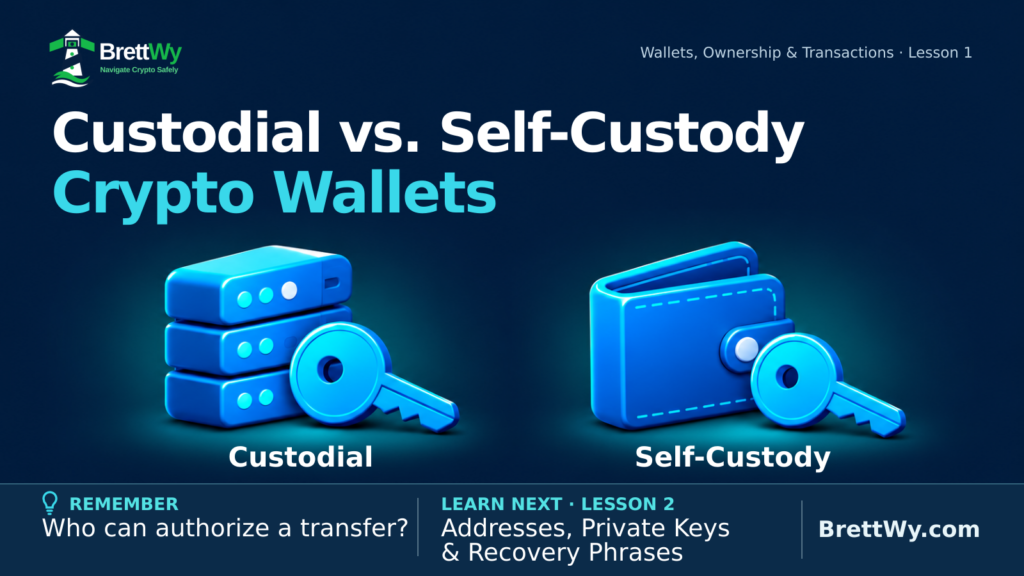
Custodial and non-custodial crypto wallets differ in who controls transaction signing and how access can be recovered. Non-custodial wallets are also commonly called self-custody wallets.
Imagine Maya opens two apps. Each shows a crypto balance and a button labeled “Send.” They look similar, but they may give her very different powers.
In one app, Maya asks a company to send cryptocurrency on her behalf. In the other, she uses credentials under her control to authorize a blockchain transaction. The difference becomes especially important if she loses her phone, forgets a password or cannot reach the company.
This guide examines custodial vs. non-custodial wallets through one central question: Who controls access to your cryptocurrency, and what responsibilities and risks come with that control?
You do not need to rush into a new wallet. First, understand the arrangement you already use—or are considering.
The BrettWy Custody Check Framework
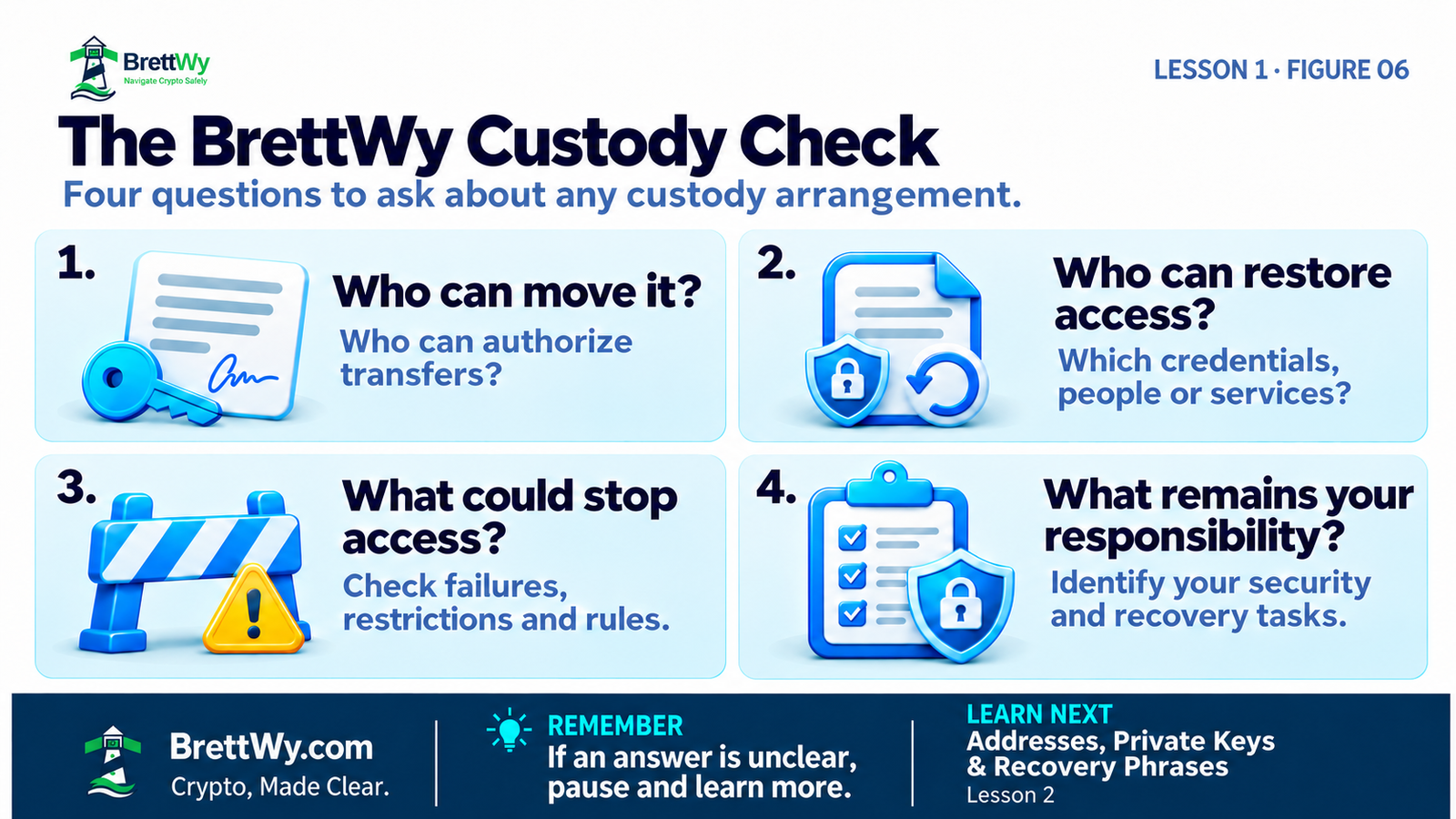
Use four questions to make sense of any custody arrangement:
- Who can move it? Who can authorize transfers, alone or with others?
- Who can restore access? Which credentials, people or services would recovery require?
- What could stop access? Which failures, restrictions or rules could interrupt your ability to use the assets?
- What remains your responsibility? Which security and recovery tasks must you manage?
Keep these questions in mind as you read. Later, we will apply them to a practical example. They are a learning tool, not a safety score or a substitute for understanding the terms.
Table of Contents
What Does Crypto Custody Mean?
Crypto custody concerns how access to cryptocurrency is safeguarded and who can authorize its use. To understand it, separate the wallet interface from the powers behind it.
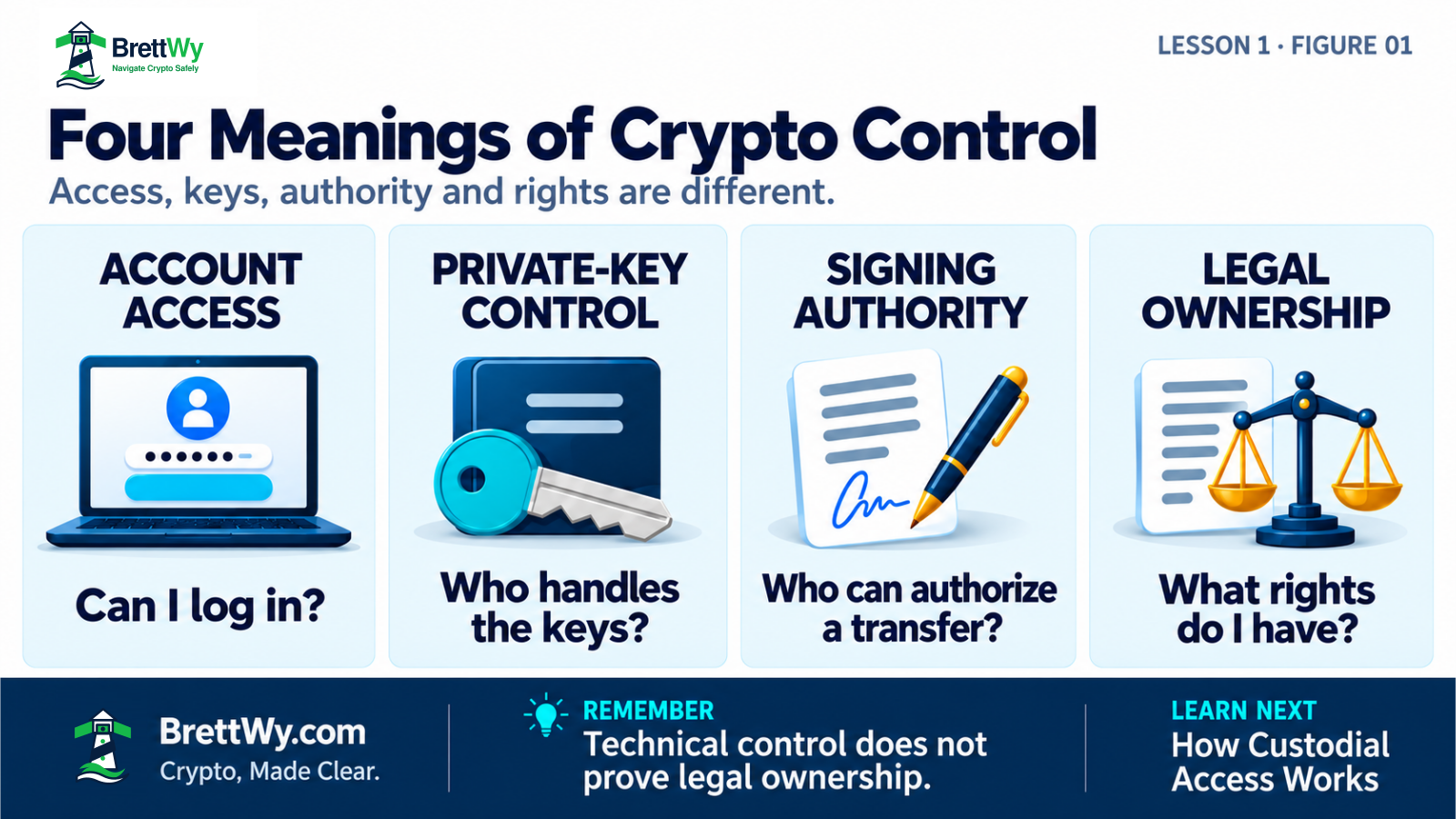
Account access, key control and signing authority
A private key is secret cryptographic information used to create digital signatures. A signature can authorize a transaction under the relevant blockchain rules. Your wallet helps manage that process; the cryptocurrency is not a file stored inside the app.
An account login, by contrast, authenticates you to a service. It might let you view a balance or request a withdrawal without giving you the key that signs the resulting blockchain transaction. Ethereum’s account documentation explains the role of keys and signatures.
| Concept | Plain-English meaning | Question to ask |
|---|---|---|
| Account access | How you enter an app or service | Can I log in? |
| Private-key control | Who possesses or manages the signing credentials | Who handles the keys? |
| Signing authority | Who can satisfy the rules for authorizing a transaction | Who can approve movement? |
| Legal ownership | Your rights or claims under the arrangement and applicable law | What am I legally entitled to? |
Signing authority can involve more than one key or participant. We will cover those arrangements after comparing the conventional models.
Legal ownership is a separate question
The ability to move an asset and the legal right to that asset are not interchangeable. Someone who steals signing credentials may gain technical power without acquiring lawful ownership.
Likewise, a custodian may control keys while its agreement recognizes customers’ rights to the assets. For example, Coinbase’s U.S. individual agreement, section 2.7, separates customer title from the provider’s key control, subject to its terms and product-specific exceptions.
That example is not a recommendation or a guarantee about a legal dispute. It shows why “who holds the keys?” cannot answer every ownership question.
What Is a Custodial Crypto Wallet?
A custodial crypto wallet is a service through which a provider manages the relevant keys on your behalf. A conventional cryptocurrency exchange account is a common example.
How account access and withdrawal requests work
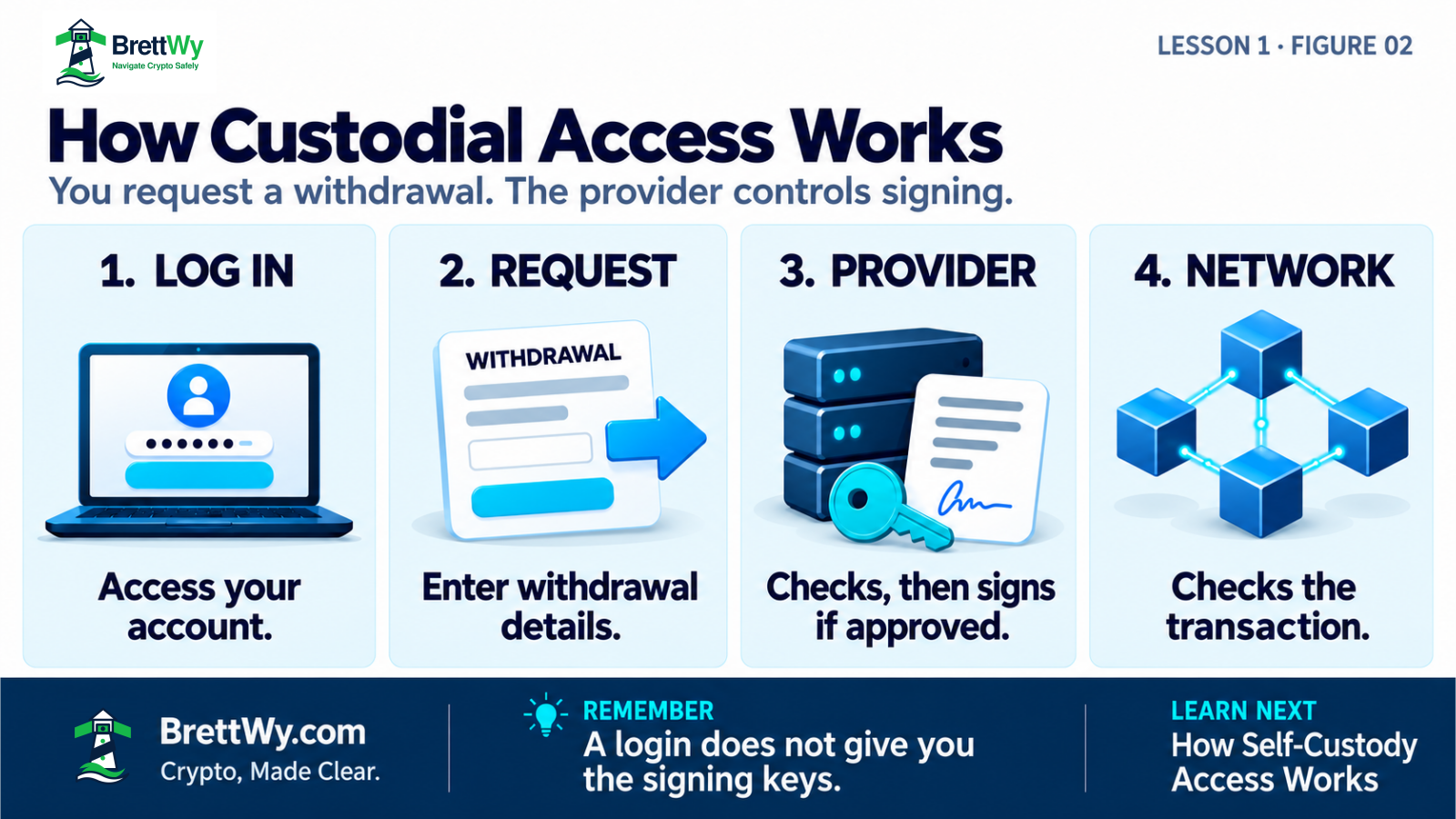
In a simplified custodial withdrawal:
- You authenticate to your account.
- You request a transfer and provide its details.
- The provider applies its checks and restrictions.
- If it proceeds, the provider’s systems authorize and submit the blockchain transfer.
Your login gives you a way to issue instructions. It does not necessarily give you direct blockchain signing power.
A displayed balance also does not prove that the provider maintains a separate blockchain address just for you. Some arrangements use shared addresses and separate customer records. The provider’s documentation should explain how your balance relates to the assets it holds.
What the provider handles—and what you still handle
The provider takes on key-management duties and may offer account-recovery assistance. You still need to protect your account, secure its recovery methods and check the instructions you submit.
Think of responsibility as divided rather than removed. Ask which duties belong to the provider and which remain yours. The SEC’s custody bulletin offers questions for evaluating that division.
What Is a Self-Custody Crypto Wallet?
In conventional self-custody, you control the credentials needed to authorize transactions. You will also see this described as a non-custodial wallet.
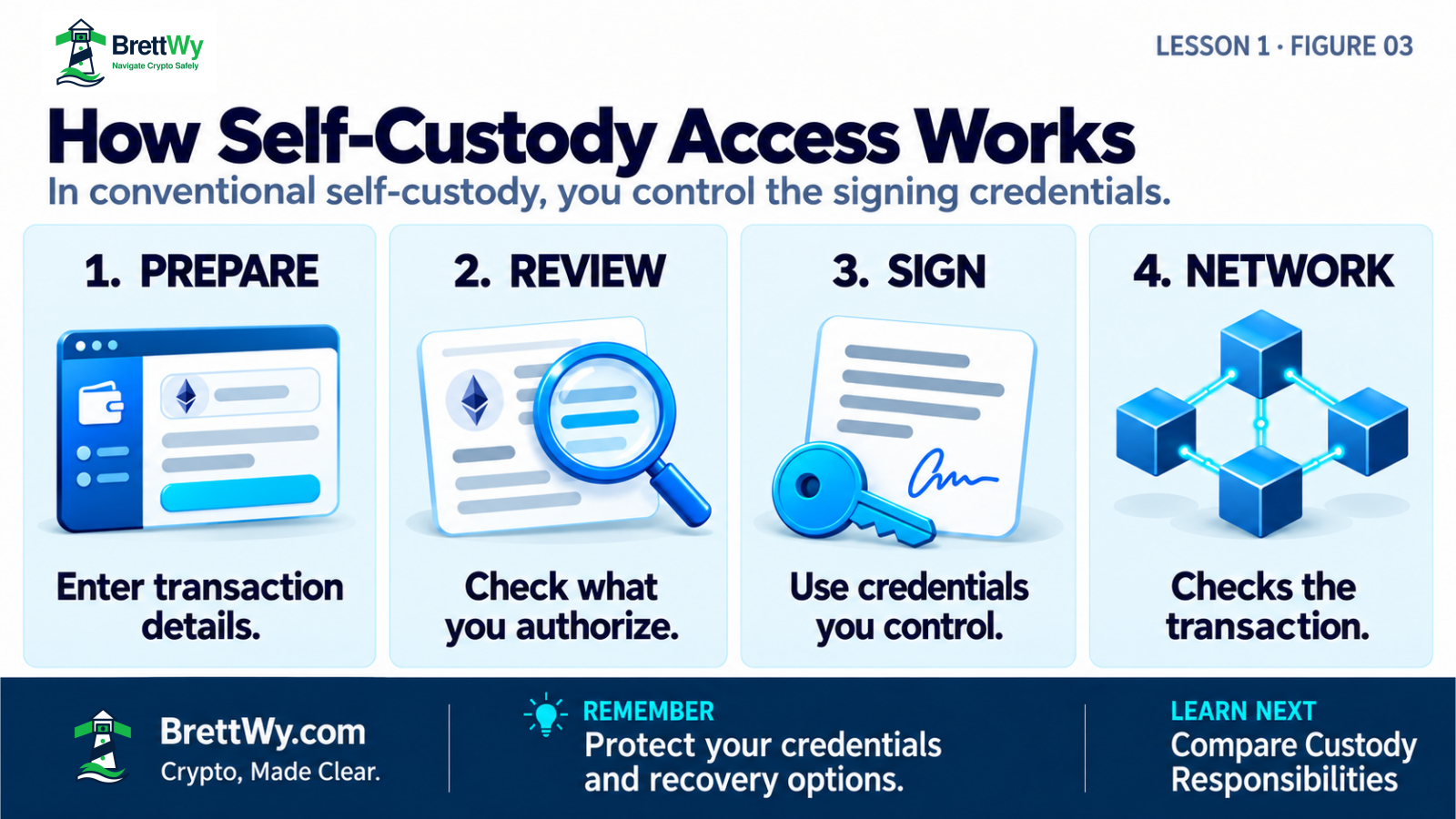
How direct authorization works
Your wallet prepares the request, a signer under your control authorizes it, and the transaction can then reach the network for verification. The signer might be software or a separate device.
The company that develops a wallet app is not automatically the custodian of the assets you access through it. In a conventional design, providing the interface does not give that developer your signing credentials. Ethereum.org’s wallet overview explains this distinction between the wallet tool and the account it accesses.
This control comes with recovery responsibilities. Before relying on a wallet, understand what would let you regain access if the device or application became unavailable.
What self-custody does not remove
Self-custody does not remove dependence on working software, compatible systems or the rules of the asset itself. It also does not guarantee that every app interface or supporting service will remain available.
Some tokens have issuer-controlled restrictions. For example, Circle’s USDC terms describe on-chain blocklisting powers. Those terms apply to holders outside the European Economic Area; the example should not be generalized to every cryptocurrency.
If you hold an affected token in self-custody, control of your wallet credentials does not cancel the token’s rules. For more context, see What Are Stablecoins?.
Custodial vs. Non-Custodial Wallets: Key Differences
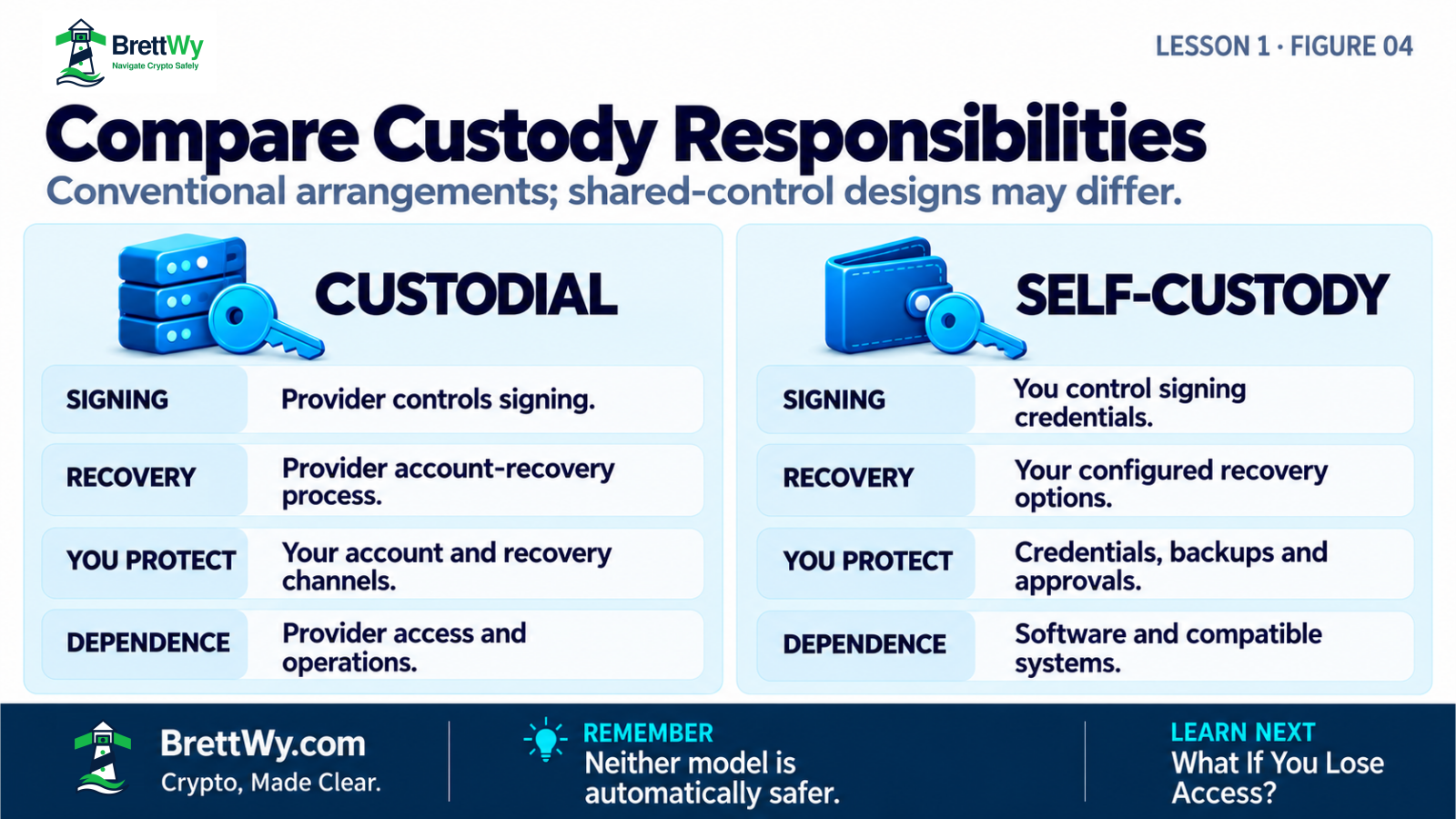
Compare responsibilities, not safety labels
The table below describes conventional arrangements. Shared-control and alternative-recovery designs may work differently.
| Question | Conventional custodial account | Conventional self-custody wallet |
|---|---|---|
| Who controls transaction authorization? | Provider-managed signing systems | Credentials under your control |
| How do you access it day to day? | Through the provider’s account process | Through a wallet and its signing method |
| How might you recover access? | Provider account-recovery process | Valid recovery material or another configured route |
| What provider dependence matters? | Continued operation, access policies and performance of custody duties | The wallet’s software and supporting services; portability depends on design |
| What must you protect? | Account credentials, recovery channels and instructions | Signing credentials, recovery arrangements, devices and approvals |
| What protection applies after a loss? | Depends on the event, terms and law | Depends on the event and any applicable arrangement; self-custody is not insurance |
For example, someone confident about account security may still be unprepared to protect an irreplaceable wallet backup. Someone with a sound backup plan may still underestimate a provider’s withdrawal restrictions. Those are different weaknesses requiring different attention.
Custody and hot/cold storage answer different questions
Custodial vs. self-custody asks who controls authorization. Hot vs. cold concerns the signing keys’ exposure to an online environment.
A custodian may use cold storage. A self-custody wallet may use keys in an internet-connected environment. These categories overlap; one does not determine the other. We will examine storage choices in Lesson 3.
Who Can Authorize Transactions or Change Access?
Some arrangements require more than one participant or provide ways to change who can authorize transactions. These designs make the question “who has the key?” incomplete.
When more than one key is required
A multisignature, or multisig, arrangement requires a specified number of signatures from a set of keys. The Bitcoin developer guide describes this threshold approach.
Consider two hypothetical two-of-three arrangements. Assume each requires signatures from any two of three distinct keys, with no additional spending conditions:
| Arrangement | Who holds the keys? | What follows? |
|---|---|---|
| A | Maya controls two; a service controls one | Maya can authorize without the service if she can use both keys. The service cannot authorize alone. |
| B | Maya controls one; a service controls one; a separate helper controls one | Maya needs another participant. The service and helper together can satisfy the threshold without her. |
Both are two-of-three, yet their control arrangements differ. Three copies of one key would not create three independent signing keys.
Smart-contract wallets and alternative recovery
A smart-contract wallet can use programmed rules to decide whether an action is authorized. A smart contract is a program on a blockchain; it does not simply possess a secret private key of its own. Ethereum’s contract signature-validation standard describes how a contract can recognize valid authorization.
Some designs also support configured recovery: backup credentials or designated participants may help replace a lost signer. Ethereum.org’s account-abstraction overview explains such possibilities.
These are capabilities a wallet may implement, not a promise that any lost wallet can be rescued. Recovery depends on its rules and setup. If the term is unfamiliar, our smart-contract guide provides the foundation.
Questions about shared control and recovery services
Ask what each participant can do during ordinary use and during recovery:
- Can anyone transfer assets without you?
- Can someone replace your signer or change the rules?
- Can a participant prevent you from acting by refusing to cooperate?
- What remains possible if the service disappears?
Do not classify an arrangement solely because it advertises “self-custody,” “keyless access” or “recovery help.” Ask for a clear explanation of the actual powers involved.
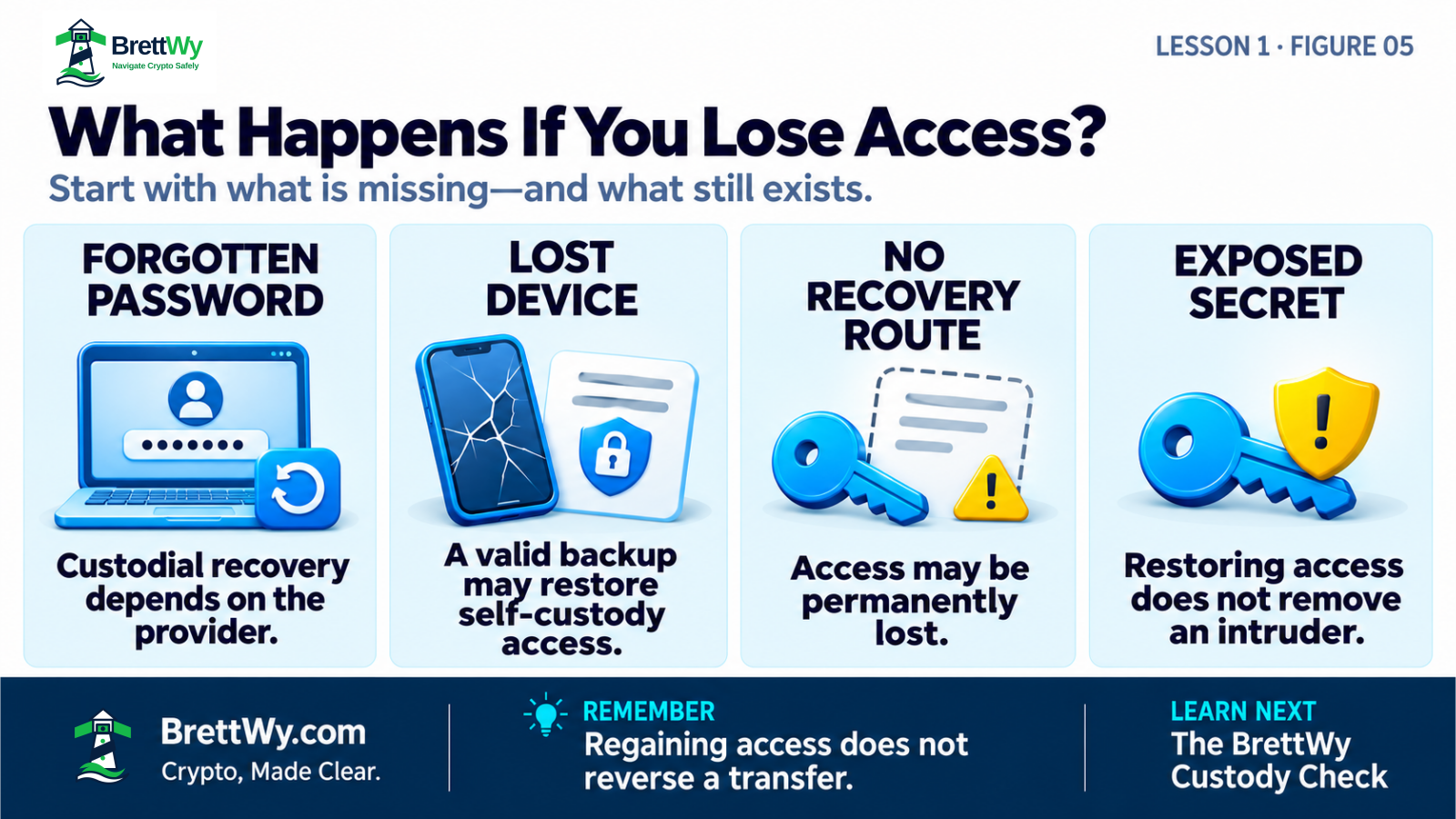
What Happens If You Lose Access?
“I cannot open my wallet” does not tell you what has failed. The first question is what you have lost—and what still exists.
Forgotten login or lost device
| Situation | What could restore access? | Important limitation |
|---|---|---|
| You forget a custodial account password | The provider’s recovery process | Successful recovery depends on its requirements and availability |
| You lose a self-custody device but retain valid recovery material | A compatible recovery process | All required information and a trustworthy environment matter |
| You lose every required credential and recovery option | There may be no remaining route | A blockchain does not generally provide a reset service for conventional key-based wallets |
| Your provider is unavailable | Restoration of its service or another applicable process | A new personal wallet cannot simply recover assets controlled by that provider |
| Someone obtains a recovery secret | This requires a security response, not merely restoring access | Restoring the same credentials does not remove the other person’s access |
For example, Maya’s phone breaks, but her conventional wallet’s valid backup remains protected. The broken phone does not by itself establish that access is permanently lost. Bitcoin.org’s security guidance explains the value of wallet backups.
Recovery compatibility matters. Some arrangements require extra information, such as a separately configured passphrase. Keeping one part does not guarantee that you have everything required. Do not delete a working wallet to “test” whether you can restore it.
Missing or exposed recovery information
A recovery phrase, also called a seed phrase, is a sequence of words used by many wallets to recreate credentials. It is not an ordinary account password. The BIP-39 specification describes one widely used mnemonic design, including an optional additional passphrase; other designs exist.
Missing information threatens your ability to recover. Exposed information may give someone else access.
Changing the password that protects a local app does not invalidate an underlying key or recovery secret already copied elsewhere. That distinction follows from the separate roles of the password and signing credentials. A wallet with configured signer-replacement rules needs its own documented response.
Recovering access is not reversing a transfer
Reopening an account or restoring a wallet does not itself bring back assets that have already been transferred away. A refund, voluntary return or legal remedy is a separate matter and may not be available.
Also distinguish recovery features you arranged in advance from strangers promising to retrieve lost funds. The FTC warns about unsolicited recovery offers that seek fees or account information from people who have already suffered a loss.
Security Risks of Custodial Wallets
Account takeover and fake support
An attacker may try to enter your account rather than steal the provider’s blockchain keys. A fake login page, stolen password or compromised recovery channel can put account access at risk.
Protect the account and the email or other services used to recover it. Use a unique password and strong multifactor authentication where available. Multifactor authentication, or MFA, requires more than one kind of proof to sign in.
NIST’s guidance explains why phishing-resistant authentication offers stronger protection against credential phishing than methods such as text-message codes. Availability depends on the service.
Suppose a message says Maya must “verify her wallet” immediately. She should reach the provider through a verified route, rather than trust the message’s login link. Urgency is not evidence that a request is legitimate.
Provider security and operational dependence
Strong account protection does not prove that a provider manages its own systems well. You may secure your login carefully and still face a custodian’s security incident, outage or financial failure.
Evaluate these as separate questions: Can someone take over my account? and Can the provider continue to safeguard and make assets available? One control cannot answer both.
For broader security habits, read Cryptocurrency Security. Provider restrictions and failure receive separate attention below.
Security Risks of Self-Custody Wallets
Stolen secrets, compromised devices and harmful requests
An attacker may target signing credentials, recovery information or the actions you approve. A wallet can remain in your possession while someone else has enough information to access the same assets.
There is another route: persuading you to authorize something harmful. A request may grant spending permission rather than make an ordinary payment. Protecting a key does not replace understanding what that key is being used to approve. Ethereum.org’s security guidance discusses recovery-secret theft, impersonation and unsafe permissions.
A device PIN, fingerprint check or app password can protect local access. Do not assume it also applies when someone uses copied credentials elsewhere. Some wallet designs add authorization controls, but those must be verified rather than inferred from the login screen.
Recovery availability and backup protection
A recovery plan has two jobs: preserve your ability to regain access and prevent unauthorized people from gaining it.
A backup that nobody can find when needed may fail the first job. A backup that a thief can easily read may fail the second. Consider loss, theft, accidental disposal and damage when planning storage, without assuming that more copies automatically solve every problem.
For example, keeping the only recovery copy on the same phone as the wallet gives Maya little help if that phone becomes unavailable. The right response is to understand and maintain the wallet’s recovery arrangement before relying on it.
Detailed credential and storage choices belong in the next lessons. Here, the essential duty is to know what recovery requires and how those requirements will remain protected and available.
What If a Custodian Restricts Withdrawals or Fails?
Outage, account restriction or financial failure?
A visible account balance and an available withdrawal are different things. Consider three hypothetical situations:
- Outage: Maya cannot use the withdrawal page because a service is unavailable.
- Account restriction: The provider can operate, but it has restricted Maya’s account under its policies or a legal requirement.
- Financial failure: The provider cannot meet obligations, potentially affecting customers’ access to assets.
These situations may look similar from a screen. They do not establish the same cause or outcome. A withdrawal restriction alone is not proof of insolvency, and a functioning login is not proof that withdrawals will succeed.
Check verified provider communications and applicable terms. Avoid guessing from social-media rumors or accepting unsolicited “unlocking” offers.
What the terms say about assets and customer rights
Read what the arrangement says about segregation—keeping assets or records separate—and asset use. Ask whether separation concerns blockchain addresses, accounting records, legal rights or more than one of these.
Also ask whether the provider may lend assets or use them as collateral. A subcustodian is another organization used to perform custody functions; its involvement adds another relationship to understand. Investor.gov’s custody questions highlight these issues.
For a possible provider failure, find out which legal entity owes you duties and what the agreement says about your rights. The custody label cannot tell you whether, when or how much you might recover. Those outcomes depend on the arrangement, applicable law and the facts of the failure.
Terms deserve scrutiny, but they are not a prediction of a court decision. Specific disputes may require qualified legal advice.
Are Custodial and Self-Custody Wallets Insured?
There is no automatic insurance answer based on the wallet category. Ask what protection covers this asset, this loss and this customer.
U.S. deposit insurance and SIPC protection
The examples in this section concern the United States. Other jurisdictions have different systems.
FDIC deposit insurance covers eligible deposits at insured banks when an insured bank fails. It does not insure crypto assets or protect against a nonbank crypto company’s failure. A provider’s relationship with a bank does not turn your cryptocurrency balance into an insured deposit. See the FDIC’s explanation of coverage.
Cash that a service places at a bank is a separate question with its own conditions. Do not apply a statement about cash deposits to a crypto balance displayed beside them.
SIPC protection concerns eligible customer cash and securities at a financially troubled member brokerage. It is not protection against falling investment prices. SIPC states that digital assets which do not qualify as securities under the Securities Investor Protection Act are not protected. Member-firm status alone does not establish that your particular crypto asset qualifies. Check what SIPC protects.
What a private policy would need to cover
For a claim such as “our assets are insured,” ask:
- Who holds the policy, and whose losses does it cover?
- Which events qualify: theft, a provider incident or something else?
- Which assets and custody arrangements are included?
- What exclusions, limits and claim conditions apply?
- Is the limit shared across many claims?
- What would you need to establish your entitlement to payment?
An insurance badge cannot answer those questions. Neither can a wallet’s custodial or self-custody label. If the relevant documentation is unavailable, treat coverage as unverified rather than assume it exists.
Can You Use Both Custodial and Self-Custody Wallets?
Different arrangements for different activities
You can maintain more than one arrangement. For example, Maya might use a custodial service for one activity and a separate self-custody wallet for another.
This is an illustration, not a recommended allocation. There is no universal percentage that belongs in either model, and using both does not automatically make someone safer.
More arrangements mean more processes to understand
Maya would need to distinguish the accounts, credentials, recovery routes and duties for each arrangement. If she moves assets between them, she also needs to understand compatibility and transfer requirements.
Before adding another wallet, ask what purpose it serves and whether you can maintain it. Adding complexity without a clear purpose can make an already confusing setup harder to manage.
Later lessons cover networks, fees and safe transfers. Understanding custody is the foundation for those practical steps.
How to Evaluate a Custody Arrangement
Apply the four-question BrettWy Custody Check
Return to the four questions, this time looking for evidence:
| Question | What to investigate | Where to look |
|---|---|---|
| Who can move it? | Ordinary signing powers, required participants and powers to change the rules | Authorization and permissions documentation |
| Who can restore access? | Required recovery information, people, services and fallback options | Recovery documentation, including what happens if a provider disappears |
| What could stop access? | Restrictions, outages, asset rules and relevant protections | Applicable terms, custody disclosures and coverage documents |
| What remains your responsibility? | Account/device security, backups, request checks and maintenance | Documented user duties and your own recovery plan |
Ask separately whether the arrangement supports your intended assets and networks, and what provider, device or transaction costs apply. Custody is one part of suitability, not the whole decision.
Find evidence behind the answers
Imagine a fictional wallet says it offers easy recovery through a designated helper. Maya finds an explanation of everyday spending but cannot tell what the helper may do during recovery.
She should ask whether the helper can replace her signer, whether another participant must agree, and whether the procedure still works if the company closes. “Recovery available” is not enough information to decide whether that arrangement suits her.
Now imagine a custodial service provides clear answers about withdrawals but vague information about asset use. The missing answer is different, yet the process is the same: identify what you do not know and seek the applicable documentation.
Where a provider claims registration or authorization, check the relevant official registry and what that status actually covers. Treat it as evidence about that status, not as a guarantee against loss.
Pause when an important answer is missing
You do not need to understand every line of code. You should be able to explain the basic control and recovery arrangements in ordinary language.
Try completing these sentences privately:
- “A transfer requires approval from …”
- “If I lose my device, access depends on …”
- “If the provider disappears, my options are …”
- “The tasks I must maintain are …”
Do not put actual passwords or recovery secrets in that summary. If an important answer remains unclear, pause before relying on the arrangement. Understanding comes before adding risk or complexity.
Common Custody Misconceptions and Beginner Mistakes
A login is not a signing key
“I can see the balance, so I directly control the blockchain assets.” A screen can show a provider-managed account balance. Ask who authorizes a withdrawal.
“Without the keys, I have no legal rights.” Key control describes technical power. Legal rights require examining the arrangement and applicable law.
“Changing my app password fixes an exposed recovery phrase.” Local password protection does not revoke credentials copied elsewhere. Treat exposed recovery information as a separate security problem.
Recovery, insurance and “self-custody” need context
“Self-custody is always the safest choice.” The answer depends on the design, failure scenarios and responsibilities you can manage.
“Self-custody means nobody can restrict any asset I hold.” Some assets have issuer or contract restrictions. Wallet control does not erase those rules.
“The service says ‘insured,’ so every loss will be reimbursed.” Coverage depends on the policy, event, asset and eligibility. An undefined claim is not enough.
Key Takeaways
- Account access, key control, signing authority and legal rights are related but distinct.
- Custody choices change who handles authorization, recovery and security duties.
- Losing a device, losing recovery information and exposing a secret are different problems.
- Shared control, provider terms and asset rules can change what a wallet label appears to promise.
- Use the BrettWy Custody Check to identify responsibilities and unanswered questions before relying on an arrangement.
Frequently Asked Questions
Is self-custody the same as non-custodial?
The terms commonly describe user-controlled signing authority. However, products can differ in recovery, co-signing and rule-changing powers. Check the design instead of assuming the label gives the whole answer.
Can a custodial provider reset my password?
It may offer an account-recovery process. That does not guarantee immediate access, a successful withdrawal or recovery of assets already lost. The provider’s requirements and circumstances still matter.
Can a self-custody wallet have recovery help?
Yes. Some designs include backup credentials or designated recovery participants. Understand what those participants can do, what cooperation is required and whether recovery works without the service.
Does using a hardware wallet determine custody?
A device’s form does not by itself establish who controls authorization. Ask who holds the relevant credentials and what other signers or recovery powers exist. Hardware and custody describe different aspects of a setup.
Can self-custody assets be restricted?
Some tokens include issuer or contract controls. Holding their signing credentials does not override those controls. Do not assume every cryptocurrency follows the same rules.
Does insurance cover my crypto?
You need to check the specific protection being claimed. U.S. deposit insurance, SIPC protection and private policies have different scopes. Neither a wallet label nor a provider’s general insurance statement proves that your loss qualifies.
Test Your Knowledge
- Maya logs into an exchange and requests a withdrawal. Does the successful login establish that she controls the provider’s blockchain signing keys?
- Her self-custody phone breaks, but valid, complete recovery information remains protected. Does the broken phone alone establish permanent loss of access?
- In a two-of-three arrangement with no extra conditions, Maya holds one key and two other people each hold one. Can Maya sign alone? Can the other two satisfy the threshold together?
- A service advertises “insured assets” without describing the coverage. Is that enough to know whether Maya would be reimbursed for a loss?
Check your answers
- No. Account authentication and blockchain authorization are separate functions.
- No. A compatible recovery route may remain available. All required information and conditions still matter.
- Maya cannot sign alone; the other two can satisfy the stated threshold together. The allocation of keys determines the participants’ powers.
- No. She needs to understand the covered event, assets, beneficiaries, exclusions, limits and claim requirements.
Official and Educational Resources
- Investor.gov — Crypto Asset Custody Basics: Questions for understanding custody arrangements.
- Ethereum.org — Wallets: How wallets relate to blockchain accounts.
- Bitcoin.org — Securing Your Wallet: Backup and wallet-security considerations.
- Ethereum.org — Security and Scam Prevention: Recovery-secret protection and common threats.
- NIST — Multifactor Authentication: Account authentication and phishing resistance.
- FDIC — Understanding Your Coverage: U.S. deposit-insurance scope and exclusions.
- SIPC — What SIPC Protects: U.S. brokerage-customer protection and its limits.
- FTC — Avoiding Crypto Recovery Scams: Warning signs in unsolicited offers to recover losses.
Final Thoughts
A custody choice becomes easier to understand when you can explain what happens during ordinary use and when something goes wrong.
Before relying on an arrangement, identify who can authorize movement, how access can be restored, what could interrupt it and which duties you must maintain. An unanswered question is a reason to learn more—not a reason to hurry into a different wallet.
Continue Your Crypto Education
If you need to revisit the foundation, return to Crypto Wallets Explained. For practical account and scam awareness, continue with Cryptocurrency Security.
You have completed the custody-model foundation for Wallets, Ownership & Transactions. Next, examine the credentials and identifiers that these arrangements rely on.
Learn what each item does, which information can be shared, and why a public address, an app password and recovery information serve different purposes.
About This Content
BrettWy creates beginner-friendly cryptocurrency education with a focus on clear explanations, practical security, and understanding risk. Content is developed with AI assistance, and relevant sources are linked so readers can explore the underlying information.
Crypto products, services, and technical guidance can change. Check current information with the original source before taking action.
Found an error or outdated information? Email info@brettwy.com with the article URL and the detail you believe needs attention. Never include passwords, private keys, or recovery phrases.
Educational and Risk Disclaimer
BrettWy provides this article for general educational and informational purposes only. It does not constitute financial, investment, legal, tax, accounting, cybersecurity, or other professional advice.
Cryptocurrency wallets, private keys, recovery phrases, self-custody, third-party custodians, applications, devices, and blockchain transactions involve significant risks, including credential theft, malicious software, fraudulent approvals, scams, provider failure, irreversible mistakes, and permanent financial loss.
No wallet, device, custodian, application, security method, or recovery process can eliminate every risk or guarantee the safety of digital assets. Verify current information through official sources and consult qualified professionals when appropriate.