
Article Snapshot
Crypto Fundamentals Learning Path
- The Complete Beginner’s Guide to Cryptocurrency
- What Is Blockchain?
- What Is Bitcoin?
- What Is Ethereum?
- ► What Are Smart Contracts? — You are here
- What Is DeFi?
- Crypto Wallets Explained
- What Are Stablecoins?
- What Is Web3?
- Cryptocurrency Security
In This Guide, You’ll Learn
- •What a smart contract is in simple terms
- •Why developers created smart contracts
- •How contract execution works step by step
- •How Ethereum, gas, and contracts connect
- •Where smart contracts are used
- •Their benefits, limitations, and risks
- •How they differ from traditional contracts
- •How to evaluate them more safely
Introduction
To begin, smart contracts are one of blockchain technology’s most important—and most misunderstood—building blocks. They power many decentralized applications, yet their name can make them sound more intelligent or legally complete than they really are.
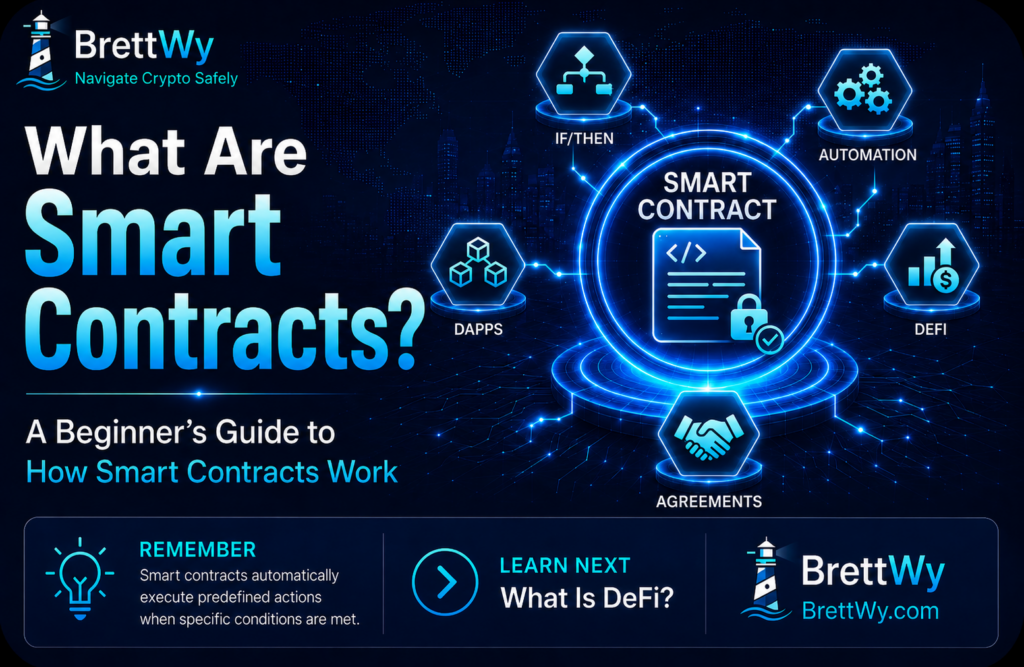
The simplest explanation is that a smart contract is a program stored on a blockchain. When someone sends a valid transaction that calls one of its functions, the network executes the contract’s programmed instructions.
Smart contracts help power decentralized finance, stablecoins, NFTs, blockchain games, DAOs, and other applications. However, automatic execution does not guarantee accurate code, trustworthy data, safe interfaces, or legal protection.
This guide builds a practical beginner mental model: what a smart contract is, what triggers it, how the network processes it, what it can do, and where its risks begin.
The BrettWy Smart Contract Framework
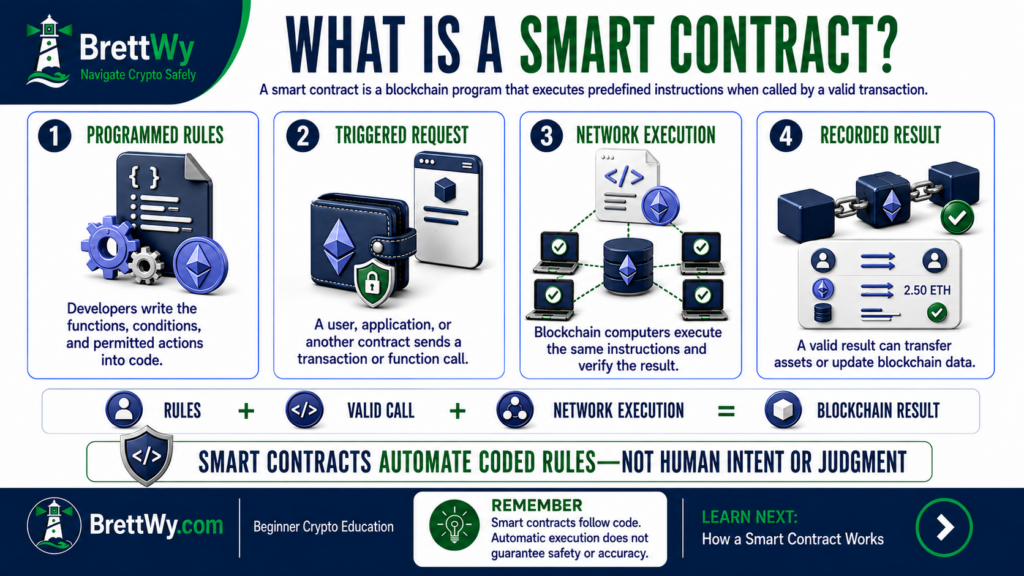
Use four connected parts to understand any smart contract without getting lost in code:
- Rules: The code defines which inputs are accepted and which actions are allowed.
- Trigger: A user, application, or another contract sends a transaction or function call.
- Execution: The blockchain processes the same instructions and determines the result.
- Record: Valid state changes become part of the blockchain’s shared history.
Table of Contents
- What Is a Smart Contract?
- Why Were Smart Contracts Created?
- How Do Smart Contracts Work?
- Ethereum and Smart Contracts
- What Is Gas?
- Can Smart Contracts Be Changed?
- What Makes Smart Contracts Verifiable?
- Smart Contracts vs. Traditional Contracts
- Are Smart Contracts Legally Binding?
- Real-World Uses of Smart Contracts
- The Smart Contract Ecosystem
- Benefits of Smart Contracts
- Limitations and Risks of Smart Contracts
- Common Misconceptions About Smart Contracts
- Beginner Safety Tips
- Key Takeaways
- Frequently Asked Questions
- Test Your Knowledge
- Official Smart Contract Resources
- Final Thoughts
What Is a Smart Contract?
Instead of relying on a person or company to process every step, participating blockchain computers execute the same contract instructions and verify the resulting state change.
Think of a smart contract as a digital “if-then” statement:
If certain conditions are true, then automatically perform a specific action.
For example, developers could program a smart contract so that if a buyer sends the required amount of cryptocurrency, ownership of a digital collectible automatically transfers to the buyer’s wallet.
Neither side needs to manually complete the final step after the buyer satisfies the conditions. The blockchain verifies the transaction and executes the instructions automatically.
A Simple Analogy: The Vending Machine
For instance, one of the easiest ways to understand a smart contract is to think about a vending machine.
Imagine that you are buying a bottle of water for $2.00:
- You insert $2.00.
- You select the drink.
- The machine checks whether you inserted enough money.
- If the requirement is met, it releases the bottle.
- If the requirement is not met, it does not dispense the product.
The machine does not negotiate or independently decide what to do. It follows the rules it was programmed to follow.
A smart contract works in a similar way. Instead of dispensing a product, it executes a digital action. Instead of checking inserted cash, it verifies blockchain-based conditions.
Why Are They Called “Smart” Contracts?
However, the term can be misleading. Smart contracts do not think, learn, reason, or make independent decisions like humans or artificial intelligence.
Instead, they are software programs that follow predefined instructions. The word smart refers to their ability to automate tasks that traditionally required human involvement.
Why Were Smart Contracts Created?
Many everyday agreements depend on trusted intermediaries. Banks transfer money, payment processors authorize purchases, escrow companies hold funds, lawyers help enforce legal agreements, and insurers review claims.
These intermediaries provide valuable services. However, they can also make a process slower, more expensive, dependent on business hours, or vulnerable to human error.
Developers created smart contracts to automate digital processes when they can define the rules clearly in advance. Rather than waiting for someone to confirm that an agreement has been fulfilled, the blockchain checks the programmed conditions.
When the conditions are satisfied, the smart contract performs the next step automatically.
The Problem Smart Contracts Solve
Imagine buying a digital artwork from someone online. The buyer may worry about sending payment without receiving the asset. The seller may worry about transferring the asset without getting paid.
A smart contract can coordinate both sides of the transaction. It can verify the payment, transfer the digital asset, send the funds to the seller, and record the result on the blockchain.
Code Instead of Personal Trust
Smart contracts can reduce the need to rely solely on promises or manual processing. Participants can review the known rules and rely on the blockchain to execute the programmed logic consistently.
However, this does not mean software should be trusted blindly. A smart contract is only as reliable as its code, design, governance, and supporting systems.
Why It Matters:
As a result, smart contracts make blockchains programmable. That is what allows developers to build applications instead of using a blockchain only to transfer cryptocurrency.
How Do Smart Contracts Work?
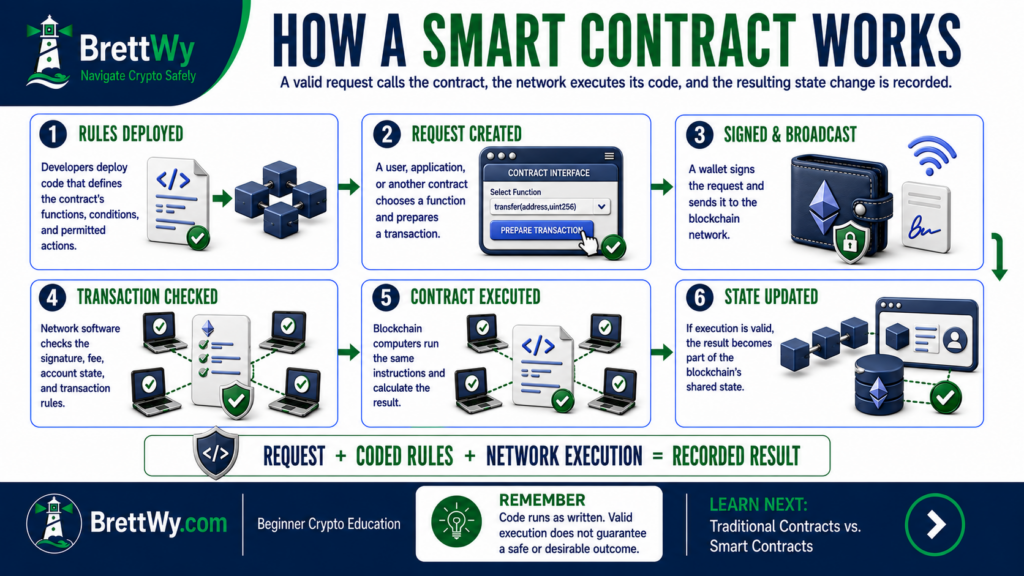
1. A Developer Creates the Smart Contract
A developer writes the contract using a blockchain-compatible programming language. The code defines the rules, permitted actions, and conditions required for execution.
After testing, the developer deploys the contract to a blockchain. Deployment gives the contract an onchain address through which users and applications can interact with it.
2. A User Initiates an Action
A person or application sends a transaction to the smart contract. For example, the action might involve swapping tokens, minting an NFT, depositing collateral, voting in a DAO, or using a blockchain game.
Next, the user normally approves the transaction through a compatible crypto wallet.
3. Network Verification
Then, the blockchain verifies the transaction and processes the contract’s logic. Depending on the contract, it may check whether the user has enough cryptocurrency, supplied a valid digital signature, met a deadline, or satisfied another programmed requirement.
If a required condition is not met, the intended state change does not occur.
4. The Smart Contract Executes
If the transaction is valid and the required conditions are satisfied, the contract performs its programmed actions. It might transfer tokens, update an ownership record, issue a digital receipt, or trigger another smart contract.
5. The Blockchain Records the Result
After execution, the blockchain records the resulting transaction and state changes. On a public blockchain, people can generally inspect this activity using a block explorer.
In practice, public blockchain records usually identify participants by wallet address rather than by a verified personal identity. This means public blockchains are transparent, but they are not necessarily anonymous.
Ethereum and Smart Contracts
Bitcoin introduced decentralized digital money. Ethereum expanded the idea of blockchain by providing a general-purpose environment where developers could deploy programmable smart contracts and build decentralized applications.
Ethereum helped popularize smart contracts at scale, establishing much of the modern dApp ecosystem. Developers have used it to create decentralized exchanges, lending protocols, stablecoins, NFT marketplaces, games, token systems, DAOs, and other applications.
Importantly, Ethereum is not the only blockchain that supports smart contracts. Many other networks now provide similar capabilities, with different approaches to fees, speed, security, decentralization, and programming.
For a deeper explanation of the network itself, read What Is Ethereum? A Beginner’s Guide to How Ethereum Works.
What Is Gas?
Gas also discourages spam and prevents programs from using unlimited network resources. More complex transactions generally require more computation than simple transfers.
Fees can change based on network demand. A transaction may cost more during periods of heavy usage and less during quieter periods.
For a technical explanation, see the official Ethereum gas documentation.
Can Smart Contracts Be Changed?
Immutability can make the rules more predictable because users know that the original code cannot be quietly changed after deployment.
However, it also creates risk. If immutable code contains a bug, correcting it may require deploying a replacement contract and moving users or assets to the new version.
By contrast, some projects use upgradeable contract designs. In those systems, an administrator, multisignature wallet, organization, or decentralized governance process may be able to change parts of the protocol.
Common Beginner Mistake:
“Deployed on a blockchain” does not always mean “nobody can change it.” Check whether a contract is immutable, upgradeable, pausable, or controlled by administrative keys.
What Makes Smart Contracts Verifiable?
Nevertheless, a contract can contain programming errors, unsafe permissions, flawed economic assumptions, or dependencies that fail. Reputable teams often use extensive testing, independent security reviews, monitoring, and bug-bounty programs.
The OWASP Smart Contract Security Verification Standard provides security requirements for designing, building, testing, and verifying smart contracts.
Security Tip:
Do not assume that a smart contract is safe because it is popular, automated, or visible on a blockchain. Verify the application’s official website, contract details, audits, permissions, and reputation before connecting a wallet or approving a transaction.
Smart Contracts vs. Traditional Contracts
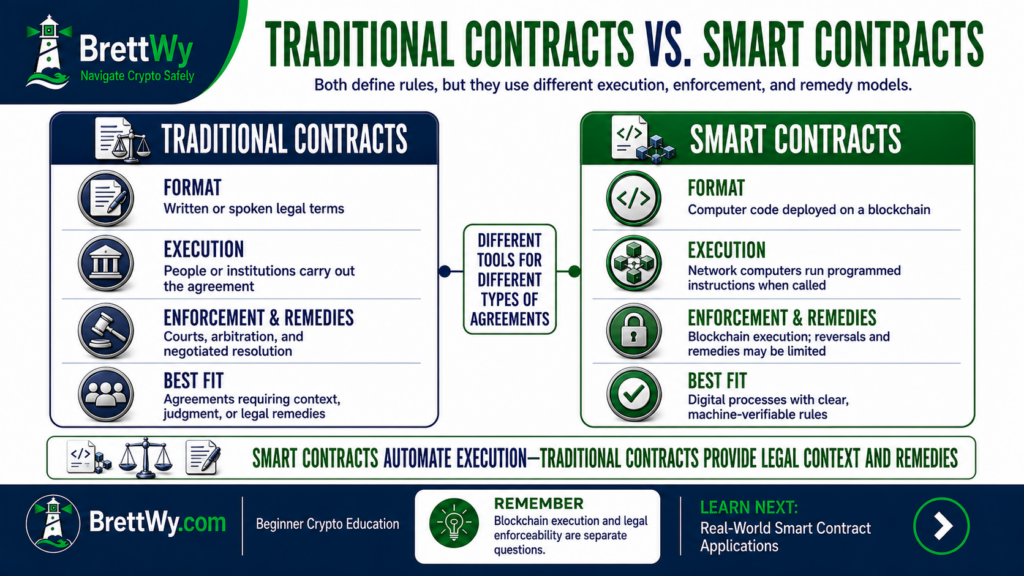
| Feature | Traditional Contract | Smart Contract |
|---|---|---|
| Primary format | Written legal language | Computer code on a blockchain |
| Execution | Usually manual or institution-managed | Automatic when programmed conditions are met |
| Enforcement | Legal systems, courts, or arbitration | Blockchain execution for programmed actions |
| Judgment | Can account for context and subjective interpretation | Best with objective, machine-verifiable rules |
| Modification | Can often be amended by agreement | May be immutable or controlled by an upgrade process |
| Transparency | Usually limited to relevant parties | Often publicly auditable on public blockchains |
| Availability | May depend on organizations and business hours | Blockchain networks generally run continuously |
| Best fit | Complex agreements requiring judgment or legal remedies | Digital processes with clear, objective conditions |
Are Smart Contracts Legally Binding?
Ultimately, whether a smart contract is legally enforceable depends on the jurisdiction, the parties, the subject matter, the agreement’s formation, and applicable law.
In some situations, code may automate part of a legally binding agreement. In others, the smart contract may operate only as software without satisfying every requirement of a legal contract.
For significant legal or financial obligations, consult a qualified professional in the relevant jurisdiction rather than assuming that blockchain execution provides complete legal protection.
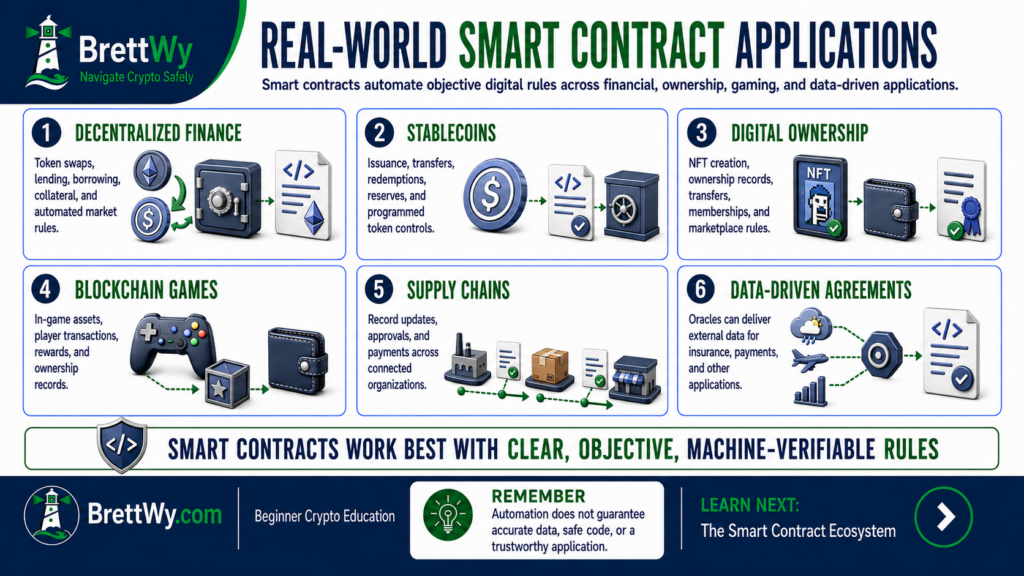
Real-World Uses of Smart Contracts
Decentralized Finance (DeFi)
DeFi applications use smart contracts to automate financial services such as token swaps, crypto-backed lending, borrowing, collateral management, and interest distribution.
DeFi can reduce reliance on traditional intermediaries, but it introduces smart-contract, liquidity, market, oracle, governance, and wallet risks.
For a closer look at these applications and their risks, read how DeFi uses smart contracts.
NFTs
Smart contracts can create NFTs, record ownership, transfer assets, and enforce programmed marketplace rules. Some contracts also include creator-payment instructions, although royalty enforcement depends on the contract and marketplace design.
Blockchain Gaming
Games can use smart contracts to issue digital items, record ownership, distribute rewards, and support player-to-player transactions.
Ownership of a blockchain token does not automatically guarantee that an item will retain usefulness inside a game. The developer still controls much of the game environment.
Stablecoins
Many stablecoins use smart contracts to issue, transfer, redeem, freeze, or manage tokens according to the system’s rules. The exact design varies widely, so users should understand what supports the token’s intended value.
Supply Chains
Organizations can use smart contracts to automate record updates, approvals, and payments as products move between manufacturers, shippers, warehouses, and retailers.
Blockchain records cannot guarantee that physical-world information is accurate when entered. Reliable data collection and accountable participants remain essential.
Insurance
A smart contract can automate a payout when an objective condition is confirmed. For example, a flight-delay policy could issue compensation after a trusted data source reports that a qualifying delay occurred.
Many insurance claims still require investigation and human judgment, making full automation inappropriate for every case.
Real Estate
Smart contracts may automate parts of escrow, payments, document workflows, or tokenized ownership systems. However, property transactions remain subject to legal, regulatory, identity, and government-record requirements.
Digital Identity
Blockchain-based identity systems may allow users to prove specific credentials without repeatedly sharing more personal information than necessary. These systems remain an evolving area with significant privacy, governance, and interoperability questions.
The Smart Contract Ecosystem
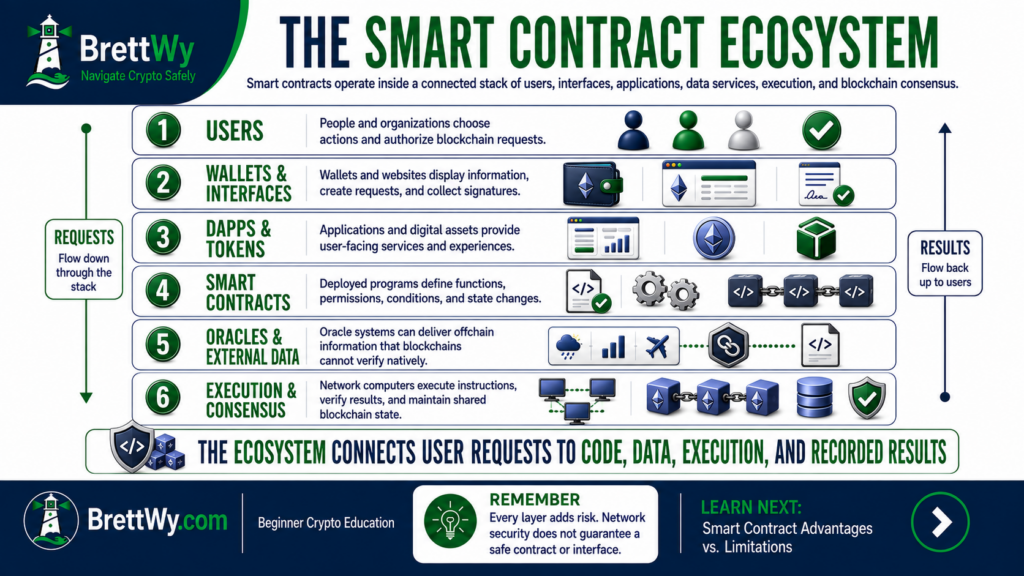
In practice, a smart contract does not operate in isolation. Users interact through wallets and application interfaces, while the contract depends on blockchain execution and may also depend on tokens, governance systems, or external data services.
Each layer has a different responsibility and risk profile. Therefore, evaluating an application requires more than reviewing its contract code alone.
For an example of how tokens fit into this ecosystem, explore how stablecoins use smart contracts and the risks associated with their different designs.
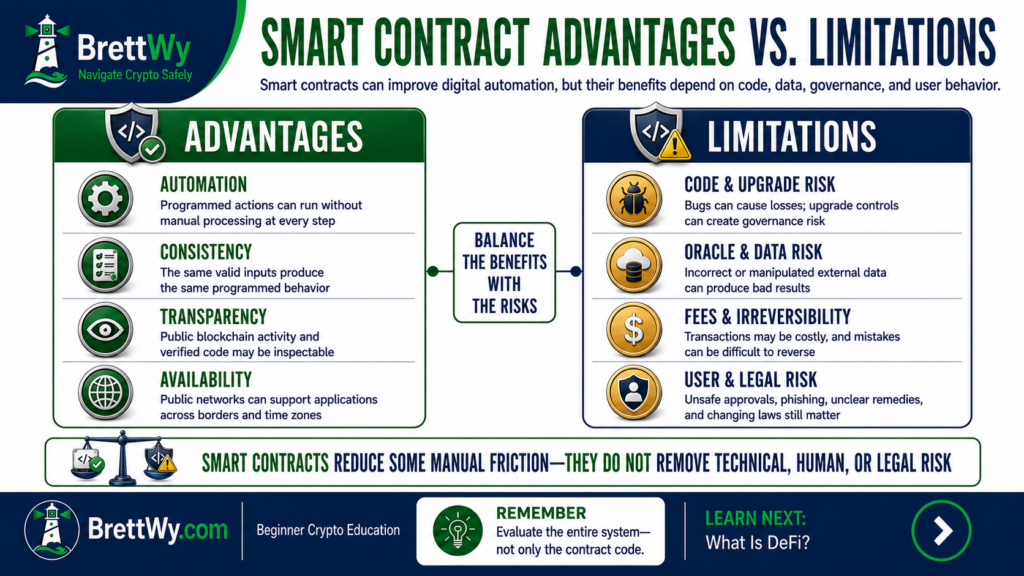
Benefits of Smart Contracts
Automation
For example, smart contracts automatically perform programmed actions after their conditions are met, reducing repetitive manual work.
Speed
Automation can reduce delays caused by paperwork, business hours, and multi-step approvals. Actual processing time depends on the blockchain and application.
Transparency
Public blockchains let users inspect transaction histories and contract activity. Transparency does not guarantee that every user can understand the underlying code.
Consistency
A contract applies the same programmed logic under the same conditions. However, consistent execution will also reproduce any mistake built into the code.
Reduced Reliance on Intermediaries
Smart contracts can let users transact directly with an application or protocol. This may simplify some processes, although legal, security, development, interface, data, and governance providers may still play important roles.
Global Availability
In addition, public blockchain networks generally operate continuously. Access can still be limited by local law, application restrictions, internet availability, network congestion, or wallet compatibility.
Limitations and Risks of Smart Contracts
Programming Bugs
Smart contracts execute their code as written. A mistake may freeze assets, enable unauthorized actions, or create unexpected outcomes.
Immutability and Upgrade Risk
For example, an immutable contract may be difficult to repair. An upgradeable contract may create a different risk if a small group controls the upgrade mechanism.
Dependence on Oracles
Blockchains cannot independently know internet prices, weather conditions, sports results, or other offchain facts. Smart contracts often rely on oracles to deliver external information.
If an oracle is inaccurate, delayed, manipulated, or unavailable, the contract may produce an incorrect result.
Network Fees
Likewise, transaction fees can make some interactions expensive, especially when a network is congested or the contract requires substantial computation.
User and Wallet Risk
Users can approve a malicious contract, sign the wrong transaction, visit a phishing website, or lose access to a wallet. Smart-contract security does not replace personal security.
Our Cryptocurrency Security guide explains smart-contract permissions and security risks in more detail.
Regulatory and Legal Uncertainty
The legal treatment of blockchain applications differs across jurisdictions and continues to evolve. A contract’s technical execution does not automatically settle questions of legal enforceability, consumer protection, taxation, or liability.
Smart Contracts Are Tools—Not Magic
Ultimately, a smart contract is software. Its effectiveness depends on the quality of its code, the security and decentralization of the underlying blockchain, the reliability of external data, the governance model, and the suitability of the use case.
Well-designed smart contracts can automate digital agreements efficiently. Poorly designed systems can introduce serious risks.
Common Misconceptions About Smart Contracts
Smart Contracts Are Artificial Intelligence
They are not. Smart contracts follow programmed logic and do not independently think or learn.
Smart Contracts Cannot Be Hacked
Blockchain networks may be resilient, but smart-contract code, upgrade mechanisms, interfaces, private keys, and connected systems can contain vulnerabilities.
Smart Contracts Eliminate All Risk
They can reduce some forms of manual and counterparty risk, but they introduce technical, governance, market, data, and user risks.
Every Blockchain Has the Same Smart-Contract Capabilities
Blockchain programmability varies. Bitcoin uses a deliberately limited scripting model, while Ethereum and other programmable networks support more general-purpose applications.
Beginner Safety Tips
- Use the official website: Avoid links from unsolicited messages, advertisements, and unknown social accounts.
- Confirm the network and contract: Impersonators can deploy look-alike tokens and applications.
- Read wallet prompts: Distinguish a simple connection request from a signature, token approval, or transaction.
- Limit token approvals: Avoid unlimited permissions unless they are necessary and you understand the trade-off.
- Start with a small amount: Test unfamiliar applications before placing significant assets at risk.
- Separate wallets by purpose: Consider using a lower-value wallet for new applications instead of exposing long-term holdings.
- Verify audits carefully: An audit can reduce risk, but it cannot guarantee that a contract is safe.
- Revoke unused permissions: Review old token approvals and remove access you no longer need.
Key Takeaways
- A smart contract is a blockchain-based program that executes predefined actions when it is called and its programmed conditions are satisfied.
- Smart contracts are not artificial intelligence and do not make independent judgments.
- Ethereum helped popularize general-purpose smart contracts and decentralized applications.
- Smart contracts power DeFi, NFTs, stablecoins, games, DAOs, and other blockchain applications.
- Benefits include automation, transparency, consistency, and continuous availability.
- Risks include code bugs, unsafe permissions, oracle failures, wallet mistakes, network fees, and regulatory uncertainty.
- Smart contracts are best suited to processes with clear, objective, machine-verifiable conditions.
Frequently Asked Questions
Do I need to know programming to use smart contracts?
No. Most users interact with smart contracts through websites, applications, and wallets. However, the user experience can hide important permissions and risks, so reviewing transaction details still matters.
Can a smart contract send cryptocurrency automatically?
Yes. A contract can transfer cryptocurrency or tokens when its programmed conditions and permissions allow it.
Can a smart contract hold cryptocurrency?
Yes. Many smart contracts can hold and manage digital assets. How those assets can be moved depends on the contract’s code.
Do smart contracts work only on Ethereum?
No. Ethereum popularized general-purpose smart contracts, but many other blockchain networks support programmable contracts.
Are smart contracts public?
Activity on a public blockchain is normally visible. The underlying source code may be published and verified, but that is not guaranteed for every contract.
Can a smart contract be stopped?
It depends on the design. Some contracts include pause controls or upgrade mechanisms. Others are designed to operate without an administrative stop function.
Can a smart contract make a mistake?
The software does not make a human-style judgment error, but its code can contain bugs or flawed assumptions that produce unintended results.
Can a smart contract be deleted?
Contract behavior varies by blockchain and design. Even when code can be disabled or a contract can no longer be used normally, historical blockchain records generally remain.
How can I view a smart-contract transaction?
You can search for a transaction hash, wallet address, or contract address using a block explorer such as Etherscan. Never assume that a contract is safe merely because it appears on a block explorer.
Do smart contracts cost money to use?
Usually. Most networks charge a transaction fee to process smart-contract activity. The fee structure depends on the blockchain.
Are smart contracts the future of business?
They are likely to become more useful for automating objective digital processes. They are unlikely to replace agreements that require negotiation, human judgment, legal remedies, or changing real-world circumstances.
Test Your Knowledge
- Is a smart contract a form of artificial intelligence?
- What normally triggers a smart contract to execute?
- Why might a smart contract need an oracle?
- Does automatic execution guarantee that a contract is safe?
- How does a smart contract differ from a traditional legal contract?
Check your answers
- No. It follows programmed logic and does not think or learn independently.
- A transaction or function call from a user, application, or another contract.
- An oracle can deliver external information that the blockchain cannot verify natively.
- No. Bugs, unsafe permissions, manipulated data, malicious interfaces, and user mistakes can still cause losses.
- A smart contract executes code automatically, while a traditional contract relies on legal interpretation, enforcement, and remedies.
Official Smart Contract Resources
- Introduction to Smart Contracts — Ethereum.org
- Anatomy of Smart Contracts — Ethereum.org
- Smart Contract Security — Ethereum.org
- Smart Contract Composability — Ethereum.org
- Blockchain Oracles — Chainlink
Final Thoughts
Understanding smart contracts gives you the foundation needed to explore DeFi, NFTs, stablecoins, DAOs, blockchain games, Web3, and many other parts of the crypto ecosystem.
The most important lesson is that automation does not remove the need for judgment. Before using a blockchain application, understand what the contract does, who controls it, what permissions you are granting, and what could go wrong.
You’ve Completed the Smart Contract Foundation
You now understand what smart contracts are, how blockchain networks execute them, where they are used, and why automation must be evaluated alongside code, data, governance, wallet, and legal risks.
Next, learn how decentralized finance combines smart contracts into financial applications for trading, lending, borrowing, stablecoins, and other services.
Crypto Fundamentals Path Progress: You have completed the smart-contract foundation. Next, see how contracts combine into decentralized financial applications.
LEARN NEXT
A beginner’s guide to decentralized financial applications, their uses, benefits, and risks.
Final BrettWy Lesson: Automatic execution proves that code ran according to its rules. It does not prove that the rules were fair, the data was accurate, the interface was honest, or the outcome was safe.
About This Content
BrettWy creates beginner-friendly cryptocurrency education with a focus on clear explanations, practical security, and understanding risk. Content is developed with AI assistance, and relevant sources are linked so readers can explore the underlying information.
Crypto products, services, and technical guidance can change. Check current information with the original source before taking action.
Found an error or outdated information? Email info@brettwy.com with the article URL and the detail you believe needs attention. Never include passwords, private keys, or recovery phrases.
Educational and Risk Disclaimer
BrettWy provides this article for general educational and informational purposes only. It does not constitute financial, investment, legal, tax, accounting, cybersecurity, software-development, or other professional advice.
Smart contracts, tokens, wallets, oracles, bridges, decentralized applications, and blockchain transactions involve significant risks, including software vulnerabilities, malicious permissions, inaccurate data, governance failures, scams, irreversible mistakes, changing laws, and permanent financial loss.
No audit, interface, blockchain, security method, or automated system can eliminate every risk or guarantee a financial or legal result. Verify current information through official sources and consult qualified professionals when appropriate.