Article Snapshot
Crypto Fundamentals Learning Path
In This Guide, You’ll Learn
- •What Web3 means in plain English
- •How Web1, Web2, and Web3 compare
- •How blockchains, wallets, smart contracts, and tokens fit together
- •How someone interacts with a Web3 application
- •What decentralized applications are and how they work
- •Which benefits, limitations, and security risks matter
- •How to evaluate a Web3 project before interacting
- •Which common beginner mistakes to avoid
Introduction
The internet has changed dramatically since the first websites appeared. At first, websites mostly allowed people to read information. Later, social networks, online marketplaces, streaming services, and cloud applications made it possible to create content and interact online.
However, most of today’s internet services are controlled by companies. As a result, these companies usually manage the platform, store user data, set the rules, and control access to accounts. Web3 proposes a different approach.
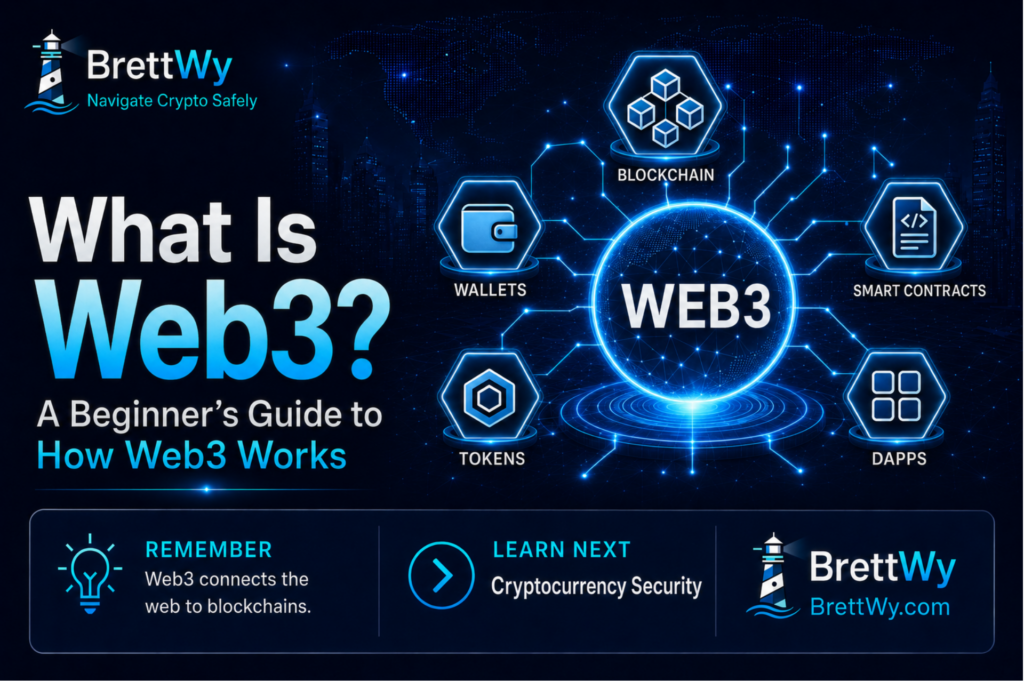
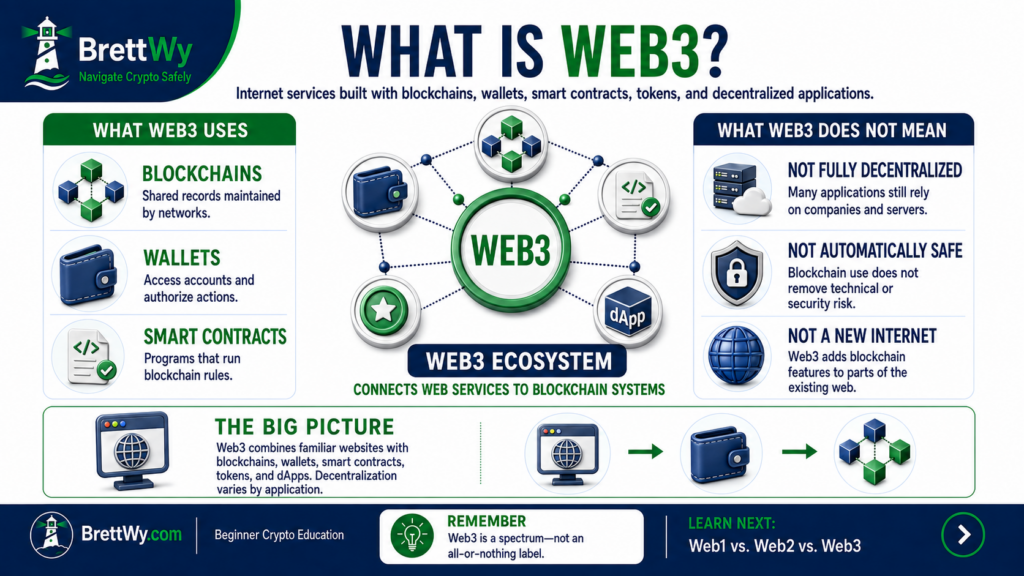
Web3 is a broad term for internet services that use technologies such as blockchains, crypto wallets, smart contracts, tokens, and decentralized applications.
Instead of relying entirely on one company’s private database, a Web3 service may use a blockchain to record transactions, manage digital assets, or execute parts of an application. In addition, a wallet can act as a way to access an application and authorize actions.
However, Web3 does not mean every part of an application is decentralized. For example, a service may still depend on a company-operated website, centralized servers, cloud providers, outside data services, or a small development team. Therefore, it is more accurate to think of decentralization as a spectrum rather than an on-or-off switch.
The BrettWy Web3 Framework
Use this five-part model to understand how a Web3 application works and where control or risk may remain:
- Network: Which blockchain records transactions, and what fees, capacity, and confirmation rules apply?
- Access: Which wallet, account, or identity method lets users enter and authorize actions?
- Rules: Which smart contracts or software control the application, and can anyone upgrade or pause them?
- Assets: Which tokens or digital items are involved, and what rights or utility do they actually provide?
- Control: Which parts remain centralized across the website, storage, administrators, governance, data, and treasury?
Table of Contents
What Is Web3?
Web3 is an idea for building internet services in which blockchains and related technologies perform some of the roles normally handled by centralized platforms. For instance, these services may let people hold digital assets in their own wallets, use smart contracts, prove control of an account with cryptography, and interact with blockchain-based communities or applications.
The World Wide Web Consortium has described Web3 as a collection of technology connecting the web to blockchains. This definition is useful because Web3 is not one blockchain, application, company, or official standard.
A Simple Web3 Analogy
For example, imagine an online arcade. In a traditional version, the company controls your account, points, purchases, and digital items. Consequently, if it closes your account or shuts down the game, you may lose access to everything stored inside it.
By contrast, a Web3-style arcade could let you hold certain digital items in your own wallet while a blockchain records which address controls each item. In theory, this could make an item easier to transfer or use with another compatible service. However, the token cannot force another game to accept the item or guarantee that the connected website, artwork, or game will remain available.
What Does “Web3” Mean?
- Decentralized infrastructure: a service may use a blockchain or peer-to-peer network instead of one company-controlled database.
- User-controlled digital assets: users may hold tokens in their own wallets and authorize transactions involving them.
- Programmable online agreements: smart contracts can perform actions when their coded conditions are met.
Web1, Web2, and Web3 Compared
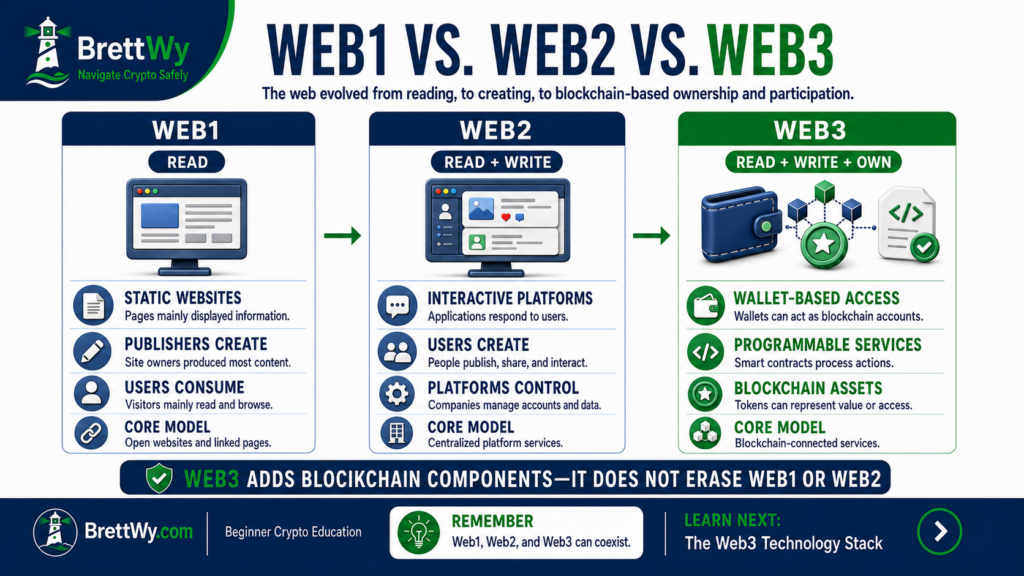
| Web stage | Simplified description | Typical user role | Who usually controls the service? |
|---|---|---|---|
| Web1 | Read information | Consumer | Website owners and publishers |
| Web2 | Read, create, and interact | Consumer and creator | Technology platforms |
| Web3 | Read, create, interact, and use blockchain-based assets or services | User, creator, asset holder, or participant | Varies by application and level of decentralization |
Although this comparison is helpful, it is not a strict historical timeline. For example, Web1 did not disappear when social media arrived. Likewise, Web3 is not replacing the entire modern internet. Instead, a Web3 application may combine a traditional website and cloud servers with a wallet, smart contracts, and blockchain-recorded assets.
How Does Web3 Work?
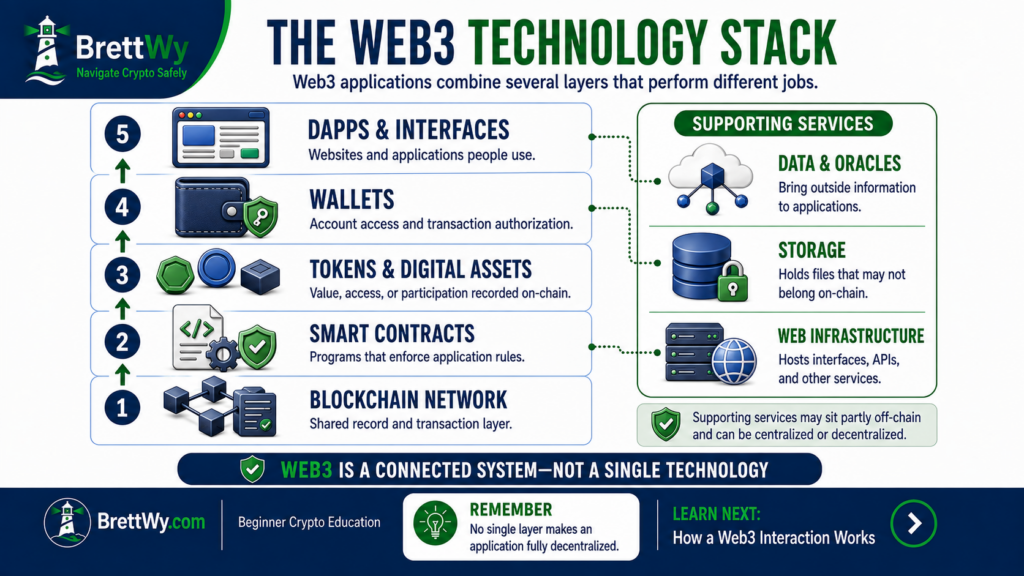
Web3 combines several technologies. First, a blockchain stores and verifies records. Next, a wallet manages the keys needed to authorize actions. Meanwhile, smart contracts provide application rules. Tokens can represent value, access, ownership, or participation. Finally, a decentralized application brings these components together through a website or mobile interface.
1. Blockchains Provide the Shared Record
A blockchain acts as Web3’s shared recordkeeping and transaction layer. Depending on the application, for example, it might record token balances, asset ownership, transfers, smart contract activity, governance votes, or digital credentials.
2. Crypto Wallets Provide Access and Authorization
A wallet helps a user view blockchain assets, connect to compatible applications, create digital signatures, and submit approved transactions. In other words, the blockchain records the assets associated with the public address, while the wallet manages the keys that control it. Accordingly, Ethereum’s wallet documentation describes a wallet as a tool for interacting with an account rather than a container holding the assets themselves.
For a closer look at keys, signatures, and permissions, read how wallets authorize Web3 actions.
| Wallet action | What it generally does | Does it move assets? |
|---|---|---|
| Connect wallet | Lets the application view the connected public address and request interactions | Usually no |
| Sign a message | Uses a digital signature to prove control of an address or approve a stated message | Usually no, but the request still requires review |
| Approve or send a transaction | Authorizes an action that changes blockchain records | It can |
3. Smart Contracts Provide the Rules
Smart contracts are programs stored and executed through a blockchain. For example, they can transfer tokens, record votes, issue digital items, check conditions, or distribute funds according to programmed rules. However, they can contain errors, hidden privileges, upgrade mechanisms, or vulnerabilities.
4. Tokens Represent Digital Value or Rights
Tokens may represent a transferable unit of value, application access, voting power, a unique digital item, membership, or a stablecoin. Nevertheless, not every application needs its own token, and creating one does not automatically make a product useful or decentralized.
5. Decentralized Applications Create the User Experience
A decentralized application, or dApp, uses smart contracts or decentralized networks for at least part of its operation. Although it may look like an ordinary website, selected requests are sent to blockchain-based smart contracts rather than handled entirely by one private database.
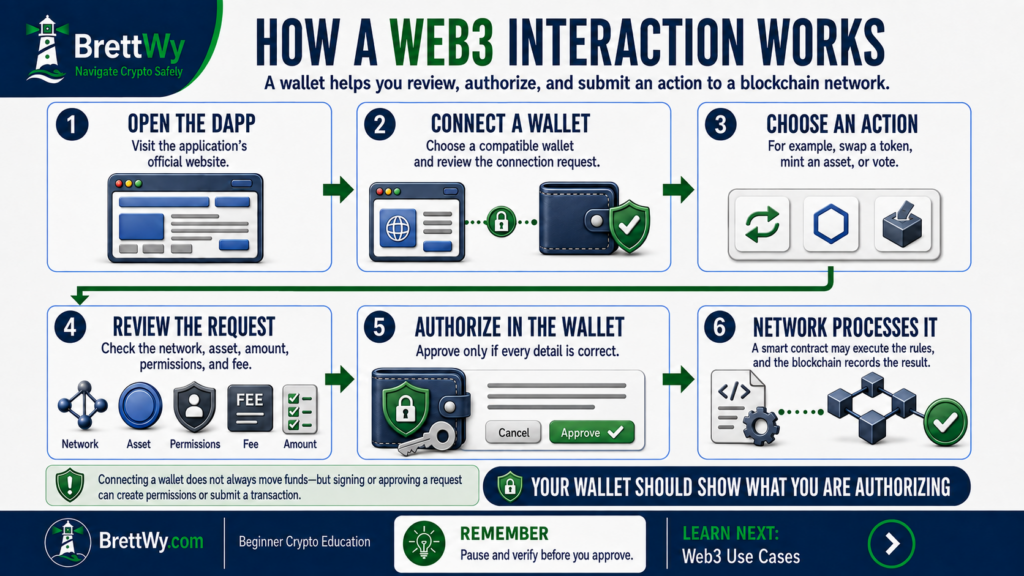
How a Web3 Interaction Works
- The user visits the application. Its visible interface may operate like a normal website.
- The user connects a wallet. The application can usually see the public address and publicly available activity associated with it.
- The application reads blockchain data. It may display balances, history, owned assets, permissions, or network information.
- The user requests an action. The application prepares a proposed transaction.
- The wallet creates a digital signature. If approved, the signature proves the action was authorized by the account’s controlling key.
- The transaction reaches the network. Network participants check that it follows the protocol’s rules.
- The smart contract executes. If its conditions are satisfied, it processes the request.
- The blockchain records the result. The application reads the updated blockchain state and refreshes its interface.
Why Do Web3 Transactions Require Fees?
Because blockchain networks have limited processing capacity, users may pay a network fee to compensate the network for validating and processing transactions. In particular, the cost can depend on network demand, transaction complexity, and the amount of computation required. In addition, an application may charge a separate fee.
Which Parts Are On-Chain and Off-Chain?
| On-chain components may include | Off-chain components may include |
|---|---|
| Token ownership, transaction records, smart contract code, governance results, asset transfers, and selected rules | Website design, large media files, search, notifications, private information, analytics, customer support, and high-volume data |
Although this combination can improve speed and reduce costs, it also creates centralized dependencies. For example, a token’s ownership record may remain on a blockchain while its image, website, or service depends on an outside provider.
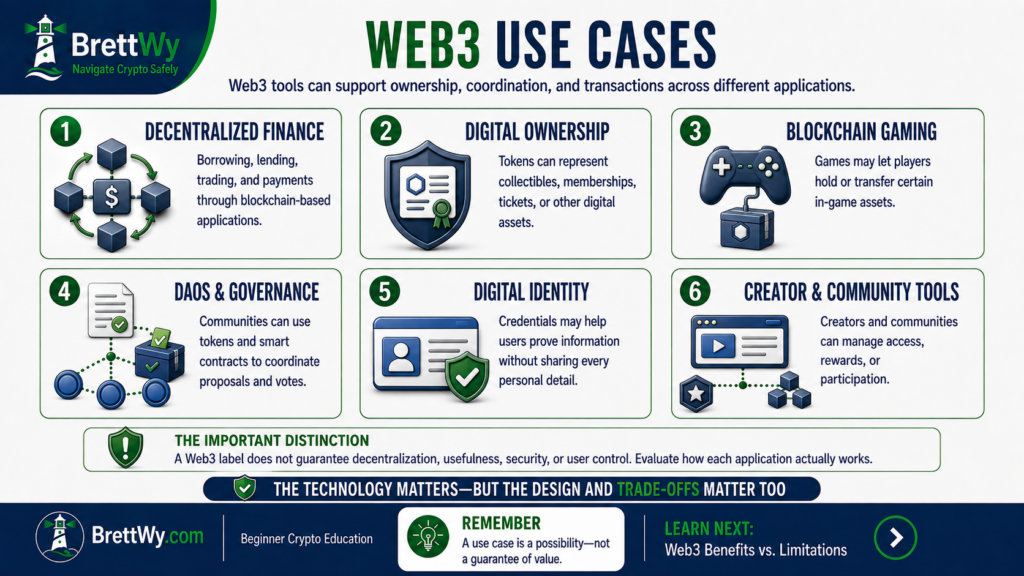
What Is Web3 Used For?
Web3 applications span finance, payments, digital ownership, identity, communities, publishing, gaming, and record verification. However, while some already have active users, others remain experimental.
1. Decentralized Finance
Decentralized finance, or DeFi, uses smart contracts to provide blockchain-based financial services. For example, applications may enable token exchanges, lending, borrowing, liquidity, or portfolio management. As a result, DeFi demonstrates wallet-based access, smart contract automation, transparent records, and composability—the ability of compatible applications to connect. However, interconnected services can also spread risk.
2. Stablecoin Payments
Stablecoins can transfer relatively steady digital value between compatible wallets and applications. Therefore, they may support payments, settlement, and DeFi activity. Even so, they still carry issuer, reserve, smart contract, network, regulatory, and depegging risks.
3. Digital Ownership and NFTs
Non-fungible tokens, or NFTs, can represent distinguishable digital items such as artwork, membership passes, game items, certificates, or tickets. In this case, the blockchain can record which address controls the token. However, token ownership does not automatically include copyright, trademark rights, the original file, commercial rights, or permanent access to a service.
4. Decentralized Identity
Decentralized identity systems explore whether people can control selected identifiers or credentials without relying entirely on one identity provider. For instance, the W3C Decentralized Identifiers standard describes identifiers whose controllers can prove control using cryptography. Yet blockchain verification cannot guarantee that the original claim was truthful.
5. Decentralized Autonomous Organizations
A DAO is a blockchain-connected group that uses smart contracts and digital voting tools to coordinate certain decisions. Nevertheless, people still write proposals, develop software, manage communication, and resolve disagreements. Moreover, token-based voting can concentrate influence among large holders.
6. Creator, Social, and Gaming Applications
For example, creators may use tokens for membership or access. Likewise, social protocols may help users carry selected profiles or relationships between compatible interfaces. Meanwhile, games may represent items as tokens. In every case, portability requires technical support from other applications; a token cannot force an unrelated service to recognize it.
7. Public Records and Credentials
Finally, organizations can use blockchains to timestamp or verify selected records, credentials, product histories, or document fingerprints. However, sensitive information should not be placed directly on a permanent public blockchain without careful privacy protections.
| Use case | Main purpose | Important limitation |
|---|---|---|
| DeFi | Blockchain-based financial services | Contract, market, and liquidity risks |
| Stablecoin payments | Transfer relatively stable digital value | Issuer, reserve, network, and depegging risks |
| Digital ownership | Record control of unique tokens | Token ownership may not include legal or media rights |
| Decentralized identity | Control and present credentials | Privacy, recovery, acceptance, and data-quality challenges |
| DAOs | Coordinate groups and shared resources | Unequal voting power and human governance problems |
| Social and gaming | Portable profiles or digital items | No guarantee of compatibility or continued usefulness |
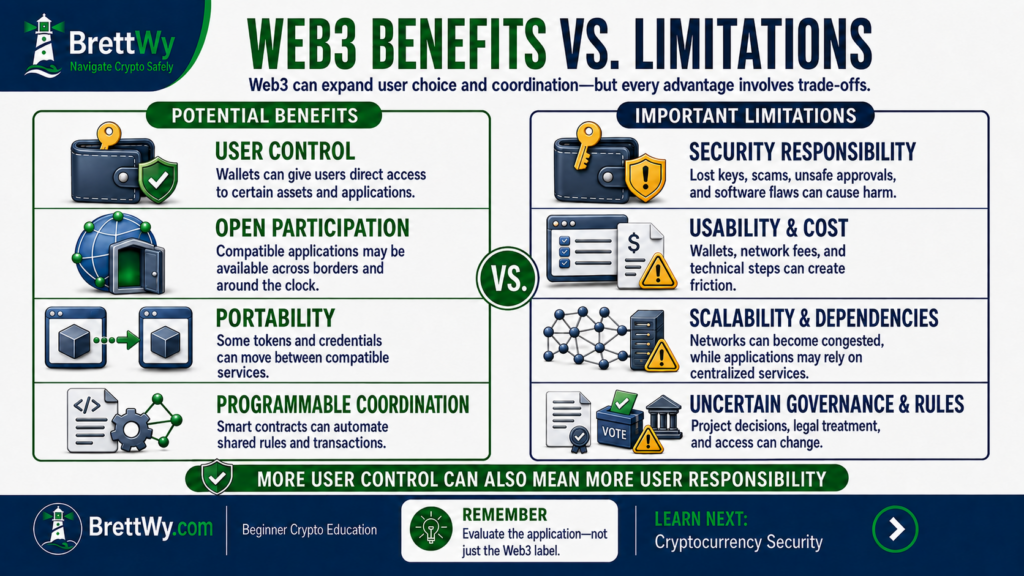
Potential Benefits of Web3
- Greater asset control: users may hold and transfer certain blockchain assets through their own wallets.
- Open access: public smart contracts may be available to anyone with compatible tools, though practical or legal restrictions can remain.
- Transparency: public blockchains can expose token supplies, transactions, votes, and contract activity.
- Portability: accounts and assets may work across compatible applications.
- Programmable transactions: smart contracts can automate predefined rules.
- Reduced platform dependence: some components may remain available through alternative interfaces.
| Proposed benefit | What it can provide | What it does not guarantee |
|---|---|---|
| Ownership | Direct control of certain blockchain assets | Copyright, permanent value, or continued usefulness |
| Open access | Wallet-based access to public smart contracts | Legal availability, affordability, or ease of use |
| Transparency | Publicly inspectable records | Safe code or understandable risks |
| Portability | Assets usable across compatible applications | Universal acceptance |
| Automation | Rules executed through smart contracts | Fair, accurate, or error-free rules |
| Decentralization | Control distributed among participants | Elimination of all centralized dependencies |
Limitations and Criticisms of Web3
Web3 Can Be Difficult to Use
For example, users may need to understand wallets, recovery phrases, addresses, networks, fees, approvals, and confirmations. Consequently, a small mistake can have serious consequences.
Users Carry More Responsibility
Although self-custody can reduce dependence on a company, no central provider may be able to restore access after the relevant keys or recovery information are lost.
Cost and Capacity
In addition, blockchain transactions can cost money, and public networks have limited capacity. Therefore, not every website action needs blockchain-level verification, particularly when a conventional database would be faster, cheaper, and more private.
Public Records Can Reduce Privacy
Furthermore, public addresses are pseudonymous, not necessarily anonymous. For instance, transaction histories can sometimes be connected with information from exchanges, websites, social profiles, or previous payments.
Centralized Dependencies Remain
Likewise, an application may depend on centralized hosting, domain names, administrator keys, development teams, data providers, and token ownership. Although centralized components may improve performance or emergency response, projects should explain them honestly.
Governance, Regulation, and Speculation
Additionally, token voting can concentrate power among large holders. Meanwhile, laws vary across jurisdictions. Tokens can also shift attention from a product’s usefulness to its price. For this reason, the Federal Trade Commission warns that fraudulent projects may use polished websites, advertisements, and fake tokens to appear legitimate.
Web3 Security Risks
Phishing Websites
For example, a phishing site may copy a legitimate application to persuade someone to reveal recovery information, approve a malicious request, send assets, or download harmful software. Therefore, CISA recommends treating unexpected messages and links cautiously and verifying requests independently.
Malicious Signatures, Transactions, and Token Approvals
Similarly, an unclear wallet prompt could authorize a transfer, token-spending permission, or malicious contract interaction. Because some approvals remain active until revoked, Ethereum provides official guidance for reviewing and revoking token access.
Smart Contract and Administrative-Key Risk
Moreover, smart contracts may contain vulnerabilities. Some also give administrators power to pause a protocol, upgrade contracts, change settings, or control treasury assets. Although these features can support emergency response, they also create concentrated authority and potential points of failure.
Fake Tokens, False Support, and Recovery Scams
In addition, an unexpected token may direct its recipient to a malicious website. Scammers may also impersonate wallet providers, projects, exchanges, or recovery services. Regardless of the story, legitimate support never needs a wallet’s recovery phrase or private key.
For a broader safety framework, continue with our guide to cryptocurrency security and scam prevention.
How to Evaluate a Web3 Project
- Identify the actual product. What problem does it solve, and why does it need a blockchain?
- Identify what is decentralized. Evaluate the blockchain, contracts, website, storage, governance, treasury, and upgrades separately.
- Identify who has control. Determine who controls administrator keys, upgrades, token supply, and voting power.
- Understand the token. Ask what it does, whether it is necessary, how it was distributed, and what rights it provides.
- Review the risks. Look for clear disclosures about contract, market, liquidity, governance, privacy, network, and regulatory risks.
- Verify claims independently. Do not rely only on a project’s website, influencers, social activity, or branding.
- Avoid urgency. Step away from unexpected rewards, guaranteed returns, demands for immediate action, or requests for recovery information.
Common Web3 Mistakes Beginners Make
- Assuming Web3 means fully decentralized: evaluate every layer separately.
- Treating wallet connections as routine: review each later signature and transaction request independently.
- Confusing a token with company ownership: identify its exact documented function and rights.
- Believing blockchain activity is private: assume public activity may eventually be connected.
- Trusting a project only because it was audited: an audit reduces uncertainty but cannot remove every vulnerability.
- Interacting with unexpected tokens: do not follow instructions embedded in unsolicited assets.
- Approving unclear requests: reject them and investigate independently.
- Treating Web3 as an investment category: judge the technology by usefulness, structure, control, and risk.
Key Takeaways
- Web3 is a broad term for internet services built around blockchains, wallets, smart contracts, tokens, and decentralized applications.
- It is not one blockchain, company, or official replacement for today’s web.
- Web3 applications often combine traditional websites with blockchain-based components.
- Connecting a wallet, signing a message, and approving a transaction are different actions.
- Web3 can support finance, payments, ownership, identity, communities, social applications, and gaming.
- Not every Web3 application is fully decentralized.
- Blockchain ownership does not automatically include copyright, permanent access, or guaranteed value.
- Public records can improve transparency while creating privacy concerns.
- Smart contracts execute code; they do not determine whether that code is safe or fair.
- Greater control can mean fewer recovery options after mistakes.
- Web3 should be judged by the problems it solves—not by the terminology used to market it.
Frequently Asked Questions About Web3
Is Web3 the same as cryptocurrency?
No. Cryptocurrency is one component of many Web3 systems. Web3 also includes wallets, smart contracts, decentralized applications, digital identity, governance, and blockchain-based assets.
Is Web3 the same as blockchain?
No. A blockchain is one technology Web3 applications may use. Web3 describes the broader ecosystem of blockchain-connected services.
Is Web3 the same as Web 3.0?
The terms are sometimes used interchangeably. However, “Web 3.0” has also referred to the Semantic Web, an earlier concept involving connected, machine-readable data.
Does Web3 replace Web2?
No. Most Web3 applications still use websites, interfaces, APIs, and cloud infrastructure associated with the modern web.
Is Web3 fully decentralized?
Not necessarily. An application may decentralize transactions while keeping its website, data, administration, or development centralized.
Do you need cryptocurrency to use Web3?
Many applications require a network’s native asset to pay transaction fees. Other services may cover fees or hide blockchain complexity from the user.
Do you need a crypto wallet to use Web3?
Most blockchain applications use wallets for account access and transaction approval, although newer applications may offer different sign-in and recovery experiences.
Is connecting a wallet dangerous?
Connecting usually exposes a public address rather than a private key. However, the application may present later requests that create permissions or authorize transactions.
Can a Web3 application need your recovery phrase?
No legitimate application needs a recovery phrase or private key. Anyone requesting either should be treated as attempting to take control of the wallet.
Are Web3 transactions reversible?
Usually not after confirmation. An application may have its own dispute features, but the underlying blockchain transaction generally cannot simply be reversed.
Are Web3 applications free?
Viewing public information may be free. Actions that change blockchain records often require a network fee, and applications may charge separate fees.
Are all dApps open source?
No. A dApp may use public smart contracts while keeping other code private. Open-source code is not automatically safe code.
What is a Web3 token?
It is a blockchain-recorded digital asset that may represent value, access, voting power, membership, or a unique item. Its exact function depends on its design.
Is an NFT proof that you own an image?
An NFT can show control of a blockchain token connected to an image. It does not automatically grant copyright or other legal rights to the image.
Can Web3 protect privacy?
Some technologies support privacy or user-controlled credentials. However, public blockchains can also expose permanent transaction histories.
Can Web3 exist without tokens?
Yes. A blockchain application does not always need a unique token. Tokens should serve a clear function rather than exist only for fundraising or speculation.
Who controls Web3?
No single organization controls all of Web3. Individual blockchains, applications, websites, tokens, and governance systems have different control structures.
Is Web3 safe?
Web3 is not automatically safe or unsafe. Risk depends on the wallet, website, smart contracts, permissions, blockchain, project team, and user decisions involved.
What is the biggest Web3 risk for beginners?
One major risk is approving a wallet request without understanding what it authorizes. Phishing, malicious contracts, false support, and lost recovery information are also significant risks.
What is the simplest definition of Web3?
Web3 is a term for internet applications that use blockchains, wallets, smart contracts, and tokens to provide digital services, transactions, or ownership.
Test Your Knowledge
- What is Web3?
- What role does a crypto wallet play in a Web3 application?
- Does connecting a wallet normally send a blockchain transaction?
- Does owning an NFT automatically grant copyright?
- What should you do when a wallet request is unclear?
Check your answers
- A broad category of internet services that use blockchains and related technologies.
- It helps a user access an account and authorize actions.
- No. A connection normally shares an address; a later signature or transaction request authorizes an action.
- No. Copyright or licensing rights depend on separate legal terms.
- Reject it, leave the page, and verify the website and requested action independently.
Official and Educational Resources
- What Is Web3? — Ethereum.org
- Ethereum Wallets — Ethereum.org
- Ethereum Applications — Ethereum.org
- Security and Scam Prevention — Ethereum.org
- Decentralized Identifiers — W3C
- What to Know About Cryptocurrency and Scams — FTC
- Recognize and Report Phishing — CISA
Related BrettWy Articles
- The Complete Beginner’s Guide to Cryptocurrency
- What Is Blockchain?
- What Is Ethereum?
- What Are Smart Contracts?
- What Is DeFi?
- Crypto Wallets Explained
- What Are Stablecoins?
Final Thoughts
In summary, Web3 connects familiar internet interfaces with blockchains, wallets, smart contracts, tokens, and decentralized applications. This combination can give users more direct control over certain assets and online actions.
However, Web3 does not eliminate companies, administrators, security failures, legal limits, or human mistakes. Beginners should evaluate what is truly decentralized, identify who retains control, understand every wallet request, and verify claims through reliable sources.
The Most Important Lesson — A blockchain connection can change how an application works, but it does not automatically make the application safe, decentralized, private, or trustworthy.
You’ve Completed the Web3 Foundation
You now understand how blockchains, wallets, smart contracts, tokens, and decentralized applications fit together—and why every Web3 service requires a separate review of control, usefulness, and risk.
Crypto Fundamentals Path Progress: You have completed the Web3 foundation. Next, learn how to protect wallets, accounts, devices, recovery information, and digital assets.
LEARN NEXT
Learn how to recognize scams, protect recovery information, review wallet requests, strengthen accounts and devices, and reduce avoidable crypto risks.
Final BrettWy Lesson: Greater control is valuable only when it is paired with careful verification, strong security habits, and a clear understanding of what each action authorizes.
About This Content
BrettWy creates beginner-friendly cryptocurrency education with a focus on clear explanations, practical security, and understanding risk. Content is developed with AI assistance, and relevant sources are linked so readers can explore the underlying information.
Crypto products, services, and technical guidance can change. Check current information with the original source before taking action.
Found an error or outdated information? Email info@brettwy.com with the article URL and the detail you believe needs attention. Never include passwords, private keys, or recovery phrases.
Educational and Risk Disclaimer
For clarity, BrettWy provides this article for general educational and informational purposes only. It does not constitute financial, investment, legal, tax, accounting, cybersecurity, or other professional advice.
In addition, Web3 applications, wallets, smart contracts, tokens, blockchain transactions, bridges, websites, and decentralized protocols involve significant risks. These risks include scams, malicious approvals, software failures, administrative control, privacy loss, irreversible mistakes, and permanent financial loss.
Finally, no audit, blockchain, wallet, smart contract, decentralization claim, or security method can eliminate every risk or guarantee a result. Verify current information through official sources and consult qualified professionals when appropriate.