
Article Snapshot
Crypto Fundamentals Learning Path
In This Guide, You’ll Learn
- •What a stablecoin is and why stablecoins were created
- •What “pegged” means and how stabilization mechanisms support a peg
- •How fiat-backed, crypto-backed, commodity-backed, and algorithmic designs differ
- •How minting, redemption, collateral, liquidity, and arbitrage connect
- •How stablecoins work across wallets, exchanges, payments, and DeFi
- •Why stablecoins can depeg and which risks beginners should evaluate
- •How stablecoins differ from bank deposits, Bitcoin, and CBDCs
- •How to evaluate a stablecoin before using it
Introduction
Cryptocurrencies such as Bitcoin and Ether can change significantly in price. As a result, that volatility creates a practical problem when someone needs to price, send, or receive a predictable amount of value.
Developers created stablecoins to address that problem. In most cases, these tokens attempt to track the U.S. dollar, meaning one token aims to remain worth approximately $1. Consequently, people can move them between compatible wallets, trade them on exchanges, and use them with decentralized applications.
However, stablecoins introduce their own risks. Their value can depend on reserve assets, collateral, smart contracts, market incentives, redemption systems, and confidence. Understanding a stablecoin therefore requires more than checking whether its price currently says $1.
Important: Most stablecoins are different from money held in an insured bank account. The word “stable” describes the design—not a guarantee.
The BrettWy Stablecoin Framework
Use this five-part model to evaluate how a stablecoin is designed and where its risks may appear:
- Reference: Which currency, commodity, or other asset is the token designed to track?
- Backing: What reserves, collateral, or market mechanism is intended to support the peg?
- Redemption: Who can exchange the token for the reference asset, and under which terms?
- Network: Which blockchain, token contract, wallets, and fee assets are involved?
- Risk: What could fail across the issuer, reserves, collateral, software, liquidity, custody, or regulation?
Table of Contents
What Are Stablecoins?
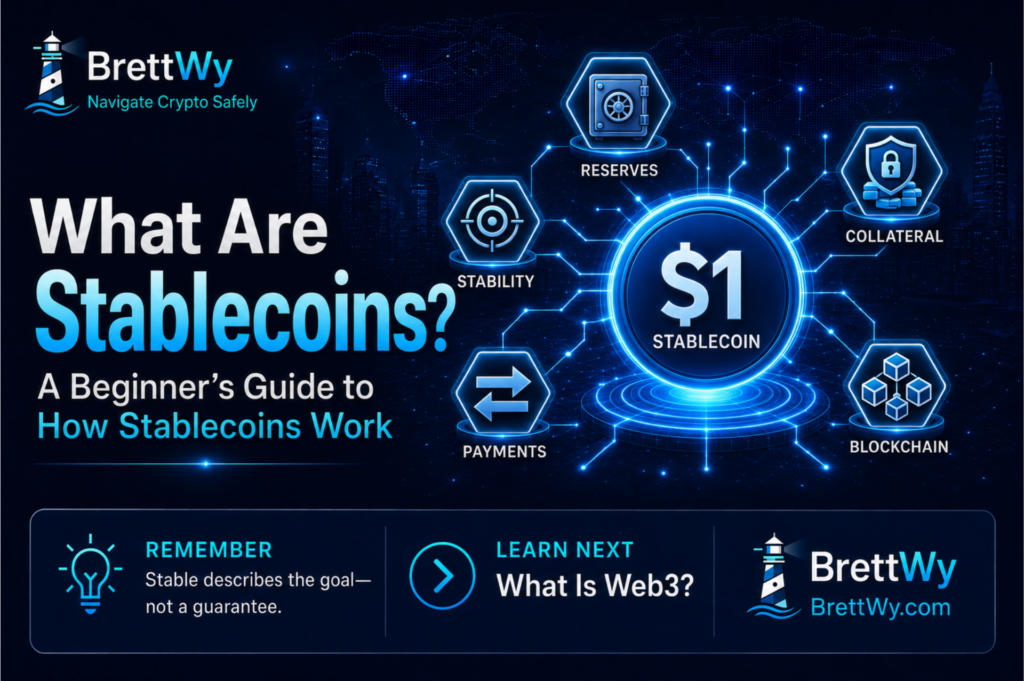
In simple terms, a stablecoin is a crypto asset that aims to track the value of another asset. For example, most track a government-issued currency such as the U.S. dollar, although some track euros, commodities, or other reference assets.
The word peg refers to the target value. A dollar-pegged stablecoin normally aims for $1. However, its price may still move slightly above or below that amount as people trade it. A working stabilization system should encourage the price to return.
A Simple Analogy
For comparison, imagine an arcade that issues one digital credit for each dollar received. Customers can then transfer credits, while eligible users can return them for dollars. In this example, confidence depends on the arcade holding enough assets, honoring redemptions, and keeping accurate records. Stablecoins use different legal and technical structures, but the analogy still shows why the displayed price is only part of the story.
Stablecoins Are Crypto Assets
In addition, stablecoins usually exist as tokens on blockchain networks. Wallets manage the credentials used to authorize transfers, while token contracts can govern balances, minting, burning, transfers, and—in some centrally issued designs—address restrictions.
Stablecoins Are Not All the Same
More importantly, the category includes different issuers, reserves, collateral, blockchains, redemption rules, governance systems, and risk profiles. Therefore, conclusions about one token may not apply to another.
BrettWy Beginner Principle — Do not evaluate a stablecoin by its name or current price alone. Identify the issuer, backing mechanism, redemption process, network, and major risks.
Why Were Stablecoins Created?
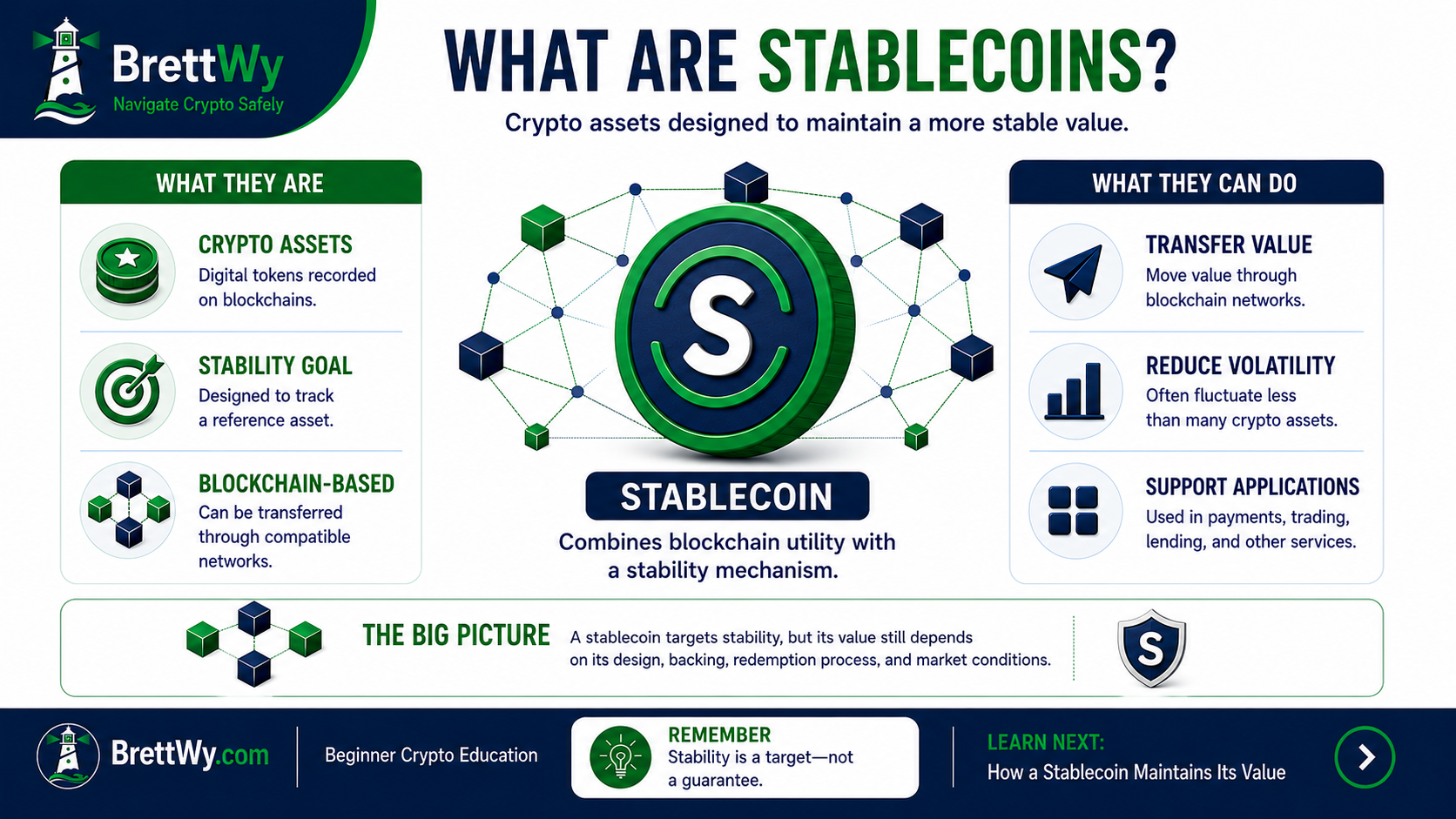
In practice, stablecoins provide a steadier unit of value inside crypto markets and blockchain applications. For instance, a volatile asset might be worth noticeably more or less by the time a recipient uses a $50 transfer. By comparison, a dollar-pegged stablecoin tries to make the short-term value more predictable.
In addition, they let users move a dollar-referenced token among compatible exchanges, wallets, and decentralized applications without returning to a traditional bank transfer for every transaction. In DeFi, stablecoins may serve as trading assets, collateral, borrowed assets, or settlement units.
However, a stable unit does not simplify every part of the system. Using a stablecoin in DeFi adds protocol, smart-contract, liquidity, network, and wallet risks to the stablecoin’s own risks.
How Do Stablecoins Work?
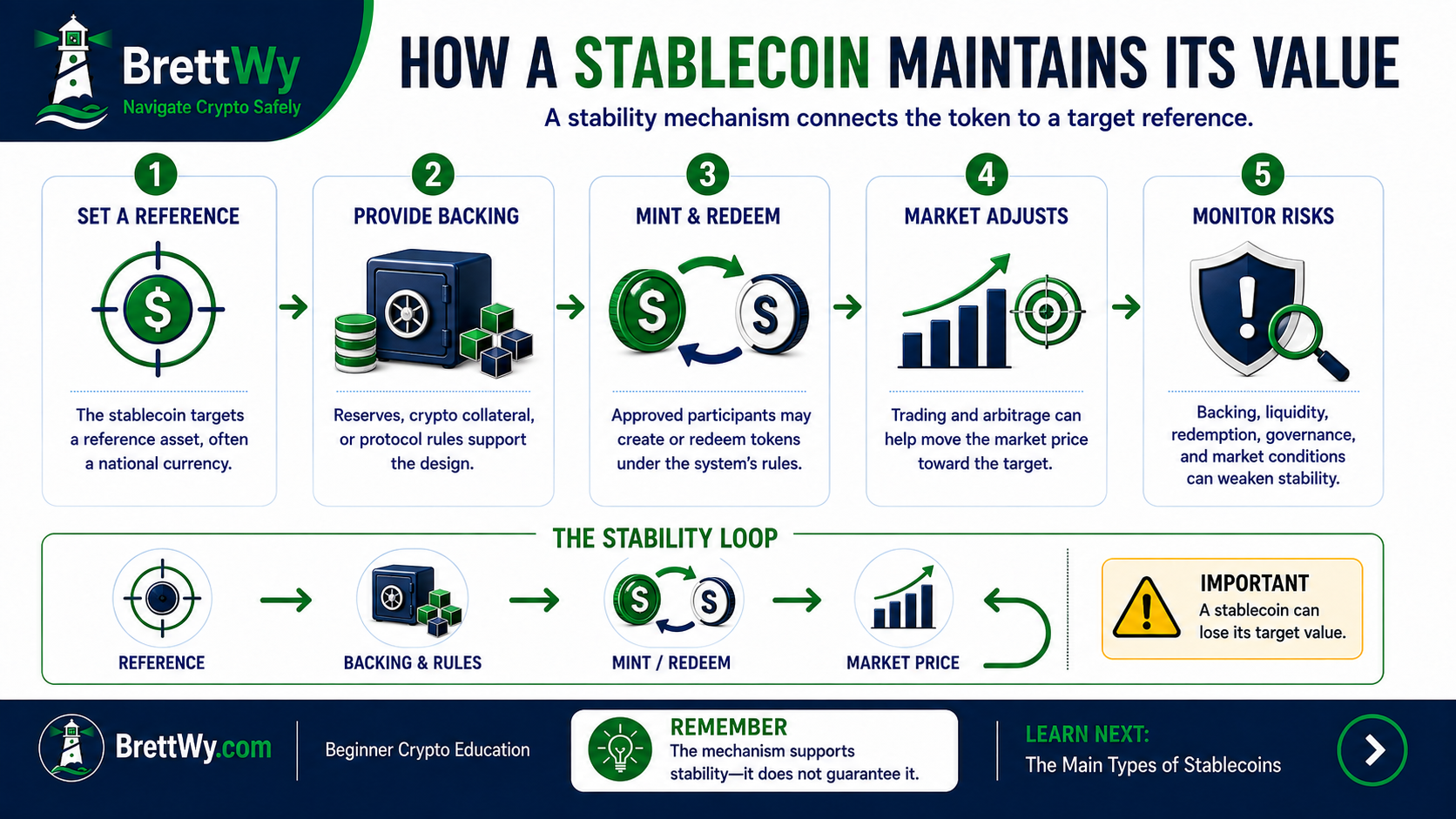
Depending on the design, stablecoins use reserves, collateral, software rules, market incentives, or a combination of these methods to keep their price near a target.
A Fiat-Backed Example
- An eligible customer provides money to the issuer.
- Next, the issuer creates, or mints, an equivalent amount of stablecoin tokens.
- Afterward, the customer receives the tokens on a supported platform or blockchain.
- Finally, the tokens circulate among users.
- An eligible holder returns tokens under the issuer’s redemption terms.
- The issuer returns traditional currency and removes, or burns, the redeemed tokens.
For example, the blockchain can show that tokens exist and move. However, it cannot independently prove that off-chain reserves are complete, liquid, legally protected, or accurately reported.
How Arbitrage Supports the Peg
In this context, arbitrage means taking advantage of a price difference. If a reliably redeemable stablecoin trades below $1, qualified participants may buy it and redeem it near $1. As a result, their buying can lift the market price. Conversely, if it trades above $1, participants may obtain or mint tokens near $1 and sell them, increasing supply.
Therefore, this process depends on functioning markets, trusted reserves, working transfers, available redemption, and enough expected profit after fees. If those conditions weaken, the price may not return quickly—or at all.
Confidence and Liquidity
Liquidity describes how easily traders can buy, sell, or redeem an asset without causing a large price change. As a result, confidence can disappear when reserves, collateral, redemptions, legal access, or technology become uncertain. Heavy selling during low liquidity can deepen a depeg.
What Are the Main Types of Stablecoins?
Fiat-Backed Stablecoins
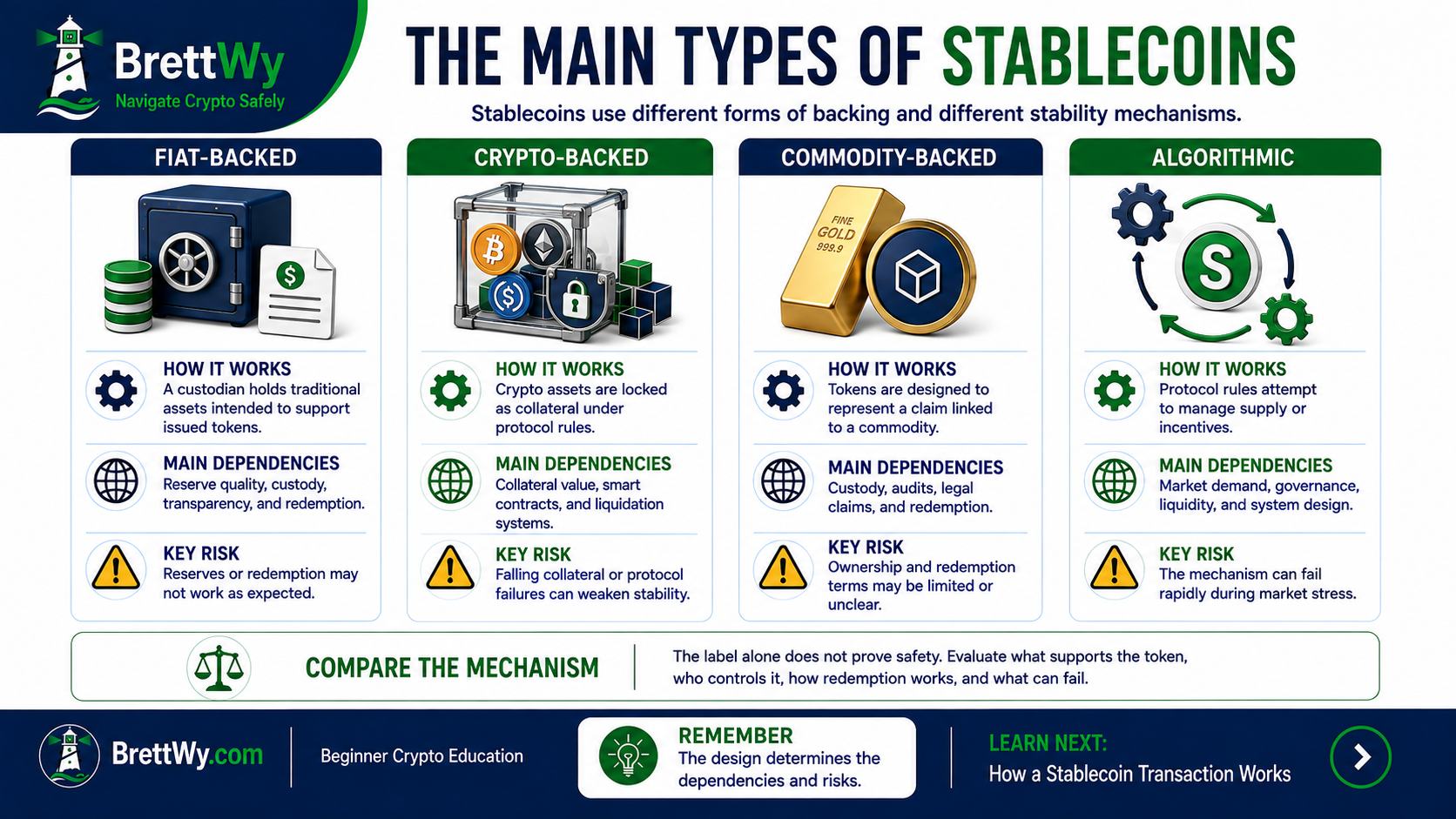
First, fiat-backed stablecoins track a government-issued currency and rely on reserve assets that custodians hold outside the blockchain. For example, reserves may include cash, bank deposits, short-term government securities, government money-market instruments, or other cash equivalents.
For example, their strengths can include a familiar model, direct redemption mechanisms, and broad market support. However, their risks include issuer failure, weak reserves, banking disruptions, redemption restrictions, legal changes, and dependence on off-chain institutions.
Crypto-Backed Stablecoins
By contrast, crypto-backed stablecoins use crypto assets that users lock in smart contracts as collateral. Because that collateral can fall quickly in value, these systems often require overcollateralization: a user might lock $150 in collateral to create $100 in stablecoins.
Consequently, if collateral falls too far, the protocol may liquidate it. Risks include rapid price declines, failed liquidations, smart-contract vulnerabilities, incorrect price oracles, governance changes, and exposure to other assets held as collateral.
Commodity-Backed Tokens
Commodity-backed tokens track assets such as gold. For example, they may make ownership units easier to transfer, but they depend on custody, storage, verification, legal claims, and redemption terms. A token can track gold accurately while its dollar price still changes.
Algorithmic Stablecoins
Algorithmic stablecoins rely mainly on software rules, supply changes, incentives, or relationships with other tokens. However, they can fail when people lose confidence in the supporting token or when incentives that worked in normal markets stop working under stress.
Safety Note — Automation does not guarantee safety. Code can enforce rules, but those rules may depend on assumptions that fail during market stress.
| Type | Primary support | Central strength | Major risk |
|---|---|---|---|
| Fiat-backed | Off-chain reserves | Direct link to traditional currency | Issuer and reserve failure |
| Crypto-backed | On-chain collateral | Visible collateral and automation | Collateral decline and liquidation |
| Commodity-backed | Physical commodity | Digital access to a reference asset | Custody and commodity-price risk |
| Algorithmic | Software and incentives | Reduced dependence on traditional reserves | Mechanism failure and loss of confidence |
Common Stablecoin Examples
Next, the following examples explain different models. They are not recommendations, and their terms, reserves, networks, and regulation can change.
USDC
For example, Circle issues USD Coin, or USDC, as a dollar-pegged stablecoin. According to Circle, highly liquid cash and cash-equivalent assets support USDC, and eligible users can redeem it one-for-one under its terms. In addition, it operates on multiple networks, so users must verify the network and official token contract.
USDT
Similarly, Tether offers its fiat-referenced USD₮ token, commonly called USDT, on multiple networks. Tether states that its reserves support the tokens and publishes circulation and reserve reporting. Therefore, beginners should review reserve composition, issuer terms, redemption eligibility, and network compatibility.
USDS and DAI
USDS is associated with Sky Protocol and is described by Sky as the upgraded version of DAI. In practice, this ecosystem uses on-chain protocol rules and diversified collateral, illustrating that stablecoin categories can overlap and evolve.
PYUSD
PayPal USD, or PYUSD, is a dollar-denominated stablecoin issued by Paxos. As a result, it demonstrates why readers must identify the actual issuer rather than assuming the consumer-facing brand shown in an application issued the token.
What Are Stablecoins Used For?
- Moving value between compatible wallets and platforms
- Trading between crypto assets using a dollar-like unit
- Interacting with DeFi applications for swaps, lending, borrowing, liquidity, or collateral
- Certain payments and person-to-person transfers
- International transfers where legally and technically supported
- Holding a dollar-referenced crypto balance inside a blockchain environment
However, the complete cost can include purchasing, withdrawal, blockchain, exchange, conversion, and cash-out fees. A low-cost blockchain transfer does not automatically make the entire process inexpensive.
For more context on these applications and their risks, read how DeFi applications use stablecoins.
How Do Stablecoin Transactions Work?
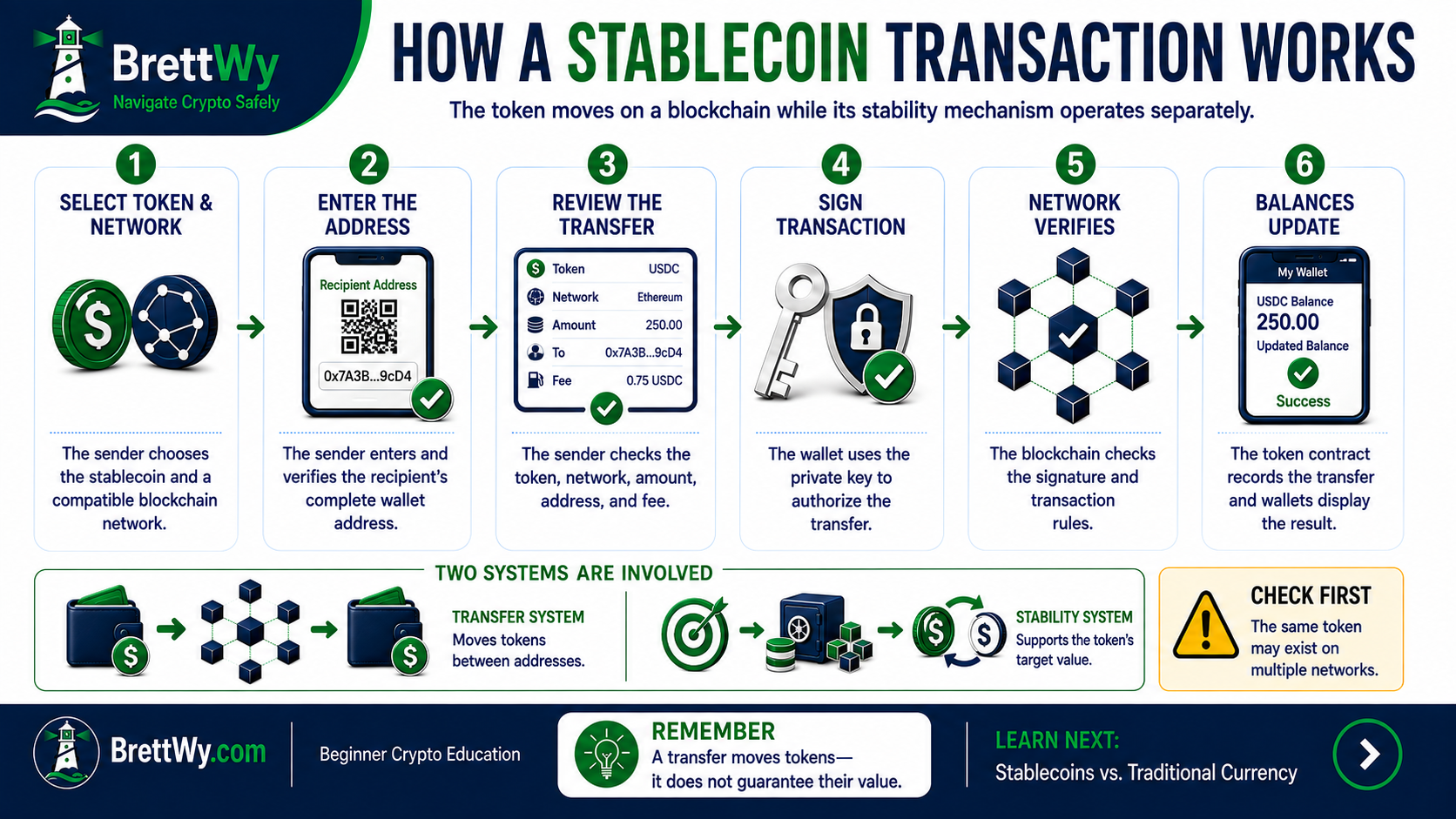
At a basic level, a stablecoin transaction transfers tokens between blockchain addresses. First, the wallet authorizes the transfer. Next, the network processes it and the token contract updates the balances.
- Select the correct stablecoin and network.
- Enter or scan the receiving address.
- Review the amount and estimated network fee.
- Authorize the transaction with the wallet.
- Wait for the network to validate and record it.
- Confirm that the recipient’s platform recognizes the correct token version.
The Token and Network Must Both Match
Importantly, the same stablecoin may exist on Ethereum, Solana, Arbitrum, Base, Stellar, Tron, or other networks. For example, a platform may support one version but not another. Consequently, sending a legitimate token through an unsupported route can cause delays or loss.
Network Fees Use the Native Asset
A token transfer usually needs the blockchain’s native fee asset—for example, ETH on Ethereum or SOL on Solana. As a result, someone can hold a stablecoin balance yet be unable to send it because the wallet lacks the correct fee asset.
Transactions May Be Irreversible
Unlike card or bank payments, blockchain transfers generally do not include the same dispute process. Although some centralized issuers can restrict addresses in specific circumstances, users should never assume they can recover an incorrect transfer.
Stablecoin Transfer Checklist
- Confirm the exact token and blockchain network
- Verify that the recipient supports that network
- Check the beginning and end of the address
- Watch for clipboard-altering malware
- Verify the official token contract when needed
- Confirm the amount, fee, and any memo or tag
- Consider a small test transfer
- Never share a private key or recovery phrase
Stablecoins Compared
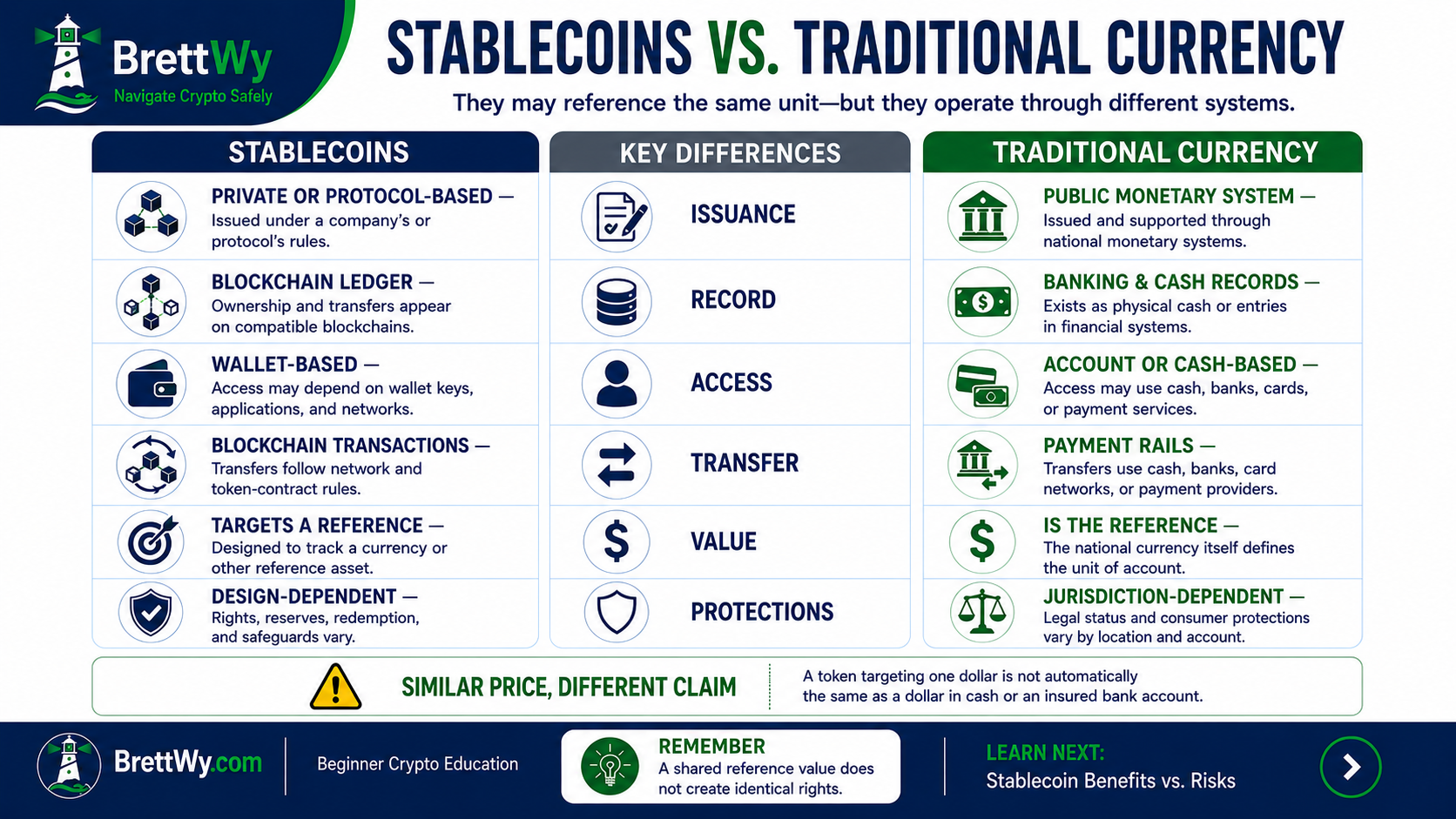
Stablecoins vs. Traditional Currency
| Feature | Dollar-pegged stablecoin | Bank-account dollars |
|---|---|---|
| Form | Blockchain token | Bank ledger balance |
| Issuer/record keeper | Private issuer or protocol | Commercial bank |
| Transfer system | Blockchain network | Banking/payment networks |
| Value | Designed to remain near $1 | Denominated directly in dollars |
| Protection | No automatic deposit insurance | Eligible deposits may be insured within legal limits |
| Reversibility | Usually difficult | Some payments offer dispute processes |
| Main risks | Issuer, reserve, depeg, contract, custody | Bank, fraud, account and payment-system risks |
Therefore, a dollar-pegged stablecoin is normally a private crypto asset, not official cash. Moreover, even when reserves are held at banks, token holders should not assume they receive direct deposit-insurance protection.
Stablecoins vs. Bitcoin
| Feature | Stablecoins | Bitcoin |
|---|---|---|
| Price objective | Track a reference value | Market determines price |
| Supply | Changes with the system | Maximum of 21 million BTC |
| Issuer | Often a company or protocol | No central issuer |
| Backing | May use reserves or collateral | No dollar reserves |
| Core risks | Depeg, issuer, reserve, contract | Volatility, custody, network and adoption |
By contrast, a stablecoin may have less short-term price movement than Bitcoin while introducing centralized issuer, reserve, redemption, or collateral risks that Bitcoin does not have in the same form.
Stablecoins vs. Central Bank Digital Currencies
By comparison, a central bank digital currency, or CBDC, would be official central-bank money in digital form. A private company or protocol generally issues a stablecoin. Therefore, their issuer, legal status, governance, privacy design, and protections can differ significantly.
Stablecoins vs. Tokenized Deposits
Meanwhile, a tokenized deposit generally represents a claim against a bank. The stablecoin issuer’s terms or protocol rules govern a stablecoin. However, similar technology does not make the financial relationships identical.
What Does “Backed by Reserves” Mean?
In practice, reserve backing means an issuer reports holding assets intended to support tokens in circulation. In other words, the word backed is only the beginning of the analysis.
- Backed by what assets?
- Held and controlled by whom?
- How liquid are the assets?
- Are reserves separate from operating funds?
- Who can redeem and under what conditions?
- How are assets and liabilities independently reviewed?
Reserve Quality and Liquidity
Cash and short-term government securities may be easier to convert into dollars than volatile or hard-to-sell investments. However, even high-quality assets do not remove banking, operational, legal, fraud, or custody risks. For example, a reserve can appear adequate by value but still be difficult to use quickly during heavy redemptions.
Audits and Attestations
For context, an attestation reports an independent professional’s conclusion about specified information, often measured at a particular time. By comparison, an audit may examine broader financial statements, evidence, and controls under applicable standards. Therefore, readers should not treat either word as a universal safety certificate; they should inspect the scope, date, preparer, standards, and any exceptions.
Redemption Terms
Direct redemption may require an approved account, identity checks, minimum amounts, supported locations, bank access, fees, and processing time. By contrast, selling on an exchange is not the same as redeeming with the issuer: one uses a market buyer, while the other follows the issuer’s terms.
Limits of On-Chain Proof
On the one hand, blockchain data can show token supply, movements, minting, burning, and on-chain collateral. On the other hand, it cannot independently prove bank balances, legal ownership, undisclosed liabilities, custody agreements, or the issuer’s full financial condition.
BrettWy Beginner Principle — Useful transparency explains assets, liabilities, custody, redemption rights, legal structure, and verification—not just a balance or dashboard.
What Is a Stablecoin Depeg?
A depeg occurs when a stablecoin’s market price moves away from its intended target. For example, a small, brief deviation may reflect ordinary trading. However, a large or lasting difference can signal reserve, redemption, collateral, liquidity, technology, or confidence problems.
Why Stablecoins Depeg
- Questions about reserve quality or availability
- Heavy redemption demand
- Falling collateral values and failed liquidations
- Algorithmic incentives that stop working
- Low market liquidity
- Smart-contract or oracle failures
- Banking, legal, cybersecurity, or operational disruptions
In some cases, a stablecoin can recover after a depeg, but recovery is never guaranteed. Ultimately, the cause, size, duration, market liquidity, and continued operation of redemption mechanisms all matter.
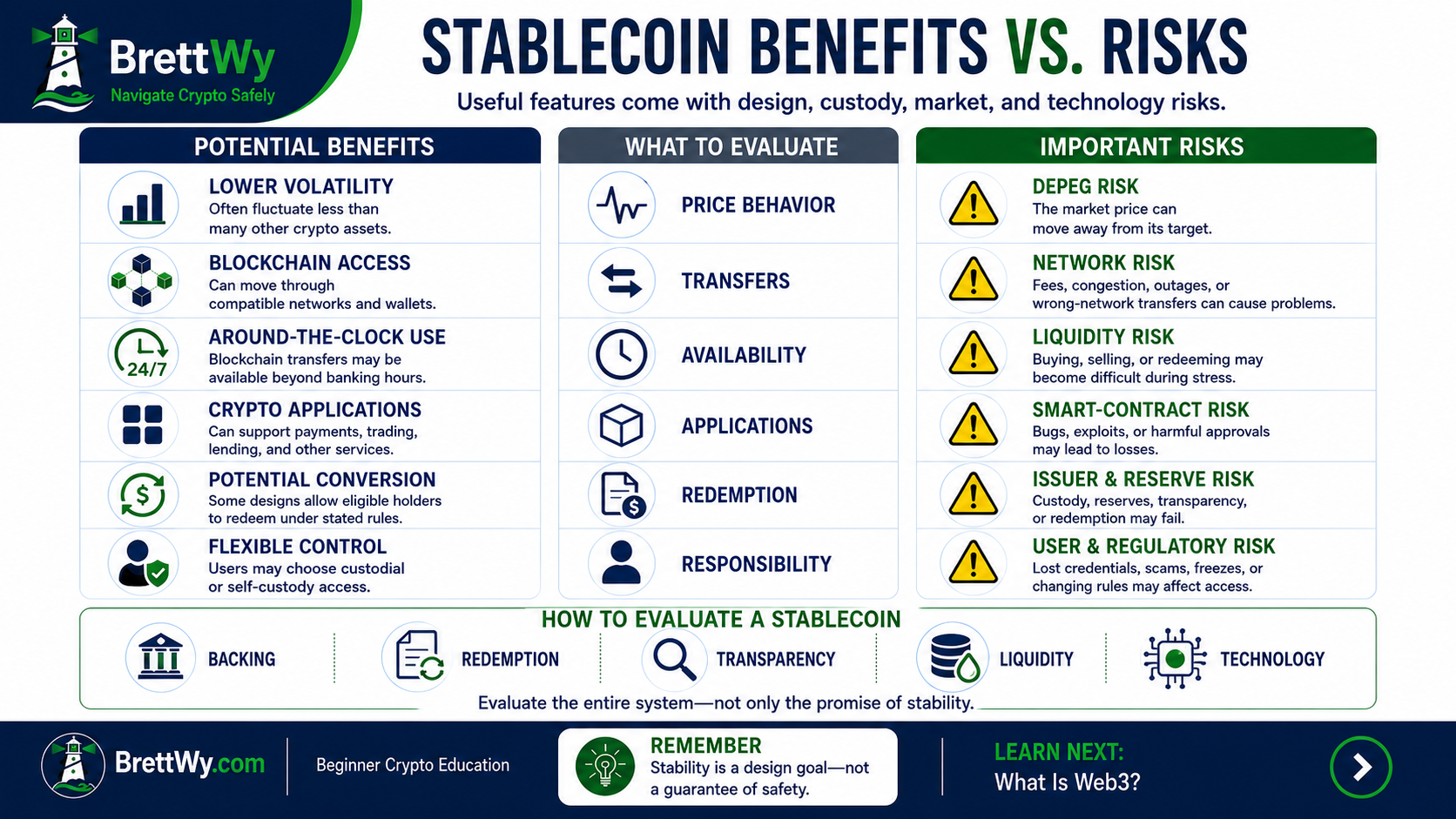
What Are the Risks of Stablecoins?
| Risk | What it means |
|---|---|
| Depegging | The market price moves away from the target |
| Reserve | Backing assets are insufficient, risky, illiquid, inaccessible, or poorly managed |
| Issuer/counterparty | An organization fails to meet its obligations |
| Redemption | Eligible holders cannot exchange tokens as expected |
| Liquidity | Selling near the target price becomes difficult |
| Smart contract/oracle | Code, permissions, upgrades, or price data fail |
| Network/bridge | The blockchain or cross-chain representation fails |
| Custody/platform | A wallet, exchange, or service loses or restricts access |
| Governance/control | Decision-makers change rules or concentrate power |
| Regulatory/legal | Laws, restrictions, or claims change |
| Fraud | Imitation tokens, fake websites, or malicious approvals deceive users |
| Yield/rewards | A return depends on lending, incentives, counterparties, or another risky product |
Are Stablecoins Safe?
No stablecoin is completely risk-free. Instead, safety depends on the stabilization mechanism, reserves, redemption access, issuer, collateral, smart contracts, network, custody, platform, legal environment, and the user’s security practices.
Therefore, a better question than “Are stablecoins safe?” is: “Which risks does this system have, and what would happen if it failed?” For example, a stablecoin held in a wallet has a different risk profile from the same token deposited into a lending protocol, bridge, exchange, or rewards program.
For the wallet, account, and phishing risks that can also affect stablecoin holders, read our cryptocurrency security guide.
Safety Rule — Never use a stable price or advertised yield as proof that a product is safe.
How Can Beginners Evaluate a Stablecoin?
- Identify the reference asset and exact peg.
- Identify the issuer, protocol, and parties with control.
- Understand the stabilization mechanism.
- Examine reserves or collateral, including liquidity and legal custody.
- Read redemption eligibility, minimums, fees, restrictions, and suspension terms.
- Review recent independent reports and their scope.
- Research past depegs and the response to them.
- Confirm the official token contract, network, wallet, and platform support.
- Evaluate who controls the keys and which custody risks apply.
- Understand the source and added risks of any advertised return.
- Match the system’s risks to the intended use and possible consequences.
Beginner Evaluation Checklist
- What does the token track?
- Who issues or governs it?
- What supports its value?
- What reserves or collateral does it use?
- How is the information verified?
- Who can redeem directly?
- Has it depegged before?
- Which blockchain version is involved?
- Is the contract authentic?
- Where will it be stored?
- What platform or protocol risks are added?
- Could the consequences of failure be managed?
Where Beginners Get Confused
“Stable” means guaranteed
In other words, stable describes a design target. A token can depeg or fail.
Every stablecoin holds one dollar in cash
Backing may include cash equivalents, crypto collateral, commodities, mixed assets, or algorithms.
Stablecoins are bank accounts
Their issuer, legal claims, protections, custody, and redemption rights differ.
A $1 price proves the reserves
However, price reflects current trading, not a complete financial audit.
Stablecoins eliminate volatility
Instead, they reduce one type of price exposure while adding other financial and technical risks.
All network versions are interchangeable
For example, platforms may support one network but reject another.
Rewards are risk-free interest
In addition, returns come from lending, reserves, incentives, or other activities with added risk.
Decentralized means no centralized dependencies
For example, protocols may depend on centralized collateral, oracles, developers, governance groups, or interfaces.
The blockchain proves off-chain backing
However, public ledgers cannot independently verify bank accounts, legal agreements, or hidden liabilities.
Stablecoins and CBDCs are the same
By contrast, private stablecoins and official central-bank money have different issuers and legal structures.
Key Takeaways
- Stablecoins are crypto assets designed to track reference values, most commonly the U.S. dollar.
- A peg is supported by a mechanism—not guaranteed by a name.
- Fiat-backed, crypto-backed, commodity-backed, and algorithmic models carry different risks.
- Minting, redemption, arbitrage, collateral, liquidity, and confidence can support price stability.
- Stablecoins move on blockchain networks, so the token, network, contract, address, and fee asset must all be correct.
- A stablecoin is not automatically official currency, an insured deposit, a CBDC, or a tokenized bank deposit.
- A depeg may be temporary or permanent. Recovery is never guaranteed.
- Evaluating a stablecoin requires examining reserves, liabilities, redemption, control, technology, history, custody, and intended use.
- A stable price does not make a DeFi, lending, bridge, exchange, or rewards product risk-free.
Frequently Asked Questions
What is a stablecoin in simple terms?
In other words, a cryptocurrency designed to track another asset, usually the U.S. dollar.
Are stablecoins always worth $1?
No. However, dollar-pegged stablecoins aim for $1 but can trade above or below it.
Are stablecoins cryptocurrencies?
Yes. In addition, they are generally blockchain-based crypto tokens.
Are all stablecoins backed by real money?
No. Instead, designs may use fiat reserves, crypto collateral, commodities, mixed backing, or algorithms.
What is a fiat-backed stablecoin?
Specifically, a token supported by off-chain reserve assets and designed to track a government currency.
What is a crypto-backed stablecoin?
For example, a stablecoin supported by crypto collateral locked in smart contracts.
What is an algorithmic stablecoin?
By contrast, a design that relies heavily on software rules and market incentives to pursue its peg.
What causes a stablecoin to depeg?
For example, reserve concerns, redemptions, weak collateral, low liquidity, technical failure, or lost confidence.
Can a stablecoin recover after depegging?
Yes. However, recovery depends on the cause and is never guaranteed.
Are stablecoins insured?
No. Therefore, token holders should not assume bank-deposit insurance applies.
Are stablecoins the same as digital dollars?
Although they may track dollars, they are normally privately issued crypto assets, not official cash.
Are stablecoins the same as CBDCs?
No. By contrast, CBDCs are central-bank liabilities; stablecoins generally come from private issuers or protocols.
Can stablecoins be stored in a wallet?
Yes. However, the wallet must support the correct token and network.
Do stablecoin transfers require fees?
Usually. In addition, the fee is commonly paid in the network’s native asset.
Can stablecoin transactions be reversed?
In most cases, users cannot reverse transactions after blockchain confirmation.
Can issuers freeze stablecoins?
For example, some centrally issued tokens include address-freezing controls.
Are stablecoin transactions anonymous?
Moreover, public blockchains generally expose transaction activity, and investigators can sometimes link that activity to identities.
Do stablecoins earn interest?
No. Instead, rewards come from a separate arrangement that adds risk.
Why are stablecoins important in DeFi?
For example, they provide a relatively steady unit for trading, borrowing, lending, collateral, and settlement.
Can stablecoins lose most of their value?
Yes. Specifically, they can lose value if backing, collateral, redemption, technology, or confidence fails severely.
How should a beginner research one?
First, review official documentation, reserve or collateral reports, redemption terms, networks, contract addresses, history, governance, and independent information.
Test Your Knowledge
- What is a stablecoin?
- What does a dollar peg mean?
- Why can a stablecoin lose its target value?
- Why must you confirm the blockchain network before transferring a stablecoin?
- What five areas does the BrettWy Stablecoin Framework evaluate?
Check your answers
- A crypto asset designed to track the value of another asset.
- The token aims to remain worth approximately one U.S. dollar; this is a target, not a guarantee.
- Reserve, collateral, redemption, liquidity, technical, market, issuer, or confidence failures can break the stabilization system.
- The same token name may exist on incompatible networks, and an incorrect transfer may be irreversible.
- Reference, backing, redemption, network, and risk.
Official Resources
- Stablecoins Explained — Ethereum.org
- Primary and Secondary Markets for Stablecoins — Federal Reserve
- The “Stable” in Stablecoins — Federal Reserve
- Cryptocurrency and Scams — Federal Trade Commission
- Digital Assets — Internal Revenue Service
- USDC Transparency — Circle
- Tether Transparency
- Sky Ecosystem Information
- PayPal USD Information
Finally, issuer websites explain their own products, so readers should not treat them as independent evaluations. Instead, compare issuer disclosures with regulatory, technical, and independent information.
Final Thoughts
In summary, stablecoins can help people transfer value, trade assets, and interact with blockchain applications. However, their stability depends on systems that may include issuers, reserves, collateral, smart contracts, market incentives, networks, and redemption processes. Each component can fail.
Therefore, beginners should not judge a stablecoin only by its name, popularity, $1 price, rewards, or associated brand. They should understand what supports the peg, who controls the system, how backing is verified, who can redeem, and what happens under stress.
The Most Important Lesson — A stablecoin may aim for price stability, but it remains a crypto asset with financial, technical, legal, and operational risks.
You’ve Completed the Stablecoin Foundation
You now understand why stablecoins exist, how different designs attempt to maintain value, and why a stable price does not eliminate risk.
Crypto Fundamentals Path Progress: You have completed the stablecoin foundation. Next, learn how wallets, tokens, smart contracts, and decentralized applications fit into the broader idea of Web3.
LEARN NEXT
Learn how blockchain networks, wallets, tokens, smart contracts, and decentralized applications connect across Web3.
Final BrettWy Lesson: A stablecoin’s current price is only one signal. Understand the system supporting that price before trusting or using the token.
About This Content
BrettWy creates beginner-friendly cryptocurrency education with a focus on clear explanations, practical security, and understanding risk. Content is developed with AI assistance, and relevant sources are linked so readers can explore the underlying information.
Crypto products, services, and technical guidance can change. Check current information with the original source before taking action.
Found an error or outdated information? Email info@brettwy.com with the article URL and the detail you believe needs attention. Never include passwords, private keys, or recovery phrases.
Educational and Risk Disclaimer
For clarity, BrettWy provides this article for general educational and informational purposes only. It does not constitute financial, investment, legal, tax, accounting, cybersecurity, or other professional advice.
In addition, stablecoins, issuers, reserves, collateral, smart contracts, wallets, exchanges, bridges, and blockchain transactions involve significant risks. These risks include depegging, insolvency, technical failure, malicious activity, changing laws, irreversible mistakes, and permanent financial loss.
Finally, no peg, reserve structure, audit, attestation, protocol, custodian, or security method can eliminate every risk or guarantee a financial result. Verify current information through official sources and consult qualified professionals when appropriate.