
Article Snapshot
Crypto Fundamentals Learning Path
In This Guide, You’ll Learn
- •What decentralized finance means in simple terms
- •Why developers created DeFi applications
- •How wallets, smart contracts, and blockchains connect
- •How a typical DeFi transaction works
- •The most common DeFi applications
- •How DeFi compares with traditional finance
- •The benefits, limitations, and risks of DeFi
- •How beginners can evaluate DeFi more safely
Introduction
For decades, most financial services have depended on trusted intermediaries.
When you deposit money into a bank, send an international payment, apply for a loan, or trade investments, a financial institution sits in the middle of the transaction. These organizations verify identities, maintain records, process payments, and enforce the rules that allow the financial system to function.
However, while this model works well for many people, it also introduces limitations. Transactions may take days to settle, services can be restricted by location or business hours, fees may accumulate through multiple intermediaries, and access is not always available to everyone.
In contrast, decentralized finance—commonly called DeFi—offers a different approach.
Rather than relying on banks or other centralized institutions, DeFi uses blockchain technology and smart contracts to provide financial services through decentralized networks. These applications are designed to operate transparently, automatically, and without requiring a central authority to manage every transaction.
However, that does not mean banks are disappearing, nor does it mean DeFi is a replacement for the traditional financial system. Instead, it represents a new way to build and access financial services using open blockchain infrastructure.
Therefore, understanding DeFi is important because many of today’s most notable cryptocurrency applications—from decentralized exchanges to crypto lending platforms—are built on its principles. Whether you eventually decide to use these services or simply want to understand the technology shaping digital finance, learning the fundamentals provides valuable context for everything that follows.
What Beginners Should Know Before Using DeFi
At the same time, DeFi is one of the most interesting areas of cryptocurrency, but it is also one of the easiest to misunderstand.
For context, this guide assumes you already understand the basics of blockchain technology, Ethereum, and smart contracts. If those topics are new to you, consider reading the previous guides in this learning path first. They will make the concepts in this article much easier to follow.
Throughout this guide, we’ll focus on how DeFi works, why it was created, and where it fits within the broader cryptocurrency ecosystem. We’ll also examine its advantages and limitations so you can build a balanced understanding of the technology rather than relying on hype or headlines.
Security Reminder: DeFi applications can give you direct control over your assets. That also makes you responsible for protecting them. Never connect a wallet to a platform you do not trust, and always verify the website address before approving a transaction.
The BrettWy DeFi Framework
Use this five-part model to understand how a typical DeFi interaction fits together:
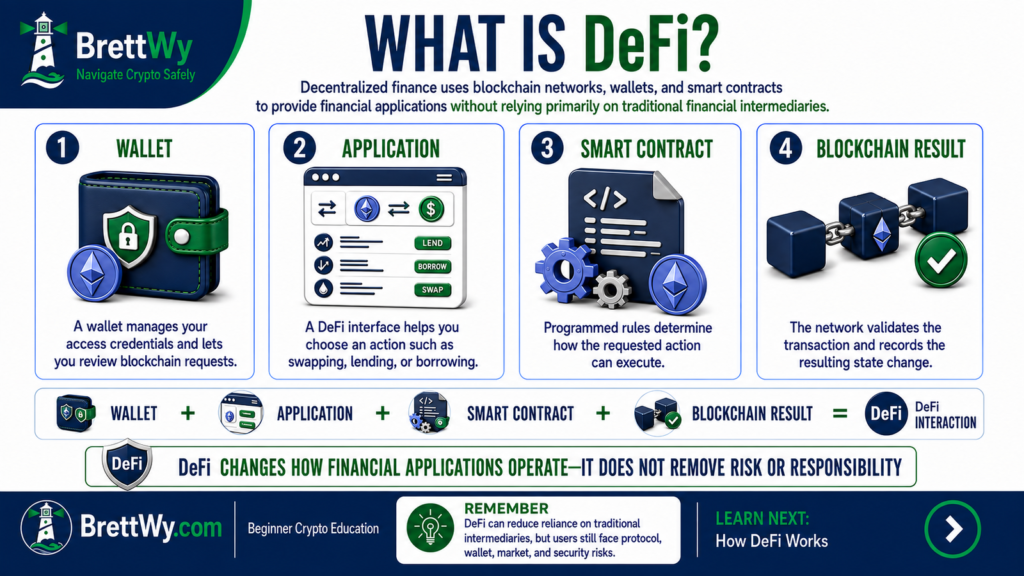
- Wallet: The user controls access credentials and reviews each request.
- Application: A website or interface helps the user prepare an action.
- Smart contract: Programmed rules determine what the action can do.
- Blockchain: The network validates the transaction and records the result.
- Responsibility: The user must evaluate fees, permissions, protocol risk, and security.
Table of Contents
What Is DeFi?
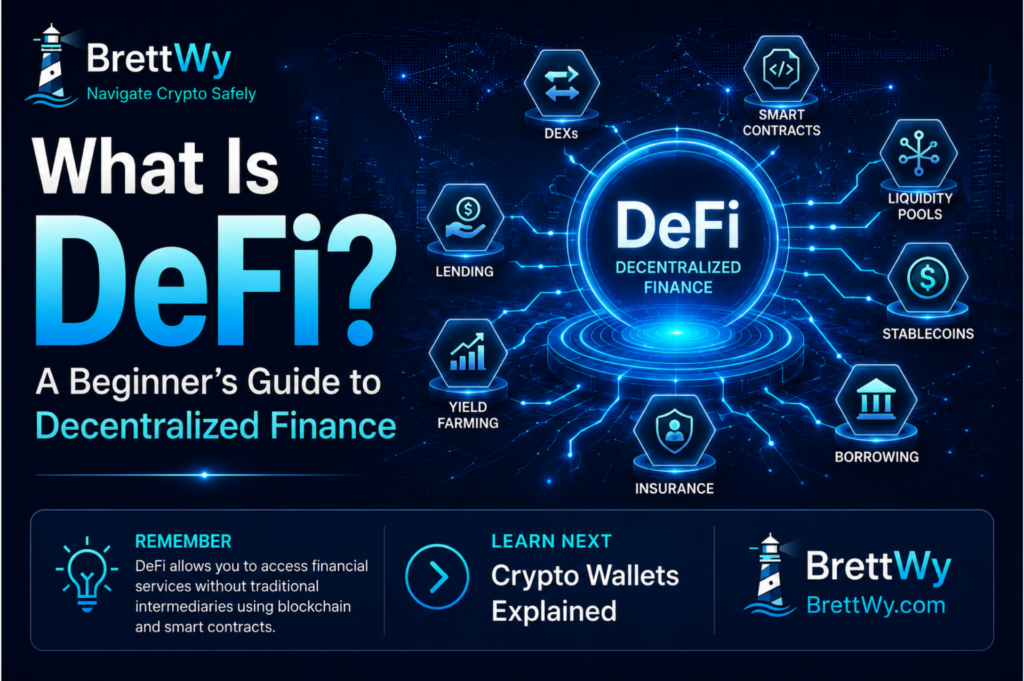
DeFi, short for decentralized finance, is a collection of financial applications built on blockchain networks that allow people to access financial services without relying on traditional intermediaries such as banks, brokerages, or payment processors.
Instead of trusting a financial institution to process transactions, DeFi applications use smart contracts—self-executing programs stored on a blockchain—to carry out financial agreements automatically according to predefined rules.
In practical terms, DeFi enables people to perform many familiar financial activities, including:
- Sending and receiving digital assets.
- Trading cryptocurrencies.
- Borrowing and lending funds.
- Earning rewards through participation in blockchain-based systems.
- Swapping one digital asset for another.
The key difference is how these services operate.
By contrast, traditional financial systems rely on centralized organizations that approve transactions, maintain customer accounts, and control access to financial products. DeFi shifts much of this responsibility to transparent software running on decentralized blockchain networks.
In practice, rather than opening an account at a bank, a user typically connects a cryptocurrency wallet to a decentralized application, often called a dApp, and interacts directly with smart contracts. Those smart contracts enforce the application’s rules without requiring a bank employee or centralized company to approve each transaction manually.
Key Definition: Decentralized finance, or DeFi, is a blockchain-based ecosystem of financial applications that uses smart contracts to provide services such as trading, lending, borrowing, and payments without relying primarily on traditional financial intermediaries.
Why “Decentralized”?
In this context, the word decentralized means that control is not concentrated in a single organization.
Instead of one company operating a central database and approving every transaction, independent computers known as nodes work together to maintain the blockchain. These computers collectively verify transactions according to the network’s rules, helping prevent any single party from controlling the entire system.
This distributed design is one of blockchain technology’s defining characteristics and forms the foundation on which DeFi applications are built.
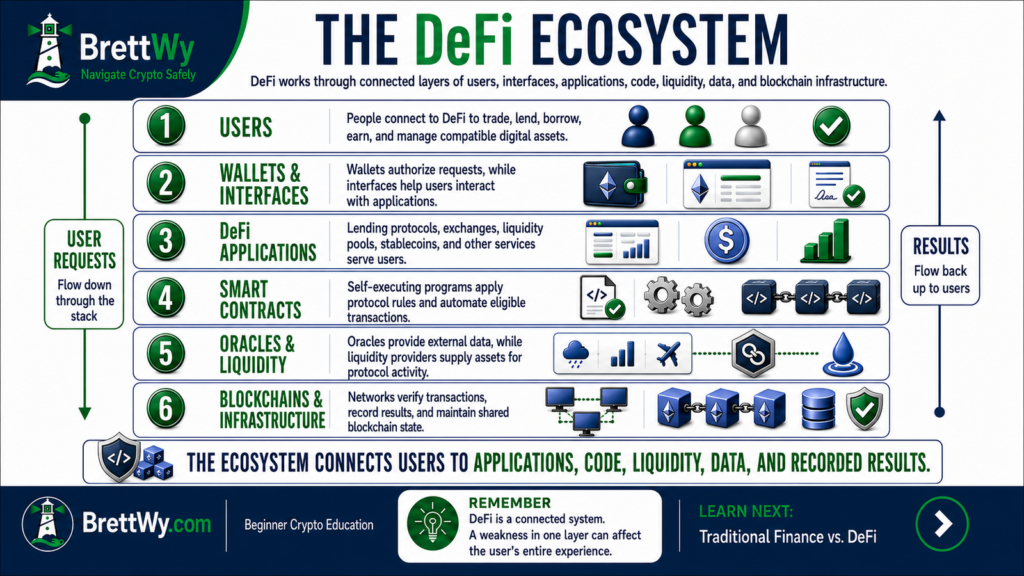
DeFi Is an Ecosystem, Not a Single Platform
One of the most common misconceptions is that DeFi is a single application or company.
It is not.
DeFi is better understood as an ecosystem containing many applications, protocols, and services built by independent development teams. For a primary-source overview, see Ethereum.org’s introduction to decentralized finance.
Some focus on cryptocurrency trading. Others specialize in lending and borrowing. Some help users exchange digital assets, while others provide payment solutions, savings-like tools, insurance services, or financial products with no direct traditional equivalent.
Although these applications serve different purposes, they share a common foundation:
- Blockchain technology
- Smart contracts
- User-controlled wallets
- Transparent, publicly verifiable transactions
Beginner Tip: Think of DeFi as an entire digital financial ecosystem rather than a single app. Just as traditional finance includes banks, exchanges, payment networks, insurers, and investment firms, DeFi contains many decentralized services that interact across blockchain networks.
Why Was DeFi Created?
To understand why decentralized finance exists, it helps to first understand how most financial services work today.
When you use a traditional financial institution—such as a bank, credit union, brokerage, or payment processor—you rely on that organization to act as a trusted intermediary. It verifies your identity, stores account balances, processes transactions, and decides whether certain services are available to you.
For many people, this system works well. However, it also has limitations that inspired developers to explore alternative approaches.
As a result, DeFi was created to address some of those limitations by using blockchain technology and smart contracts to automate financial services and reduce dependence on centralized intermediaries.
It is important to understand that DeFi was not created because banks are inherently “bad.” Instead, it represents a different technological model for delivering financial services.
1. Limited Access to Financial Services
Not everyone has equal access to traditional banking.
Depending on where someone lives, opening a bank account or accessing financial products may be difficult. Documentation requirements, geographic limitations, or limited banking infrastructure can restrict participation.
Because many DeFi applications are accessible through an internet connection and a compatible cryptocurrency wallet, they may provide another way for people to interact with digital financial services.
However, access to DeFi still depends on internet connectivity, compatible software, local laws, and the knowledge required to use blockchain technology safely.
Did You Know? DeFi has encouraged new ideas about expanding access to financial tools through open blockchain networks. It is not a complete solution to global financial exclusion, but it demonstrates a different infrastructure model.
2. Multiple Intermediaries
Many financial transactions involve several organizations working together behind the scenes.
For example, when you use a debit or credit card, the transaction may involve:
- Your bank
- The merchant’s bank
- A card payment network
- Payment processors
- Fraud-prevention systems
Each participant performs an important role, but each can also add cost, complexity, or processing time.
DeFi attempts to simplify certain transactions by allowing smart contracts to automate parts of this process directly on a blockchain. That does not eliminate every cost or risk, but it changes how transactions are coordinated.
3. Operating Hours
Traditional financial institutions often operate within defined business hours.
Although online banking has made many services more convenient, some processes—such as international settlement, securities transfers, or back-office reconciliation—may still take time.
Most public blockchains operate continuously. As a result, DeFi applications can generally be accessed 24 hours a day, seven days a week, as long as the underlying network and application remain operational.
This does not guarantee instant transactions, but it removes the concept of standard banking hours from many blockchain-based services.
4. Greater User Control
One of cryptocurrency’s defining ideas is self-custody.
Instead of a financial institution holding your assets on your behalf, you can choose to control them through a cryptocurrency wallet.
DeFi builds on this concept. Rather than signing into an account managed by a company, users typically connect their own wallet directly to a decentralized application.
This gives individuals more direct control over their assets, but it also creates greater responsibility. If someone loses access to a wallet or exposes a recovery phrase, there may be no customer-support department capable of restoring access.
Security Reminder: Self-custody gives you greater control over your assets, but it also makes wallet security your responsibility. Never share your recovery phrase, and store it securely offline.
5. Transparency
Traditional financial systems generally operate using private databases.
Customers can view information related to their own accounts, but they usually cannot inspect how an institution processes every transaction internally.
Public blockchains work differently. Transactions are recorded on a shared ledger that anyone can inspect using a blockchain explorer. Wallet addresses are visible, although they are not automatically tied to real-world identities.
This transparency allows participants to verify that transactions occurred without relying only on statements from a financial institution.
However, transparency should not be confused with anonymity. Blockchain activity is often publicly traceable, and transaction histories can be analyzed using specialized tools.
Common Misconception: Cryptocurrency and DeFi are not necessarily anonymous. Most public blockchains are better described as pseudonymous: wallet addresses are public, and transaction histories can often be traced even when the owner’s identity is not immediately known.
Is DeFi Trying to Replace Banks?
A common misconception is that DeFi exists to eliminate traditional banks.
The reality is more nuanced.
Traditional financial institutions provide important services, including consumer protections, fraud support, regulatory compliance, lending, payment infrastructure, and customer service.
DeFi approaches many of these functions differently by relying on open blockchain networks and smart contracts rather than centralized organizations.
For some situations, traditional financial institutions may remain the better choice. For others, decentralized applications may offer advantages such as greater accessibility, transparency, or user control.
Rather than viewing the two systems only as direct competitors, it is often more accurate to think of them as different approaches to delivering financial services—each with its own strengths, trade-offs, and appropriate use cases.
How Does DeFi Work?
At first glance, using a DeFi application may seem very different from using a traditional banking app.
However, the basic goal is often familiar: you want to move, exchange, borrow, lend, or manage assets.
The difference lies in who performs the work behind the scenes.
In traditional finance, banks and other institutions verify transactions, maintain account balances, and enforce the system’s rules. In DeFi, much of that responsibility is handled automatically by blockchain networks and smart contracts.
The Three Core Components
| Component | Role in DeFi |
|---|---|
| Blockchain | Records transactions and stores data across a decentralized network. |
| Smart Contracts | Execute the rules of a financial application automatically. |
| Crypto Wallet | Allows users to manage digital assets and interact with decentralized applications. |
For a fuller explanation of wallets and the access they control, read how crypto wallets work.
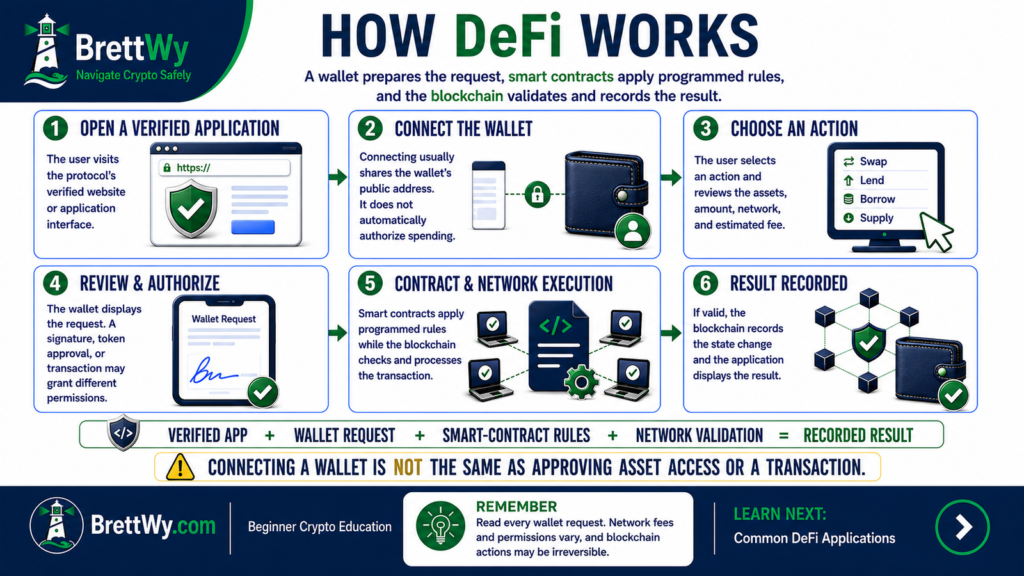
Step 1: Connect Your Cryptocurrency Wallet
Instead of creating an account with a username and password, most DeFi applications begin by asking you to connect a cryptocurrency wallet.
Your wallet acts as your digital identity within the blockchain ecosystem. Rather than storing money in the same way as a traditional bank account, it stores or manages the cryptographic keys that allow you to access and control digital assets recorded on a blockchain.
Once connected, the application can recognize your wallet address and display compatible assets. It should not be able to move funds unless you approve a transaction or permission request.
Key Definition: A cryptocurrency wallet is software or hardware that manages the cryptographic keys used to access and control digital assets on a blockchain. Ethereum.org provides an additional wallet overview for readers who want to study the concept further.
Step 2: Choose a DeFi Service
After connecting your wallet, you choose the service you want to use.
Different DeFi applications specialize in different financial activities. Some allow users to exchange one cryptocurrency for another. Others focus on lending, borrowing, payments, or reward-based participation.
Step 3: Review the Transaction
Before anything happens on the blockchain, you will usually see a summary of the transaction.
- The asset you are sending.
- The asset you expect to receive.
- Estimated network fees, often called gas fees.
- The wallet or contract address involved.
- Other important transaction details.
Because confirmed blockchain transactions are generally irreversible, it is important to review every detail carefully before approving it.
Beginner Tip: Always verify the website address before connecting your wallet. Fraudulent websites often imitate legitimate DeFi platforms in an attempt to trick users into approving malicious transactions.
Step 4: Approve the Transaction
Once you review the details, your wallet asks you to approve the transaction.
Approval creates a digital signature for a specific request. This signature proves that the wallet owner authorized the transaction without revealing the private key itself.
Some applications may also request token permissions. These permissions deserve careful review because they can define how a smart contract may interact with a particular asset.
Step 5: The Smart Contract Executes
After approval, the request is sent to a smart contract on the blockchain.
The smart contract checks whether the transaction meets the application’s programmed conditions. For example, it may verify that:
- You control the assets involved.
- The requested action follows the protocol’s rules.
- The transaction includes sufficient network fees.
- Any other protocol-specific requirements have been met.
If the conditions are satisfied, the smart contract executes the transaction automatically.
Step 6: The Blockchain Validates the Transaction
The transaction is then processed according to the underlying blockchain’s consensus rules.
Network participants verify that the transaction is valid. After confirmation, the blockchain records the updated state, creating a permanent and publicly verifiable transaction history.
Step 7: Your Wallet Updates
After confirmation, your wallet reflects the updated balances.
Depending on the blockchain network and current congestion, the process may take anywhere from a few seconds to several minutes or longer.
A Real-World Example
Imagine you own Ethereum‘s native asset, ETH, but want to exchange some of it for a stablecoin such as USDC.
- First, visit a trusted decentralized exchange.
- Next, connect your cryptocurrency wallet.
- Choose the option to swap ETH for USDC.
- The application then calculates the estimated amount and network fee.
- Carefully review the details before approving the transaction.
- After approval, your wallet signs the request.
- In turn, the smart contract processes the swap according to the protocol’s rules.
- Once the request is valid, the blockchain confirms the transaction.
- Finally, your wallet displays less ETH and more USDC.
How a Typical DeFi Transaction Works
Connect Wallet
      ↓
Choose DeFi Application
      ↓
Select Transaction
      ↓
Review Details
      ↓
Approve Transaction
      ↓
Smart Contract Executes
      ↓
Blockchain Validates
      ↓
Wallet Balance Updates
Why Smart Contracts Matter
Without smart contracts, most DeFi applications would not exist. Ethereum.org’s official smart-contract introduction explains how these blockchain programs execute rules written into their code.
Smart contracts automate agreements that would traditionally require banks, payment processors, brokers, or other intermediaries.
Because they are deployed on a blockchain, their code and activity may be publicly inspectable. However, transparency does not make them risk-free. A flaw in the code, poor design, or an overlooked security vulnerability can still cause serious losses.
Security Reminder: Never approve a wallet transaction unless you understand what you are authorizing. Blockchain transactions may be permanent, so taking a few extra moments to review the details is one of the simplest ways to protect your assets.
Common DeFi Applications
Now that you understand how DeFi works, let’s explore what people use it for.
Just as traditional finance includes banks, investment firms, payment processors, and exchanges, the DeFi ecosystem includes different types of financial applications.
1. Decentralized Exchanges
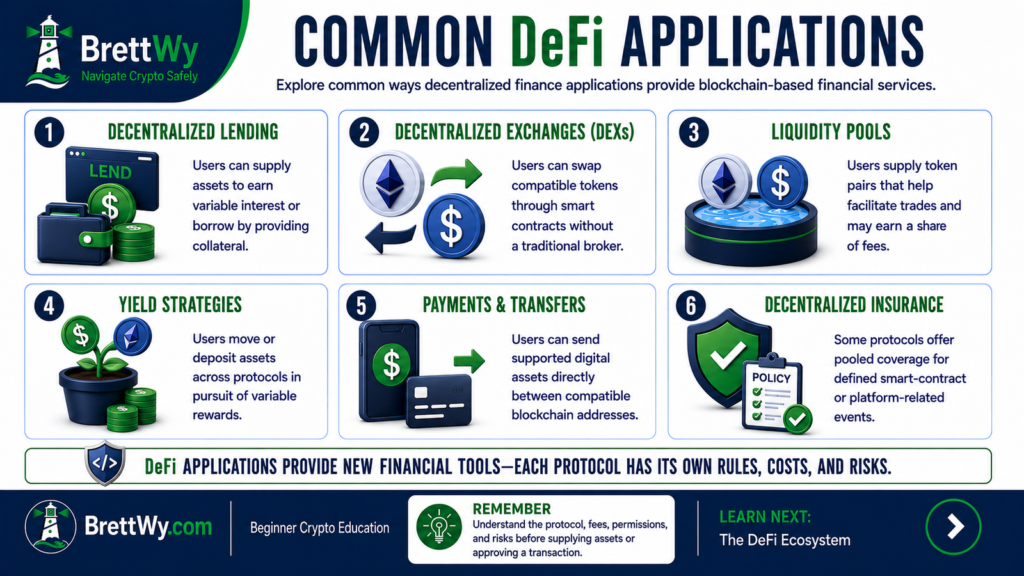
One of DeFi’s most common uses is exchanging one cryptocurrency for another.
Instead of buying and selling through a centralized cryptocurrency exchange, users can connect a wallet directly to a decentralized exchange, or DEX, and swap supported digital assets.
Key Definition: A decentralized exchange is a blockchain application that allows users to exchange cryptocurrencies from their own wallets using smart contracts rather than relying on a centralized exchange to hold customer funds.
2. Lending and Borrowing
Traditional loans usually require financial institutions to review applications, evaluate creditworthiness, and manage repayments.
Some DeFi protocols take a different approach. Users may be able to borrow digital assets by depositing other assets as collateral. Likewise, participants may make assets available to lending protocols that facilitate loans according to predefined rules.
These systems generally rely on collateral and smart contracts rather than traditional credit scores or manual approval processes.
Borrowing against cryptocurrency involves substantial risks, including price volatility and possible liquidation if collateral values fall below a protocol’s required level.
Did You Know? Many DeFi lending protocols require borrowers to deposit collateral worth more than the amount borrowed. This is known as overcollateralization.
3. Stablecoins
Price volatility can make it difficult to use some cryptocurrencies for everyday financial activities.
To address this challenge, many DeFi applications use stablecoins. These are digital assets designed to maintain a relatively stable value, often by referencing another asset such as the U.S. dollar.
Stablecoins can support trading, lending, payments, and other financial activities throughout the DeFi ecosystem.
Our guide to stablecoins in decentralized finance explains their different designs and risks.
Common Misconception: Not every stablecoin works the same way. Different designs use different reserve structures or stabilization mechanisms, and each can introduce distinct risks.
4. Payments and Money Transfers
Blockchain networks make it possible to transfer compatible digital assets directly between wallet addresses.
Depending on the network, settlement time and transaction costs may vary. For international transfers, blockchain-based payments have encouraged new approaches to moving value across borders.
This does not automatically make blockchain payments better than traditional systems, but it provides another infrastructure option for certain use cases.
5. Earning Rewards
Some DeFi applications allow users to earn rewards for participating in a protocol or providing assets for a specific function.
Depending on the application, rewards may come from transaction fees, network incentives, or other protocol-defined mechanisms.
Higher potential returns frequently come with higher risk. Rewards should never be evaluated without considering market volatility, smart contract vulnerabilities, token incentives, liquidity conditions, and changing protocol rules.
Security Reminder: Be cautious of platforms advertising unusually high or guaranteed returns. Legitimate financial opportunities still involve risk, and unusually high returns often signal unusually high risk.
The DeFi Ecosystem at a Glance
| Category | Primary Purpose | Traditional Comparison |
|---|---|---|
| Decentralized Exchanges | Exchange digital assets | Currency exchange or brokerage |
| Lending Protocols | Borrow or lend assets | Bank lending |
| Stablecoins | Maintain a relatively stable reference value | Digital cash-like instrument |
| Payment Applications | Transfer value | Payment network |
| Reward Protocols | Incentivize participation or liquidity | Interest or incentive programs, though structured differently |
Traditional Finance vs. DeFi
At first glance, traditional finance and decentralized finance appear to offer many of the same services.
Both allow people to store value, make payments, borrow funds, lend assets, and exchange currencies. However, how these services are delivered differs significantly.
Traditional financial systems rely on trusted institutions to manage accounts, verify transactions, and enforce rules. DeFi relies on blockchain networks, smart contracts, and user-controlled wallets to perform many of these functions automatically.
Neither model is inherently better in every situation. Each offers advantages and trade-offs that may suit different use cases and different users.
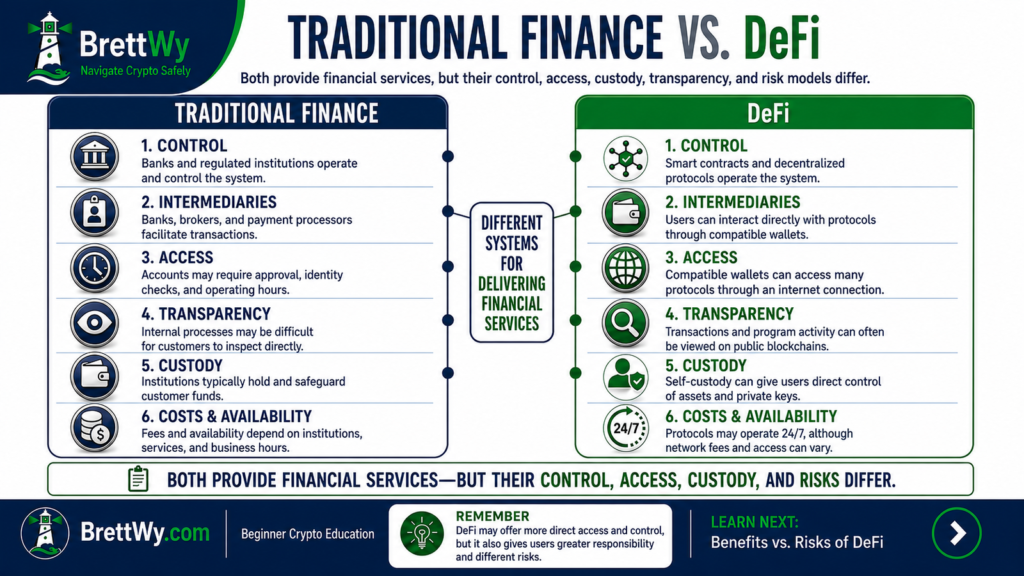
| Feature | Traditional Finance | Decentralized Finance |
|---|---|---|
| Account Access | Institution-managed accounts | User-controlled cryptocurrency wallets |
| Transaction Approval | Financial institution and payment infrastructure | Smart contracts and blockchain consensus |
| Availability | May depend on institution and service | Generally available while the network and application are operational |
| Transparency | Internal records maintained by institutions | Publicly verifiable blockchain transactions |
| Customer Support | Institution provides assistance | Varies; often documentation, community support, or an interface provider |
| Asset Custody | Institution may hold customer assets | Users often maintain direct control through self-custody |
A Real-World Example
Imagine two people who each want to send $500 to a family member in another country.
Traditional Finance: One person uses a bank or money-transfer service. The transaction may pass through several institutions before reaching the recipient. Processing time, fees, and exchange rates depend on the organizations and countries involved.
DeFi or Blockchain-Based Transfer: The other person uses a compatible wallet and blockchain network. After reviewing and approving the transaction, the network processes it according to its consensus rules. Once confirmed, the recipient can access the digital assets through a compatible wallet.
Both approaches can accomplish the same broad goal—transferring value—but they rely on different infrastructure.
Which System Is Better?
A common question is whether DeFi will eventually replace traditional finance.
The answer is more complex than a simple yes or no.
Traditional financial institutions provide important services, including consumer protections, regulatory oversight, fraud assistance, and customer support.
At the same time, DeFi has introduced new ideas about transparency, automation, accessibility, and user control that continue to influence digital finance.
It is often more accurate to think of traditional finance and DeFi as two different approaches to delivering financial services, each with distinct strengths, limitations, and appropriate use cases.
Benefits and Limitations of DeFi
Like any financial technology, decentralized finance offers both opportunities and trade-offs.
Some people are drawn to DeFi because it provides flexibility, transparency, or direct control over digital assets. Others prefer the familiarity, consumer protections, and customer support offered by traditional institutions.
Understanding both the advantages and the limitations will help you evaluate DeFi more objectively.
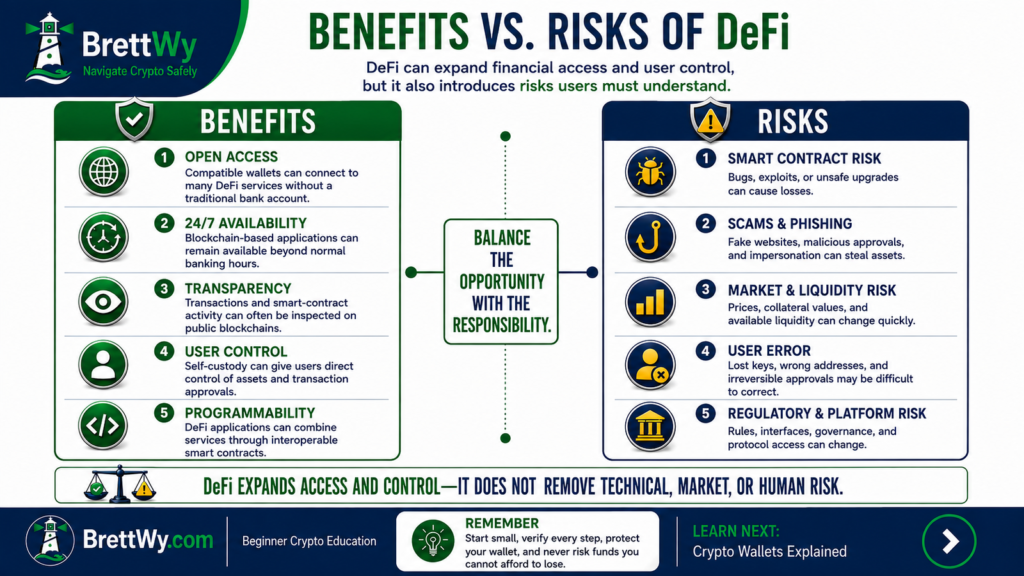
Benefits of DeFi
1. Greater User Control
One of DeFi’s defining characteristics is self-custody. Instead of relying on a financial institution to hold your assets, you can manage them through your own cryptocurrency wallet.
For many users, this provides greater independence and reduces reliance on centralized intermediaries. However, greater control also means greater responsibility.
2. Global Accessibility
Many DeFi applications are available to people who have a compatible wallet, supported digital assets, and an internet connection.
This open-access model has encouraged innovation and wider participation. Practical access may still depend on local laws, technical knowledge, internet availability, and the ability to obtain compatible assets.
3. Transparency
Most DeFi activity occurs on public blockchains. Transactions can often be independently verified using blockchain explorers.
This differs from traditional systems, where internal records are generally maintained privately by institutions.
4. Continuous Availability
Public blockchain networks generally operate continuously. As long as the underlying network and application are functioning, users can typically interact with compatible DeFi services without waiting for normal business hours.
5. Innovation
Because DeFi applications are built on programmable infrastructure, developers can create and combine financial tools in new ways.
Innovation also introduces experimentation, and experimentation creates risk. Newer does not automatically mean safer or better.
Limitations and Risks of DeFi
1. Self-Custody Responsibility
When you control your own cryptocurrency wallet, you are responsible for protecting it.
If you lose your recovery phrase or private keys, there is usually no customer-support department that can restore access to your assets.
Security Reminder: Store your wallet recovery phrase on a secure offline medium. Do not keep it in cloud storage, email drafts, screenshots, or text messages.
2. Smart Contract Risk
Smart contracts are software. Like any software, they can contain bugs, design flaws, or security vulnerabilities.
Independent audits may reduce risk, but no audit can guarantee that a protocol is completely secure.
3. Market Volatility
Many cryptocurrencies experience significant price fluctuations. Even when a DeFi application works as intended, the value of the assets involved may rise or fall quickly.
4. Fraud and Scams
Because anyone can publish blockchain applications, tokens, or websites, fraudulent projects also exist.
Scammers may create fake websites, counterfeit wallet prompts, malicious approvals, or imitation tokens designed to deceive users.
Common Misconception: A project operating on a public blockchain is not automatically trustworthy. Transparency helps people inspect activity, but it does not guarantee that a protocol is secure, competently designed, or legitimate.
5. Regulation Continues to Evolve
Governments and regulators continue to develop approaches to blockchain technology and decentralized finance.
As legal frameworks evolve, some services, interfaces, or products may change depending on where they are offered. Users should understand the laws and tax obligations that apply in their jurisdiction.
| Benefits | Limitations |
|---|---|
| Greater control through self-custody | Greater personal responsibility |
| Public blockchain transparency | Smart contract vulnerabilities |
| Global accessibility | Technical learning curve |
| Continuous availability | Cryptocurrency price volatility |
| Rapid innovation | Fraud, scams, and evolving regulation |
Is DeFi Safe?
The most accurate answer is: It depends on the protocol, the user’s security practices, and the specific activity being performed.
Established protocols with transparent documentation, independent audits, and active development communities may reduce certain risks, but no financial system is completely risk-free.
Losses in DeFi have resulted from problems such as:
- Wallet phishing attacks
- Fake websites
- Scam tokens
- Smart contract exploits
- Malicious or overly broad token approvals
- Users authorizing transactions they did not fully understand
For beginners, education is one of the strongest forms of protection. Understanding wallets, smart contracts, permissions, and blockchain transactions makes it easier to recognize warning signs and avoid preventable mistakes.
For more on phishing, wallet permissions, and common warning signs, read our cryptocurrency security guide.
BrettWy Security Reminder
- Verify the official website before connecting a wallet.
- Research the protocol and its documentation.
- Start with small transactions while learning.
- Read every wallet approval carefully.
- Protect your recovery phrase.
- Never commit more money than you can afford to lose.
These habits cannot eliminate every risk, but they can reduce the likelihood of preventable mistakes.
Key Takeaways
- DeFi stands for decentralized finance.
- DeFi uses blockchain technology and smart contracts to provide financial services.
- Users typically interact with DeFi through cryptocurrency wallets.
- Common DeFi applications include decentralized exchanges, lending protocols, stablecoins, and blockchain-based payment systems.
- DeFi offers transparency and user control but also introduces significant responsibilities and risks.
- Understanding the technology is the best first step toward making informed decisions.
Frequently Asked Questions
What does DeFi stand for?
DeFi stands for decentralized finance. It refers to financial applications built on blockchain networks that use smart contracts instead of relying primarily on traditional financial intermediaries.
Is DeFi a cryptocurrency?
No. DeFi is not a cryptocurrency itself. It is an ecosystem of blockchain-based financial applications that often use cryptocurrencies to provide services such as trading, lending, borrowing, and payments.
Does DeFi replace banks?
Not necessarily. DeFi offers an alternative model for delivering certain financial services, but traditional institutions continue to provide important functions, including consumer protections, customer support, fraud assistance, and regulatory compliance.
Do I need Ethereum to use DeFi?
Not always. Many early DeFi applications were built on Ethereum, but decentralized finance also exists on other blockchain networks. The assets and network fees required depend on the application and blockchain you use.
Is DeFi safe for beginners?
Beginners should approach DeFi carefully. Learning about wallets, smart contracts, blockchain transactions, permissions, and common scams before using real assets is strongly recommended.
Test Your Knowledge
- What does DeFi stand for?
- What role do smart contracts play in decentralized finance?
- How does DeFi differ from traditional financial institutions?
- Why is a cryptocurrency wallet important when using DeFi?
- What are two benefits and two risks associated with DeFi?
Check your answers
- It stands for decentralized finance.
- Smart contracts execute the programmed rules behind DeFi applications.
- DeFi primarily uses wallets, smart contracts, and blockchain networks instead of relying mainly on centralized institutions.
- A wallet manages the credentials used to access assets and approve blockchain actions.
- Potential benefits include access and transparency; risks include contract vulnerabilities, malicious approvals, scams, volatility, and irreversible mistakes.
Official Resources
For additional research, consult primary sources and official documentation from organizations such as:
- Decentralized Finance (DeFi) — Ethereum.org
- Introduction to Smart Contracts — Ethereum.org
- Ethereum Wallets — Ethereum.org
- Global Findex Database — World Bank
- What to Know About Cryptocurrency and Scams — Federal Trade Commission
Reading official documentation alongside beginner-friendly educational resources can help you develop a more balanced understanding of the technology.
Final Thoughts
DeFi demonstrates how blockchain technology can support programmable financial applications. However, removing a traditional intermediary does not remove risk, responsibility, or the need for careful judgment.
Before using a DeFi application, understand what the protocol does, which network it uses, what the wallet request authorizes, which fees apply, and how you could lose access or funds.
You’ve Completed the DeFi Foundation
Now that you understand how decentralized finance works, you are ready to explore the tools that make it possible.
Recommended next reading: Crypto Wallets Explained
- What cryptocurrency wallets actually store
- The difference between hot and cold wallets
- How private keys work
- Best practices for protecting digital assets
- How wallets connect to DeFi applications
Crypto Fundamentals Path Progress: You have completed the decentralized-finance foundation. Next, learn how cryptocurrency wallets manage access and connect users to blockchain applications.
LEARN NEXT
Learn how wallets hold your access credentials, connect to DeFi applications, and affect the security of your digital assets.
Final BrettWy Lesson: DeFi replaces some institutional processes with software, but it does not replace due diligence, wallet security, or personal responsibility.
About This Content
BrettWy creates beginner-friendly cryptocurrency education with a focus on clear explanations, practical security, and understanding risk. Content is developed with AI assistance, and relevant sources are linked so readers can explore the underlying information.
Crypto products, services, and technical guidance can change. Check current information with the original source before taking action.
Found an error or outdated information? Email info@brettwy.com with the article URL and the detail you believe needs attention. Never include passwords, private keys, or recovery phrases.
Educational and Risk Disclaimer
BrettWy provides this article for general educational and informational purposes only. It does not constitute financial, investment, legal, tax, accounting, cybersecurity, or other professional advice.
DeFi protocols, smart contracts, tokens, wallets, bridges, oracles, and blockchain transactions involve significant risks, including software vulnerabilities, malicious permissions, inaccurate data, scams, volatility, changing laws, irreversible mistakes, and permanent financial loss.
No audit, interface, blockchain, security method, or automated system can eliminate every risk or guarantee a financial result. Verify current information through official sources and consult qualified professionals when appropriate.