
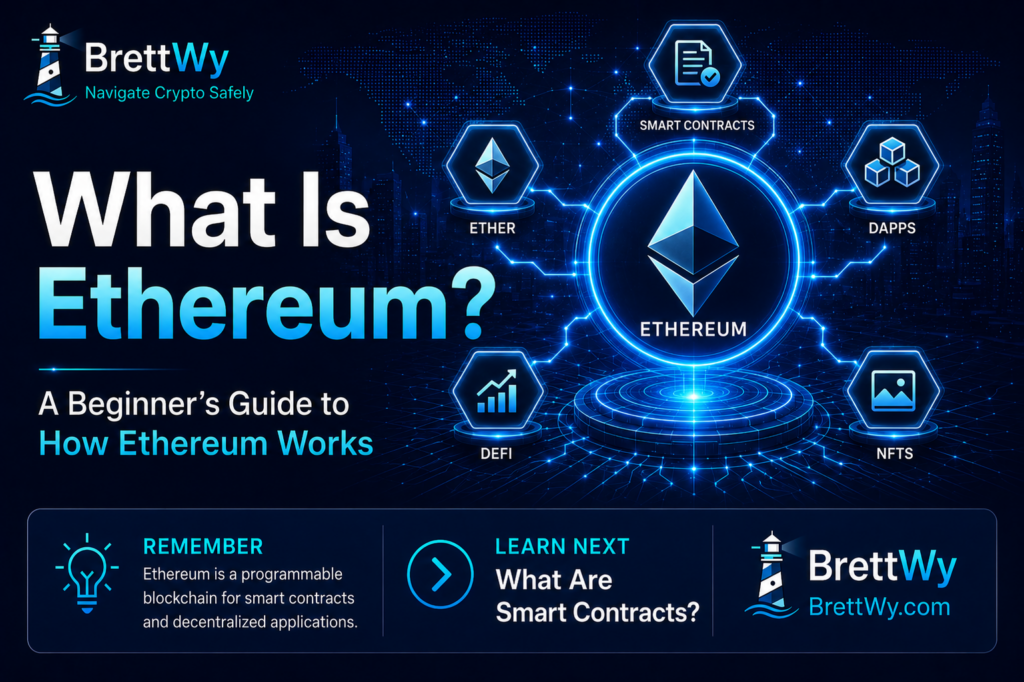
Article Snapshot
Crypto Fundamentals Learning Path
In This Guide, You’ll Learn
- •What Ethereum is and why developers created it
- •The difference between Ethereum and Ether (ETH)
- •How transactions, validators, and Proof of Stake work
- •What gas, the EVM, and smart contracts do
- •How dApps and the Ethereum ecosystem fit together
- •How Ethereum compares with Bitcoin
- •The benefits, limitations, scams, and safety risks
- •What to learn next in the Crypto Fundamentals path
Introduction
Ethereum can feel confusing because people use the same conversation to discuss a blockchain network, a cryptocurrency called ETH, programmable contracts, digital assets, and decentralized applications.
The simplest starting point is this: Ethereum is a public blockchain designed to run programmable instructions as well as transfer digital value.
Bitcoin established a model for decentralized digital money. Ethereum expanded the idea by giving developers a shared platform on which they could create blockchain-based programs and applications.
This guide builds the complete beginner mental model one layer at a time. You will learn what the network is, what ETH does, how validators confirm activity, why users pay gas fees, and where smart contracts and dApps fit.
The BrettWy Ethereum Framework
Use four connected layers to understand Ethereum without getting lost in technical terminology:
- Network: Independently operated computers follow compatible rules and maintain Ethereum’s shared state.
- Native asset: ETH transfers value, pays network fees, and supports Proof of Stake.
- Programs: Smart contracts execute blockchain instructions through the Ethereum Virtual Machine.
- Applications: Wallets and dApps give users interfaces for interacting with contracts and assets.
Table of Contents
- What Is Ethereum?
- Why Was Ethereum Created?
- Who Created Ethereum?
- What Is Ether (ETH)?
- How Does Ethereum Work?
- What Are Smart Contracts?
- What Are Decentralized Applications?
- What Can You Build on Ethereum?
- Ethereum vs. Bitcoin
- The Ethereum Ecosystem
- Benefits of Ethereum
- Limitations and Risks
- Beginner Safety Tips
- Common Beginner Mistakes
- Key Takeaways
- Frequently Asked Questions
- Test Your Knowledge
- Official Resources
- Final Thoughts
What Is Ethereum?
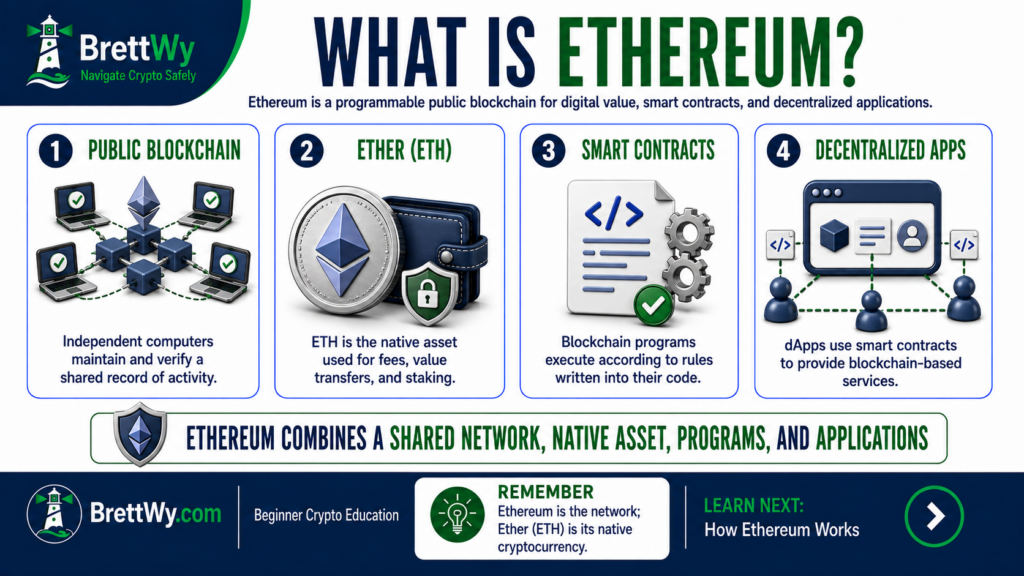
Ethereum is a decentralized blockchain platform that allows people to transfer digital value and run programmable applications without relying on one central company or authority. Bitcoin’s creators designed it primarily as a form of decentralized digital money. By contrast, Ethereum expanded the idea by giving developers a blockchain they could program.
For instance, a simple way to think about Ethereum is as a shared global computer. Instead of one company maintaining the network on a private server, independent computers around the world follow the same rules and keep compatible copies of its data.
For example, Ethereum records transactions on a public blockchain. More importantly, it can run smart contracts: programs that developers store on the blockchain and that execute according to rules written into their code.
As a result, smart contracts make decentralized applications, often called dApps, possible. These applications can support payments, financial services, digital ownership, games, online communities, and many other uses.
Why Ethereum Matters
Ethereum matters because it showed that blockchain technology could do more than record payments. In other words, developers could use a blockchain as a foundation for software that follows transparent, shared rules.
Consequently, this idea helped enable major parts of the modern crypto ecosystem, including decentralized finance, stablecoins, NFTs, blockchain games, decentralized autonomous organizations, and Web3 applications. Therefore, understanding Ethereum helps you understand much more than one cryptocurrency.
In addition, it provides a foundation for learning how many blockchain-based applications work.
Ethereum at a Glance
| Feature | Ethereum |
|---|---|
| First proposed | 2013 |
| Network launch | July 30, 2015 |
| Founder | Vitalik Buterin, with several co-founders |
| Native cryptocurrency | Ether (ETH) |
| Primary purpose | Run smart contracts and decentralized applications |
| Network type | Public, open-source blockchain |
| Consensus mechanism | Proof of Stake |
| Common uses | Payments, DeFi, stablecoins, NFTs, gaming, DAOs, and token creation |
Why Was Ethereum Created?
When Bitcoin launched in 2009, it demonstrated that people could transfer digital value without depending on a bank or another central payment processor. Even so, Bitcoin focused mainly on digital money.
However, developers soon recognized that the same basic technology might support more than financial transactions. They imagined blockchains that could execute programmable instructions and support complete applications.
Therefore, developers created Ethereum to make that broader vision possible. Instead of forcing developers to create a new blockchain for every application, Ethereum offered a shared platform on which many teams could build.
In the simplest terms:
- Bitcoin primarily transfers and preserves digital value.
- Ethereum provides a programmable platform for blockchain applications.
Even so, this comparison is useful but deliberately simplified. Bitcoin also supports programmable functions, and Ethereum can transfer value. Their main difference is the emphasis of each network’s design.
Who Created Ethereum?
Historically, Vitalik Buterin first proposed Ethereum in 2013. At the time, he believed blockchain technology could support a flexible programming platform rather than only a digital payment system.
Later, several co-founders helped develop and launch the project, including Gavin Wood, Joseph Lubin, Anthony Di Iorio, Charles Hoskinson, Mihai Alisie, Amir Chetrit, and Jeffrey Wilcke. The Ethereum network officially launched on July 30, 2015, with its first block.
Today, a broad community of developers, researchers, validator operators, application teams, and users supports Ethereum as an open-source network. Although the Ethereum Foundation contributes to the ecosystem, it does not own or unilaterally control the network.
What Is Ether (ETH)?
In practice, beginners often use “Ethereum” and “Ether” as though they mean the same thing. However, although they are closely connected, they are not identical.
- Ethereum is the blockchain network and software platform.
- Ether (ETH) is the native cryptocurrency that powers that network.
For instance, you can think of Ethereum as a public transportation system and ETH as the fare needed to use certain services within it. Although the analogy is not perfect, it highlights the difference between the infrastructure and the asset used inside it. People use ETH to:
- Pay fees for transactions and smart-contract activity.
- Send digital value to another Ethereum address.
- Interact with decentralized applications.
- Purchase or exchange eligible Ethereum-based assets.
- Participate in staking and help secure the network.
How Does Ethereum Work?
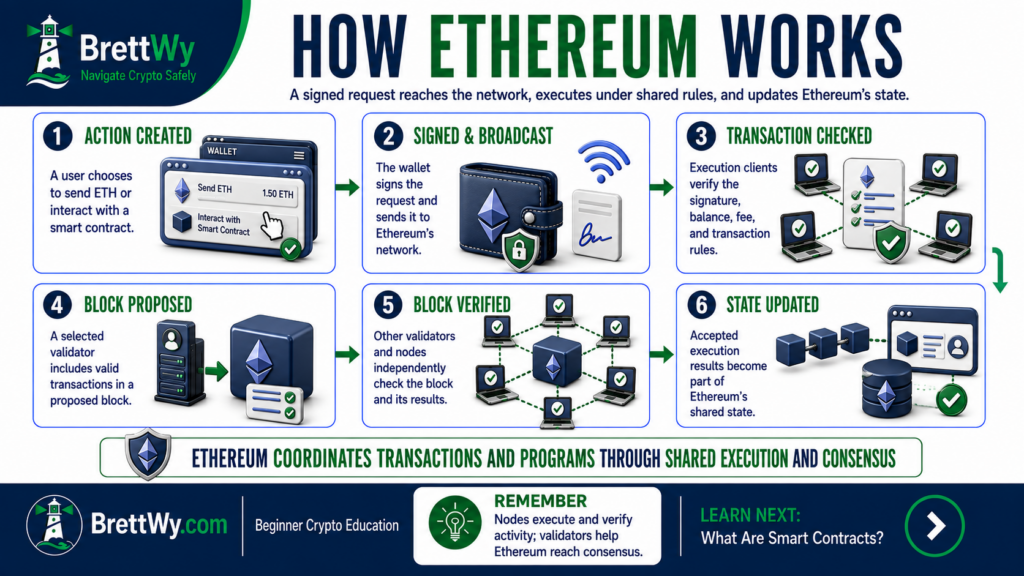
In practice, computers running compatible Ethereum software maintain the network. Together, they share information, verify activity, and agree on the state of the blockchain. To see how these parts work together, here is a simplified view of what happens when someone uses Ethereum.
Step 1: A User Creates a Transaction
For example, a user may send ETH, interact with a smart contract, exchange an eligible token, or use a decentralized application. The user’s wallet prepares the transaction. The wallet then uses the user’s private key to create a digital signature that proves the address owner authorized the transaction.
Step 2: The Transaction Reaches the Network
Next, the wallet broadcasts the signed transaction to Ethereum’s network. Participating software then checks whether the transaction follows the protocol’s rules. For example, the network checks that the signature is valid, the account can cover the requested amount and fee, and the transaction uses the correct sequence number.
Step 3: A Validator Proposes a Block
Additionally, Ethereum uses a consensus system called Proof of Stake. Validators commit ETH to the staking system and run software that helps the network reach agreement.
At specific intervals, the protocol selects a validator to propose a new block. Meanwhile, other validators check the proposed block and attest when they consider it valid.
Validators can earn rewards when they perform their duties correctly. Conversely, they may lose rewards or face stronger penalties when they fail certain duties or act dishonestly.
Step 4: The Blockchain Updates
Finally, after the network accepts the block, participating computers update their view of Ethereum’s state. The transaction then becomes part of the blockchain’s shared history. Ethereum’s consensus process gives users a common record without requiring one company to maintain the official database.
What Are Gas Fees?
Because transactions and smart-contract operations require computing resources, Ethereum measures that computational work in units called gas. Users pay the resulting fee in ETH; gas itself is not a separate token.
How Does the Ethereum Virtual Machine Work?
In turn, the Ethereum Virtual Machine (EVM) is the shared execution environment that processes smart-contract instructions and calculates resulting changes to Ethereum’s state.
In other words, a useful analogy is an operating system shared by thousands of independently operated computers. Each participating node re-executes the same valid instructions so it can verify the result rather than trusting one central server.
The EVM does not make code safe or correct. It executes the instructions developers provide, including instructions that contain mistakes or unsafe logic.
What Are Smart Contracts?
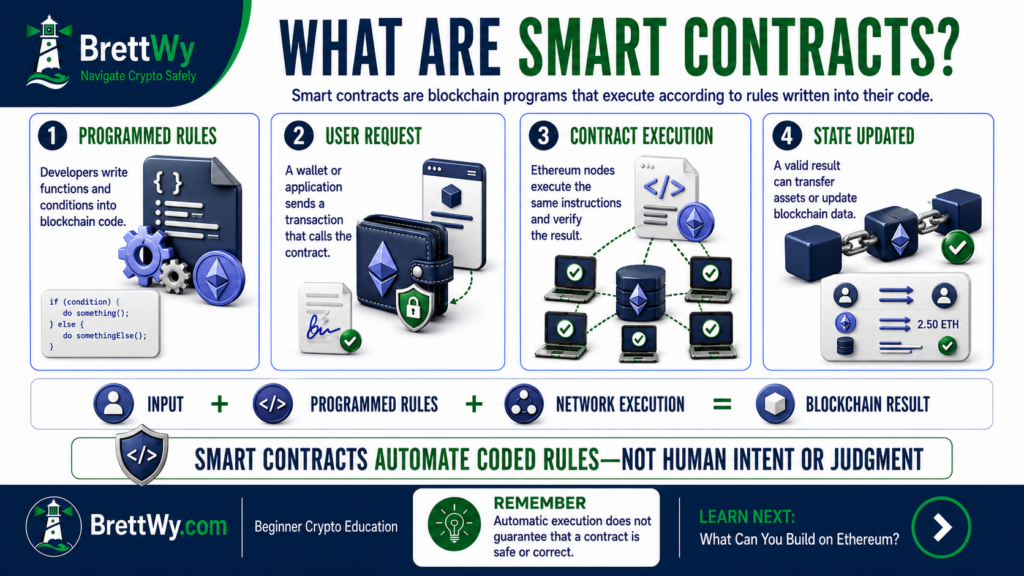
A smart contract is a program that developers store on a blockchain and that runs according to rules written into its code. Despite the name, a smart contract is not automatically a legal contract, nor is it “smart” in the sense of artificial intelligence. Instead, it is software that responds predictably when users or other programs call its functions.
For example, a familiar analogy is a vending machine. The machine follows programmed rules: accept a valid payment, receive a selection, and release the corresponding item.
Therefore, a cashier does not need to approve each purchase. Similarly, a smart contract can perform a programmed action when the required inputs and conditions are present.
Depending on its design, therefore, a smart contract may:
- Transfer digital assets.
- Facilitate a token exchange.
- Manage lending or borrowing rules.
- Issue an NFT or another blockchain-based token.
- Distribute rewards in an application.
- Record votes for a decentralized organization.
Why Smart Contracts Matter
Smart contracts allow multiple users and applications to rely on the same visible set of programmed rules. As a result, they can reduce the need for a central operator to process every action manually.
Furthermore, smart contracts are composable. Developers can design applications that interact with existing smart contracts, similar to how software developers use shared tools and application programming interfaces.
However, automation does not guarantee safety. A smart contract may contain a coding error, insecure design, or unexpected economic weakness.
Therefore, users should never assume an application is trustworthy simply because it runs on Ethereum.
Continue with What Are Smart Contracts? for a deeper explanation of contract design, uses, benefits, and limitations.
How Do Decentralized Applications Work?
A decentralized application, or dApp, is an application that uses smart contracts on a decentralized network for part of its core operation. Many dApps still use ordinary websites and user interfaces.
However, blockchain-based smart contracts may handle important actions—such as transferring assets, recording ownership, or following financial rules—instead of relying only on a private company database. Typically, users access a dApp by connecting a compatible crypto wallet.
In practice, the wallet then acts as both an account and an approval tool for blockchain transactions.
Potential Advantages of dApps
- Transparency: Smart-contract addresses, transactions, and some program code may be publicly inspectable.
- Direct asset control: Users may hold eligible digital assets in their own wallets.
- Interoperability: Applications can interact with compatible tokens and smart contracts.
- Open access: Some applications are available to anyone with an internet connection and compatible wallet.
Potential Trade-Offs
- Users must take greater responsibility for wallet security.
- Blockchain transactions are generally difficult or impossible to reverse.
- Network fees may make small transactions impractical.
- Smart-contract bugs and scams can cause losses.
- A dApp’s website, development team, or supporting services may still contain centralized components.
What Can You Build on Ethereum?
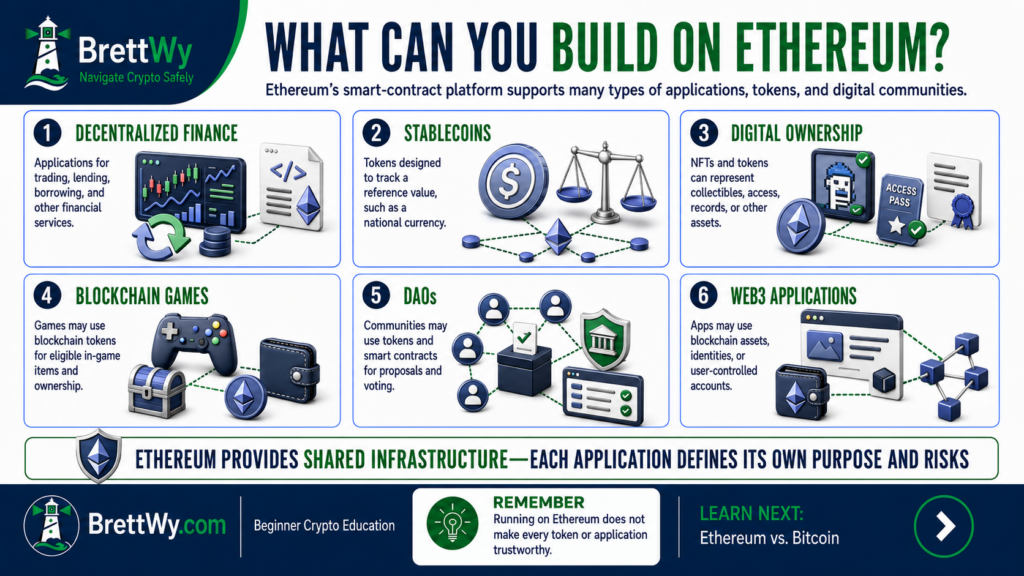
Because Ethereum is programmable, it supports many types of applications and digital assets. The following categories are among the most common.
Decentralized Finance
Decentralized finance, commonly called DeFi, uses smart contracts to provide services such as trading, lending, borrowing, and asset management. In these applications, smart contracts execute the platform’s rules. Nevertheless, users still face technical, market, liquidity, and security risks.
Stablecoins
For another example, stablecoins are crypto assets that aim to track a reference value, often a national currency such as the U.S. dollar. Many stablecoins use Ethereum token standards. However, their stability mechanisms and risks vary, so users should not interpret the word “stable” as meaning risk-free.
Non-Fungible Tokens
Non-fungible tokens, or NFTs, are blockchain-based tokens designed to represent distinct items or records. For instance, people may associate them with digital art, collectibles, memberships, tickets, gaming assets, or other forms of digital ownership.
Blockchain Games
Similarly, some blockchain games use Ethereum or Ethereum-compatible networks to represent in-game assets. Depending on the game, players may be able to hold or transfer those assets through their own wallets.
Decentralized Autonomous Organizations
A decentralized autonomous organization, or DAO, is a blockchain-based coordination structure that may use tokens and smart contracts for proposals, voting, and treasury management. However, the level of decentralization varies widely. For example, a small group of developers, token holders, or service providers may still heavily influence some DAOs.
Web3 Applications
Web3 is a broad term for internet applications that use blockchain-based assets, identities, or ownership systems. Ethereum has played a major role in Web3 development because it provides widely used smart-contract infrastructure and token standards.
Ethereum vs. Bitcoin
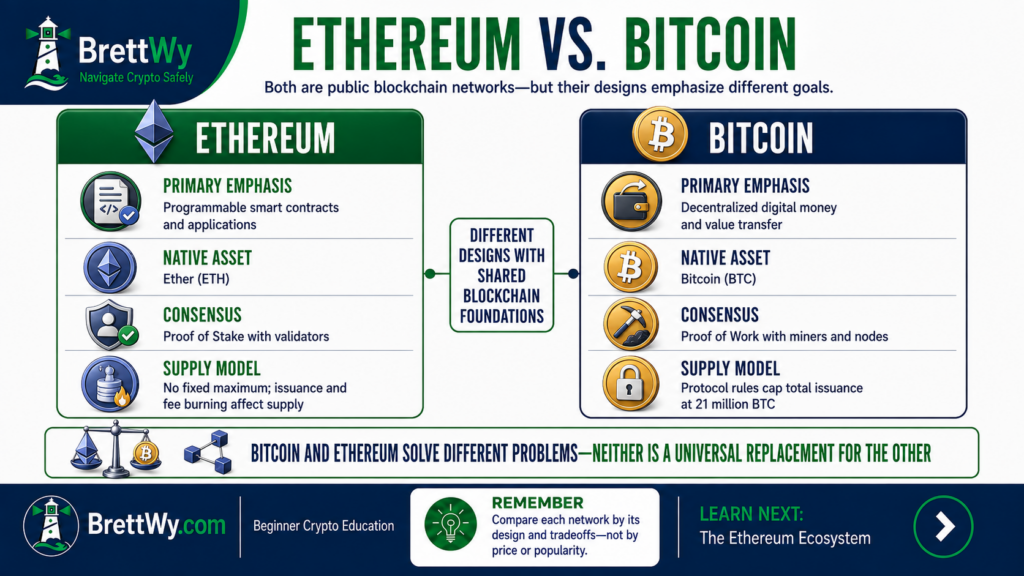
People often compare Bitcoin and Ethereum because both are prominent public blockchain networks. However, their creators designed them with different primary goals. Bitcoin emphasizes decentralized digital money and a predictable monetary policy. Ethereum emphasizes programmable smart contracts and applications.
| Feature | Bitcoin | Ethereum |
|---|---|---|
| Primary design emphasis | Decentralized digital money | Programmable blockchain applications |
| Native asset | Bitcoin (BTC) | Ether (ETH) |
| Consensus mechanism | Proof of Work | Proof of Stake |
| Smart-contract capability | Available, but more limited by design | Central to the network’s application model |
| Common uses | Value transfer and long-term holding | Smart contracts, dApps, tokens, DeFi, and digital assets |
| Maximum supply | 21 million BTC | No fixed maximum supply in the protocol |
The Ethereum Ecosystem
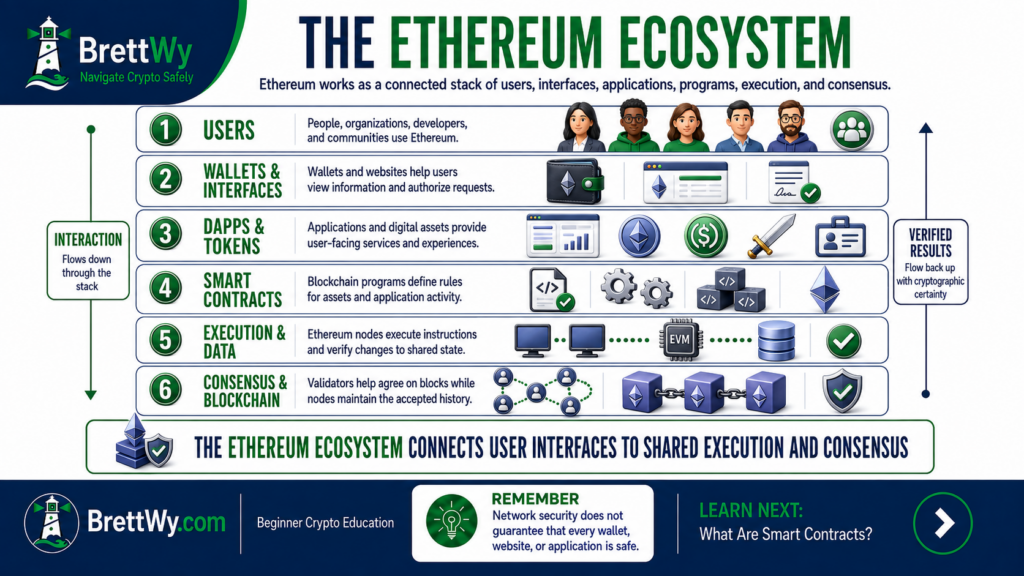
More broadly, the Ethereum ecosystem is a connected technology stack rather than a single application. Users interact through wallets and interfaces, which connect them to dApps, tokens, and the smart contracts that define blockchain-based rules.
Meanwhile, below those user-facing tools, Ethereum’s execution and consensus layers process instructions, verify results, and maintain the blockchain’s shared state. Understanding these layers makes it easier to separate an application’s interface from the network infrastructure operating behind it.
Benefits of Ethereum
Open Participation
First, anyone can create an Ethereum address, inspect public blockchain data, transfer eligible assets, or interact with publicly available applications. Nevertheless, local laws, user interfaces, and third-party service restrictions may still affect access.
Programmability
Second, developers can create smart contracts that define custom rules for digital assets and applications. Consequently, Ethereum can support far more than basic transfers.
Large Developer Ecosystem
In addition, Ethereum has a substantial open-source developer ecosystem, extensive documentation, established tools, and widely used technical standards.
Interoperability
Moreover, compatible smart contracts and tokens can interact. This interoperability allows developers to build new applications using existing blockchain components.
Public Verifiability
Finally, Ethereum records transactions and smart-contract activity on a public blockchain. Users can inspect this information with blockchain explorers, although interpreting it correctly may require technical knowledge.
Limitations and Risks
Although Ethereum is influential, no blockchain is perfect. Therefore, beginners should understand its trade-offs before using ETH or interacting with applications.
Transaction Fees
For example, every Ethereum transaction requires a gas fee. Complex actions and periods of high demand can make these fees expensive.
Network Capacity
Likewise, Ethereum has limited block space, so high demand can lead to fee competition. Layer 2 networks aim to process more activity at a lower cost; however, they introduce their own systems and risks.
Smart-Contract Risk
In addition, a smart contract may contain bugs, design flaws, insecure dependencies, or economic vulnerabilities. An audit may reduce risk, but it cannot guarantee a contract’s safety.
Scams and Malicious Interfaces
Furthermore, scammers may create fake websites, counterfeit tokens, malicious wallet prompts, or fraudulent support accounts. Therefore, a legitimate blockchain does not make every project that uses it legitimate.
Irreversible Transactions
Moreover, users generally cannot reverse Ethereum transactions. Sending assets to the wrong address or approving a malicious transaction may therefore cause a permanent loss.
Regulatory and Market Risk
Finally, laws and regulations differ by location and may change. In addition, ETH and Ethereum-based assets can experience substantial price volatility.
Beginner Safety Tips
- Never share your recovery phrase or private key.
- Download wallets only from verified official sources.
- Bookmark legitimate websites instead of relying on advertisements or unsolicited links.
- Check the network, recipient address, asset, amount, and fee before confirming.
- Start with a small test transaction when using a new address or network.
- Research an application before connecting your wallet.
- Review token approvals and remove permissions you no longer need.
- Use a separate wallet for testing unfamiliar applications.
- Ignore urgent messages promising rewards, refunds, account recovery, or guaranteed returns.
- Remember that genuine support staff should never request your recovery phrase.
For a complete protective framework, continue with the BrettWy guide to cryptocurrency security.
Common Beginner Mistakes
- Using “Ethereum” and “ETH” as though they are identical.
- Assuming Ethereum is simply another version of Bitcoin.
- Buying ETH before learning how wallets and transaction fees work.
- Connecting a wallet to an unfamiliar site without verifying it.
- Ignoring the gas fee or selected blockchain network.
- Assuming every Ethereum token or application is trustworthy.
- Sending an unsupported asset to an incompatible platform or network.
- Approving a transaction or signature without understanding the request.
- Treating an audited smart contract as risk-free.
- Making decisions based on hype instead of understanding the technology.
Key Takeaways
- Ethereum is a public blockchain designed to support smart contracts and decentralized applications.
- Ether (ETH) is the native cryptocurrency used to pay fees and participate in the network.
- Ethereum uses Proof of Stake, with validators helping to check and propose blocks.
- Smart contracts are blockchain programs that execute according to their code.
- Ethereum supports DeFi, stablecoins, NFTs, gaming, DAOs, and other Web3 applications.
- Ethereum and Bitcoin have different primary goals rather than serving as direct substitutes.
- Wallet security, smart-contract risk, scams, fees, and irreversible transactions all require careful attention.
Frequently Asked Questions
Is Ethereum a cryptocurrency?
Ethereum is the blockchain network, whereas Ether, or ETH, is the network’s native cryptocurrency. Although people often use “Ethereum” informally when referring to ETH, the terms have different meanings.
What is ETH used for?
Specifically, people use ETH to pay Ethereum transaction fees, transfer value, interact with smart contracts and dApps, and participate in staking.
Is Ethereum better than Bitcoin?
Neither network is universally better. Instead, their creators designed Bitcoin and Ethereum with different priorities. Bitcoin focuses primarily on decentralized digital money, while Ethereum focuses on programmable blockchain applications.
Can I buy part of one ETH?
Yes. Because Ether is divisible, a person can acquire a fraction of one ETH rather than purchasing a whole unit.
Who controls Ethereum?
No single company owns Ethereum. Its operation and development involve independent users, node operators, validators, developers, researchers, application teams, and community organizations.
Is Ethereum safe?
Ethereum uses a decentralized consensus system and has operated since 2015. Nevertheless, using Ethereum still involves risks, including wallet theft, phishing, malicious smart contracts, application failures, and user mistakes.
Can Ethereum still be mined?
No. In September 2022, Ethereum replaced Proof of Work mining with Proof of Stake. As a result, validators now perform the consensus duties that miners previously handled.
What is Ethereum staking?
Staking involves committing ETH to Ethereum’s Proof of Stake system. Validators run software that checks blocks, attests to valid proposals, and may propose blocks when selected. Running an independent validator currently requires a protocol-defined deposit of 32 ETH, technical knowledge, and reliable infrastructure. Other staking arrangements introduce different custody, counterparty, liquidity, and smart-contract risks.
What is an Ethereum gas fee?
A gas fee covers the cost of processing a transaction or smart-contract action on Ethereum. Specifically, the fee depends on the computational work required and current demand for block space.
What should I learn after Ethereum?
Therefore, the next logical topics are smart contracts, crypto wallets, decentralized applications, DeFi, stablecoins, Layer 2 networks, and cryptocurrency security.
Test Your Knowledge
- What is the best beginner distinction between Ethereum and ETH?
- What does gas measure?
- What do Ethereum validators do?
- Does running on Ethereum make an application trustworthy?
- Which guide comes next in the learning path?
Check your answers
- Ethereum is the network; ETH is its native asset.
- Gas measures the computational work required by an Ethereum action.
- Validators participate in block proposal, attestation, and consensus.
- No. Smart contracts, websites, teams, tokens, and wallet requests can still contain risks.
- The next guide is What Are Smart Contracts?
Official Ethereum Resources
Final Thoughts
Ultimately, Ethereum expanded the idea of blockchain beyond digital payments. It introduced a general-purpose platform where developers could create smart contracts, tokens, and decentralized applications.
In practice, Ether, or ETH, powers activity on the network. Meanwhile, validators help Ethereum reach agreement through Proof of Stake, and smart contracts provide the programmable rules behind its application ecosystem.
Ethereum’s flexibility has helped support DeFi, stablecoins, NFTs, blockchain games, DAOs, and other Web3 technologies. At the same time, fees, smart-contract vulnerabilities, scams, irreversible transactions, and user-security responsibilities create meaningful risks.
For a beginner, however, the most important step is not memorizing every technical detail. Instead, it is building an accurate mental model:
- Ethereum is the network.
- ETH is the network’s native asset.
- Smart contracts make the network programmable.
- dApps use smart contracts to provide blockchain-based services.
- Users must protect their wallets and carefully review every transaction.
As a result, once these fundamentals are clear, topics such as smart contracts, DeFi, stablecoins, NFTs, and Web3 become much easier to understand.
You’ve Completed the Ethereum Foundation
At this point, you understand Ethereum’s purpose, the role of ETH, how validators and Proof of Stake support consensus, and how gas, the EVM, smart contracts, and dApps fit together.
Next, examine smart contracts more closely so you can understand how blockchain programs operate, where they are useful, and why their risks matter.
Crypto Fundamentals Path Progress: You have completed the Ethereum foundation. Next, learn how smart contracts turn blockchain rules into programmable actions.
LEARN NEXT
A beginner’s guide to blockchain programs, automated rules, real-world uses, and smart-contract risks.
Final BrettWy Lesson: Separate Ethereum from ETH, smart-contract execution from application safety, and network security from personal wallet security. Those distinctions lead to better decisions.
About This Content
BrettWy creates beginner-friendly cryptocurrency education with a focus on clear explanations, practical security, and understanding risk. Content is developed with AI assistance, and relevant sources are linked so readers can explore the underlying information.
Crypto products, services, and technical guidance can change. Check current information with the original source before taking action.
Found an error or outdated information? Email info@brettwy.com with the article URL and the detail you believe needs attention. Never include passwords, private keys, or recovery phrases.
Educational and Risk Disclaimer
BrettWy provides this article for general educational and informational purposes only. It does not constitute financial, investment, legal, tax, accounting, cybersecurity, or other professional advice.
Ethereum, ETH, staking, tokens, smart contracts, wallets, bridges, and decentralized applications involve significant risks, including volatility, fraud, custody failure, software vulnerabilities, transaction mistakes, changing laws, and permanent financial loss.
No network, wallet, application, audit, security method, or investment approach can eliminate every risk or guarantee a financial result. Verify current information through official sources and consult qualified professionals when appropriate.