
Article Snapshot
Crypto Fundamentals Learning Path
- ► The Complete Beginner’s Guide to Cryptocurrency — You are here
- What Is Blockchain?
- What Is Bitcoin?
- What Is Ethereum?
- What Are Smart Contracts?
- What Is DeFi?
- Crypto Wallets Explained
- What Are Stablecoins?
- What Is Web3?
- Cryptocurrency Security
In This Guide, You’ll Learn
- What cryptocurrency is and why it was created
- How blockchains record ownership and transactions
- How Bitcoin, Ethereum, stablecoins, and other digital assets differ
- How smart contracts, DeFi, and Web3 fit into the ecosystem
- How crypto wallets and exchanges provide different forms of access
- How cryptocurrency transactions work
- Which benefits, limitations, scams, and security risks matter most
- Where to continue through the Crypto Fundamentals Learning Path
Introduction
Cryptocurrency can feel confusing because one word is often used to describe many different technologies, assets, networks, and applications. However, Bitcoin, blockchains, wallets, exchanges, stablecoins, decentralized finance, and Web3 are connected without being the same thing.
Fortunately, you do not need a computer science degree or a finance background to understand the fundamentals. Instead, you only need a clear starting point and a sensible order in which to learn the major concepts.
This beginner’s guide provides that starting point. First, it explains the cryptocurrency ecosystem in plain English. Then, it shows how the main components fit together and identifies the risks that every beginner should understand. In addition, each major subject connects to a dedicated BrettWy guide when you are ready to explore it in greater depth.
Importantly, this guide is educational. Therefore, it does not tell you which cryptocurrency to buy or whether cryptocurrency is appropriate for your financial situation. In short, learning how the system works should come before purchasing an asset, opening an account, connecting a wallet, or approving a transaction.
BrettWy Core Lesson: You do not need to understand every cryptocurrency before learning the fundamentals. Start with how value is recorded, how access is controlled, and how to recognize risk.
The BrettWy Crypto Fundamentals Framework
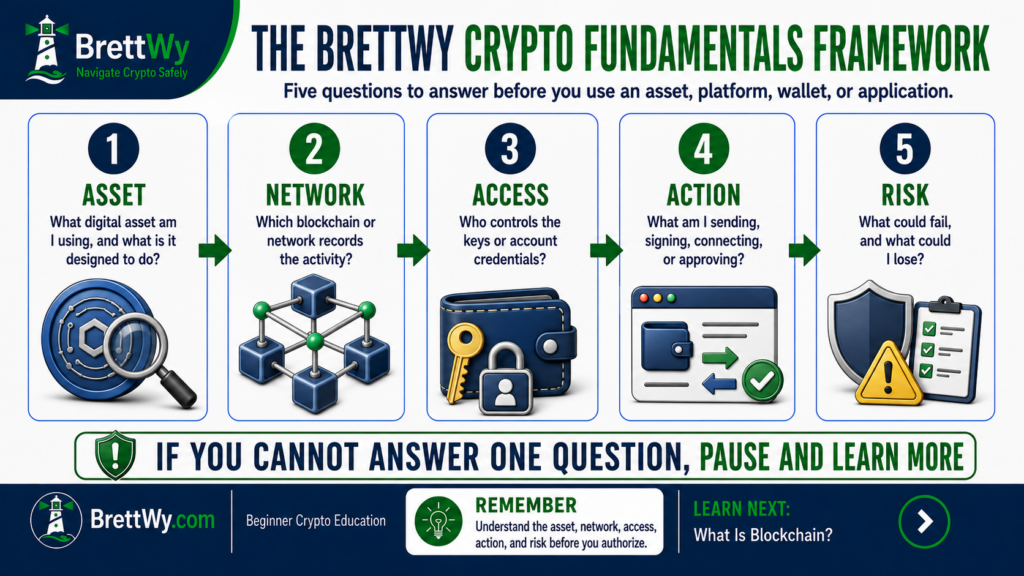
Therefore, before using any crypto asset, platform, wallet, or application, answer five questions:
- Asset: What digital asset am I using, and what is it designed to do?
- Network: Which blockchain or network records the activity?
- Access: Who controls the keys or account credentials?
- Action: What am I sending, signing, connecting, or approving?
- Risk: What could fail, and what could I lose?
If you cannot answer one of these questions, pause and learn more before proceeding. In practice, this framework will reappear throughout the Crypto Fundamentals Learning Path.
Table of Contents
- What Is Cryptocurrency?
- Why Was Cryptocurrency Created?
- How Blockchain Makes Cryptocurrency Possible
- What Is Bitcoin?
- What Is Ethereum?
- What Are Smart Contracts?
- What Is DeFi?
- What Are Crypto Wallets?
- What Are Stablecoins?
- What Is Web3?
- Types of Cryptocurrencies
- How Cryptocurrency Transactions Work
- How People Access Cryptocurrency
- Benefits and Limitations
- Cryptocurrency Risks and Security
- Common Beginner Mistakes
- Cryptocurrency and Taxes
- Key Takeaways
- Frequently Asked Questions
- Test Your Knowledge
- Official and Educational Resources
- Final Thoughts
- Continue Your Crypto Education
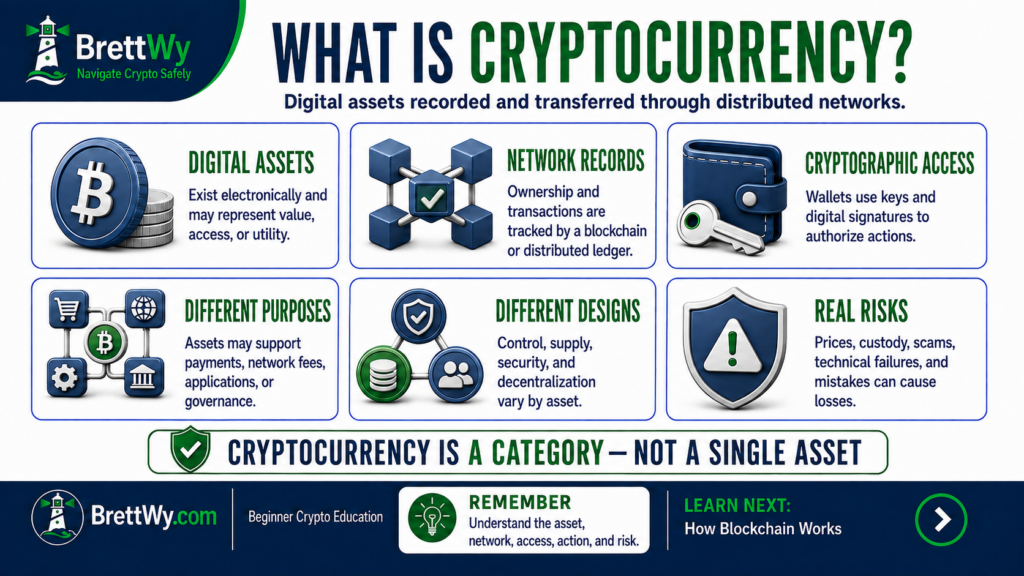
What Is Cryptocurrency?
For example, some cryptocurrencies are designed primarily for payments or storing value. In addition, others help people pay network fees, use blockchain applications, vote on protocol decisions, or represent assets inside digital ecosystems.
Cryptocurrency Explained Simply
For comparison, imagine sending $20 through a banking application. Then, the bank updates its private records to show that your balance decreased and the recipient’s balance increased.
By contrast, with many cryptocurrencies, a blockchain network performs the record-keeping. In this model, participants follow shared rules for validating transactions and updating the ledger. As a result, control may be distributed across many independent computers rather than held by one company.
For instance, a useful analogy is internet-native value. In simple terms, email allows information to move through the internet. Similarly, cryptocurrency allows certain forms of digital value or ownership to move through blockchain networks.
However, cryptocurrency is not identical to cash in a bank account. For instance, prices may fluctuate, transactions may be difficult to reverse, access can be lost, and legal treatment differs by country and asset.
Why Was Cryptocurrency Created?
In practice, different cryptocurrencies were created for different reasons. For example, Bitcoin was introduced as a peer-to-peer electronic cash system that could operate without a central payment administrator.
By comparison, traditional financial systems rely on institutions such as banks, card networks, payment processors, and governments. For example, these organizations provide consumer protection, identity verification, fraud controls, and account recovery. At the same time, they may introduce fees, delays, access requirements, operating hours, and geographic restrictions.
In contrast, cryptocurrency networks explore a different model: participants use software, cryptography, and shared rules to coordinate ownership and transactions. Common goals include:
- Transferring value across borders
- Reducing dependence on a single administrator
- Creating publicly verifiable records
- Supporting programmable digital agreements
- Giving users the option to control assets directly
Nevertheless, these goals do not guarantee that every cryptocurrency is useful, decentralized, secure, or valuable. Therefore, each network must be evaluated on its own design, adoption, governance, risks, and real-world purpose.
How Blockchain Makes Cryptocurrency Possible
Consequently, many cryptocurrencies use blockchains to record transactions and determine which addresses control particular assets.
A Shared-Notebook Analogy
For example, imagine a notebook copied across many computers. When the network accepts a new entry, the participating computers update their copies according to the same rules. As a result, earlier entries are designed to be difficult to alter without detection.
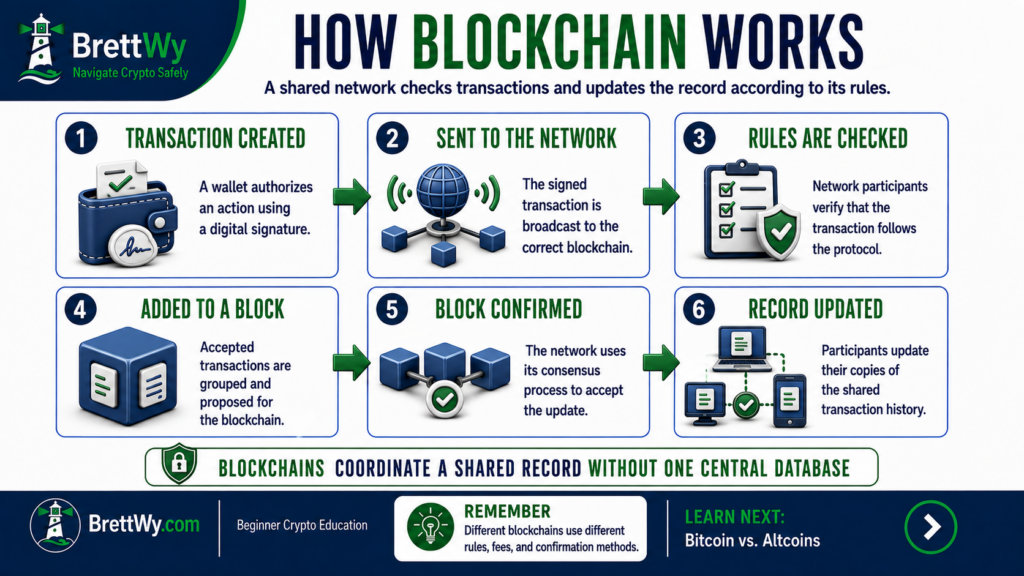
In general, a blockchain transaction follows this process:
- First, a user creates and signs a transaction.
- Next, the wallet sends the transaction to the network.
- Then, network participants check it against the protocol’s rules.
- Afterward, the network adds accepted transactions to the blockchain.
- Finally, participants share the updated record across the network.
However, exact processes vary by blockchain. For example, networks use different consensus mechanisms, fee systems, confirmation rules, and security models.
Why Blockchains Can Be Difficult to Change
- Distribution: Many participants may maintain or verify the record.
- Cryptography: Digital signatures and cryptographic links help protect transaction integrity.
- Consensus: Participants use agreed rules to decide which updates are valid.
- Economic incentives: Some networks reward honest participation and penalize certain harmful behavior.
Importantly, blockchain security does not automatically protect every exchange, wallet, application, or user. In other words, a network can operate correctly while an individual still loses access through phishing, exposed recovery information, or an unsafe transaction.
Continue with What Is Blockchain? A Beginner’s Guide to How Blockchain Works.
What Is Bitcoin?
Specifically, it was introduced in 2009 by a person or group using the name Satoshi Nakamoto.
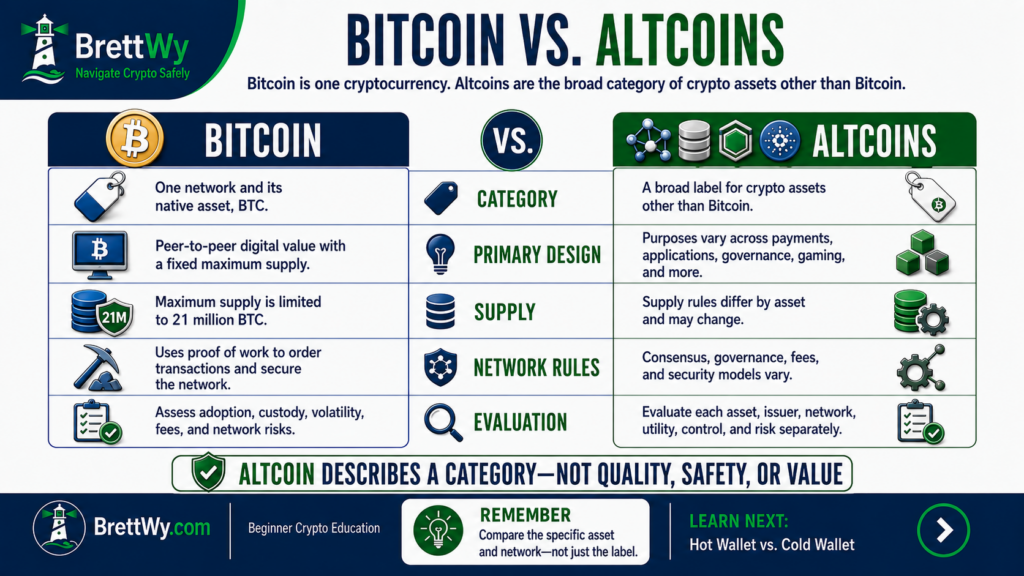
In addition, Bitcoin’s rules limit its maximum supply to 21 million units. Meanwhile, the network uses proof of work, in which miners contribute computing resources to help order transactions and secure the blockchain.
As a result, people describe Bitcoin in different ways, including digital money, a scarce digital asset, or “digital gold.” However, those descriptions reflect how people choose to use or value it; they do not guarantee price stability or future adoption.
The original design is described in the official Bitcoin whitepaper. For a beginner-focused explanation, read What Is Bitcoin? A Beginner’s Guide to How Bitcoin Works.
What Is Ethereum?
In addition, its native asset, ether (ETH), is used to pay network fees and help secure the network.
Bitcoin primarily introduced decentralized digital value transfer. Later, Ethereum expanded the idea by allowing developers to deploy programs that run according to blockchain rules. Consequently, this capability supports applications involving tokens, decentralized finance, digital identity, games, collectibles, and other uses.
Importantly, no single application or company controls Ethereum. Instead, it is an open network with independent users, developers, validators, infrastructure providers, and applications. Its capabilities and risks are explained in What Is Ethereum? A Beginner’s Guide. In addition, you can review Ethereum.org’s educational resources.
What Are Smart Contracts?
For example, a vending machine is a useful—but imperfect—analogy. When the machine receives the required payment and selection, it follows programmed rules to release an item. Similarly, a smart contract can transfer a token, record a vote, process a trade, or update an application when specified conditions are satisfied.
Although smart contracts can reduce dependence on manual processing, they are not automatically intelligent, legally enforceable, or safe. For example, code can contain errors, permissions can be overly broad, and users can approve actions they do not understand.
Learn how the pieces fit together in What Are Smart Contracts? A Beginner’s Guide to How They Work.
What Is DeFi?
Instead of asking a traditional financial institution to process every action, a user may interact with a smart contract through a crypto wallet. On one hand, this can make services globally accessible to compatible wallets. On the other hand, it introduces smart-contract risk, market risk, liquidity risk, governance risk, and the possibility of irreversible mistakes.
Therefore, DeFi is not the same as a bank account, and protocol deposits may not receive traditional deposit insurance or customer support. Begin with What Is DeFi? A Beginner’s Guide to Decentralized Finance before interacting with a DeFi application.
What Are Crypto Wallets?
However, the wallet does not hold coins in the same way a physical wallet holds cash. Instead, the blockchain maintains the ownership record.
Custodial and Self-Custody Access
- Custodial access: A company controls the private keys and gives the user access through an account.
- Self-custody: The user controls the wallet’s recovery information and assumes responsibility for backups and transactions.
However, neither approach removes risk. On one hand, custodial users depend partly on the platform’s security, finances, policies, and availability. On the other hand, self-custody users must protect recovery information and verify transactions without relying on a company to reverse mistakes.
Hot Wallets and Cold Storage
- Hot wallet: Wallet software operating on an internet-connected phone, browser, or computer.
- Cold-storage method: A setup intended to keep signing keys away from routine internet-connected activity.
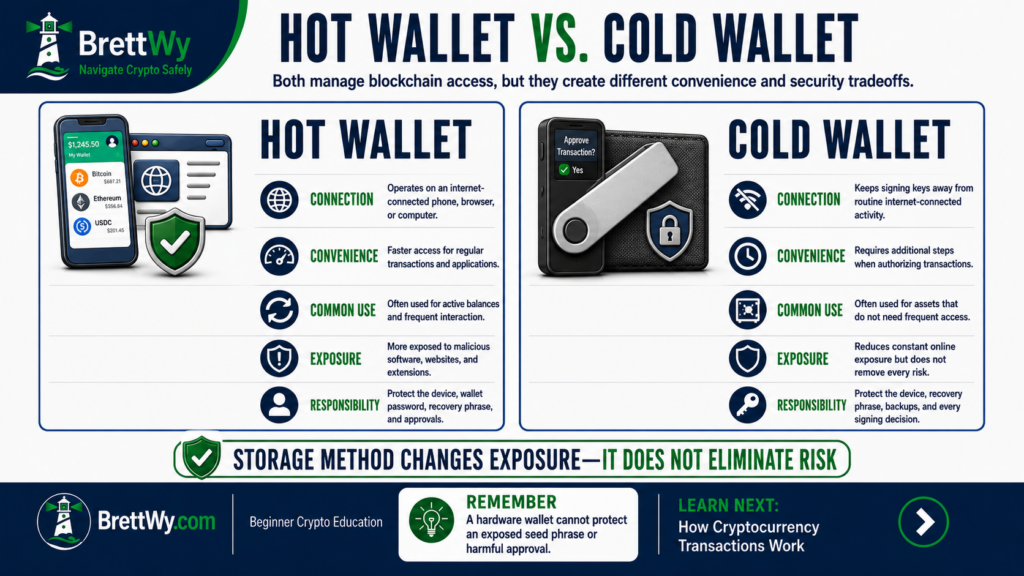
Although a hardware wallet can reduce some risks, it cannot protect someone who reveals a seed phrase or approves a deceptive transaction. Therefore, read Crypto Wallets Explained before choosing a custody method.
What Are Stablecoins?
For example, they may be backed by reserves, secured by crypto collateral, or managed through other mechanisms.
For example, stablecoins are often used for payments, transfers, trading, and DeFi. However, “stable” describes the intended price behavior—not a guarantee. Therefore, users should consider risks such as insufficient or unclear reserves, loss of the target price, smart-contract failure, issuer failure, frozen assets, and regulatory restrictions.
Learn how the main models differ in What Are Stablecoins? A Beginner’s Guide to How Stablecoins Work.
What Is Web3?
In a typical Web3 interaction, a wallet can act as both an account and an authorization tool. For instance, a user may connect the wallet to an application, sign a message, approve a token permission, or submit a blockchain transaction.
Nevertheless, Web3 remains an evolving category rather than one agreed technical standard. Although some applications are meaningfully decentralized, others still depend on companies, websites, hosted infrastructure, or administrators. Explore the concept without the hype in What Is Web3? A Beginner’s Guide to How Web3 Works.
Types of Cryptocurrencies
In other words, “cryptocurrency” is an umbrella term. Therefore, assets can have very different purposes, supply rules, governance systems, and risks.
| Category | General purpose | Important consideration |
|---|---|---|
| Bitcoin | Peer-to-peer digital value with a fixed maximum supply | Price volatility and custody risk remain significant |
| Platform assets | Pay fees or support programmable networks | Value may depend on network use, design, and competition |
| Stablecoins | Track another asset’s value | The target value is a goal, not a guarantee |
| Utility tokens | Access a product, service, or network function | Utility does not guarantee demand or value |
| Governance tokens | Participate in certain protocol decisions | Voting power and control may be concentrated |
| Collectible or gaming assets | Represent items, access, or ownership within an application | Demand, transferability, and platform dependence can change |
In short, the label “altcoin” generally refers to crypto assets other than Bitcoin, but it does not describe their quality or purpose. Therefore, evaluate the specific network and asset rather than relying on a category name.
How Cryptocurrency Transactions Work
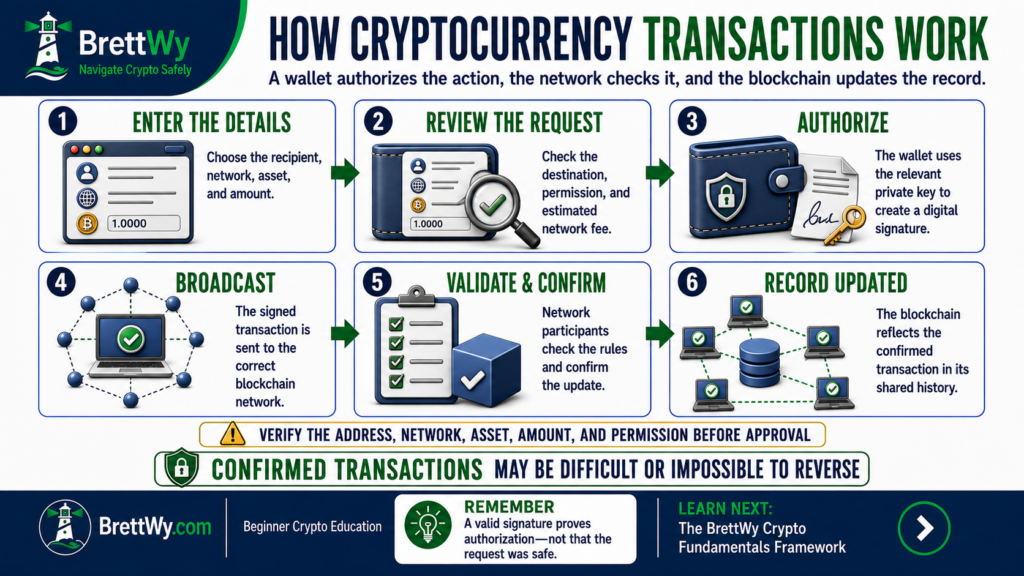
In simple terms, a cryptocurrency transaction updates a blockchain’s record according to the network’s rules.
For example, suppose Alice wants to send cryptocurrency to Bob:
- Alice enters Bob’s receiving address, the asset, and the amount.
- Her wallet shows the transaction details and estimated network fee.
- Alice authorizes the transaction with the relevant private key.
- The signed transaction is broadcast to the correct blockchain network.
- Network participants check whether it follows the protocol’s rules.
- After confirmation, the blockchain reflects the updated ownership record.
Importantly, the private key should not be typed into an ordinary transaction form. Instead, a legitimate wallet uses it internally to create a digital signature.
Because blockchain transactions are generally difficult to reverse, verification matters. Before approval, check the website or application, recipient, network, asset, amount, permission, and fee.
How People Access Cryptocurrency
Generally, people access cryptocurrency through custodial platforms, self-custody wallets, or a combination of both.
Cryptocurrency Exchanges
A cryptocurrency exchange is a platform that may allow eligible users to buy, sell, convert, or transfer supported digital assets. In most cases, a custodial exchange controls the private keys associated with assets held through the account.
Therefore, before using a platform, review:
- Eligibility and availability in your location
- Fees, spreads, deposit methods, and withdrawal limits
- Security controls and account-recovery procedures
- Which assets and blockchain networks are supported
- Custody terms and applicable legal protections
- The platform’s operational, financial, and regulatory risks
A Neutral Overview of the Purchase Process
- Research whether cryptocurrency fits your goals and risk tolerance.
- Compare eligible, reputable providers using verified information.
- Create and secure an account if you decide to proceed.
- Review the asset, amount, price, spread, and total fee before confirming.
- Understand the custody arrangement before leaving assets on a platform or withdrawing to a wallet.
Important: Do not withdraw to self-custody merely because someone says it is always safer. First understand wallet addresses, networks, seed phrases, backups, test transactions, and the consequences of losing recovery information.
Cryptocurrency Benefits and Limitations
| Potential benefit | Related limitation or tradeoff |
|---|---|
| Global digital transfers | Fees, speed, and access vary by network and service |
| Direct user control through self-custody | The user becomes responsible for backups, verification, and mistakes |
| Publicly verifiable blockchain records | Public records can create privacy concerns and do not prove every project is trustworthy |
| Programmable smart contracts | Code may contain errors, exploits, or unexpected permissions |
| Open application access | Interfaces, infrastructure, and legal availability may still be restricted |
| New forms of digital ownership | Ownership may depend on external platforms, files, issuers, or legal rights |
Therefore, cryptocurrency is not automatically faster, cheaper, safer, more private, or more decentralized than every traditional alternative. Instead, the outcome depends on the network, application, service provider, user behavior, and specific transaction.
Cryptocurrency Risks and Security
Above all, cryptocurrency can involve permanent financial loss. Therefore, beginners should understand the following risks before acting:
- Volatility: Market prices can change rapidly and substantially.
- Scams: Fraudsters use fake investments, giveaways, support accounts, websites, applications, and recovery services.
- Custody risk: A platform may experience a breach, failure, withdrawal delay, or legal restriction.
- Self-custody risk: Lost recovery information or an exposed seed phrase can lead to permanent loss.
- Transaction risk: Sending to the wrong address or network may be difficult or impossible to reverse.
- Smart-contract risk: Applications can contain vulnerabilities or request harmful permissions.
- Regulatory and tax risk: Rules differ by jurisdiction and can change.
- Asset risk: A token may lose demand, liquidity, utility, or nearly all of its market value.
Common Scam Warning Signs
- Guaranteed profits or “risk-free” returns
- Urgent instructions to send funds or move assets to a “safe” wallet
- Requests for a seed phrase, private key, password, or authentication code
- Unexpected customer-support messages
- Fees or taxes demanded before a supposed balance can be withdrawn
- Websites reached through unsolicited messages or unverified advertisements
For additional help, the U.S. Federal Trade Commission provides current guidance on cryptocurrency scams. Then, for a complete safety system, continue to Cryptocurrency Security: How to Protect Your Crypto and Avoid Scams.
Beginner Security Baseline
- Never share a seed phrase or private key.
- Use unique passwords and strong authentication.
- Download wallets and applications through verified providers.
- Verify websites, addresses, assets, networks, and permissions.
- Stop when you cannot explain what an action will allow.
General account-security guidance from the Cybersecurity and Infrastructure Security Agency can also help protect email accounts, devices, and authentication methods.
Common Beginner Mistakes to Avoid
| Mistake | Better approach |
|---|---|
| Acting before understanding the basics | Complete the learning path before making unfamiliar decisions |
| Using money needed for essential expenses | Recognize that crypto can lose substantial or all market value |
| Buying because of hype or urgency | Research independently and define a mandatory waiting period |
| Assuming a well-known logo makes a message legitimate | Verify the organization through a separate official channel |
| Ignoring total fees and spreads | Review the complete transaction cost before confirmation |
| Withdrawing to a wallet without understanding recovery | Learn custody, networks, addresses, backups, and test transactions first |
| Leaving every asset exposed to one account or wallet | Understand concentration and custody risks |
| Approving requests without reading them | Verify the purpose, application, address, network, amount, and permission |
| Believing recovery is guaranteed | Treat paid recovery promises and follow-up contact as potential scams |
Cryptocurrency and Taxes
Because tax treatment depends on the country, transaction, asset, and individual circumstances, reporting requirements vary. For example, selling, exchanging, spending, receiving, staking, mining, gifting, or earning cryptocurrency may have different consequences.
Therefore, keep accurate records that may include:
- Dates and transaction types
- Assets and quantities
- Purchase prices or fair-market values
- Fees
- Sale or disposal proceeds
- Wallet addresses and transaction records where relevant
For current U.S. information, taxpayers should review the IRS’s digital-assets guidance. Because laws and guidance change, verify current official information and consult a qualified tax professional for advice about your circumstances.
Key Takeaways
- Cryptocurrency is a broad category of digital assets rather than one single technology or investment.
- Similarly, many cryptocurrencies use blockchains to record ownership and transactions.
- By comparison, Bitcoin and Ethereum are separate networks designed around different primary capabilities.
- In addition, smart contracts make blockchain applications programmable, including many DeFi and Web3 services.
- Crypto wallets manage access; they do not physically store coins.
- However, stablecoins can still fail or lose their target value despite aiming for price stability.
- Custodial and self-custody methods create different responsibilities and risks.
- Therefore, verification matters before approving transactions that may be difficult to reverse.
- Crypto can involve volatility, scams, technical failures, regulatory changes, and permanent loss.
- Above all, education and security should come before financial action.
Frequently Asked Questions About Cryptocurrency
What is cryptocurrency?
Cryptocurrency is a digital asset that uses cryptography and a distributed network to record ownership and authorize transactions.
How does cryptocurrency work?
First, a wallet authorizes a transaction. Next, the network checks it against shared rules. Finally, a blockchain or other distributed ledger updates the ownership record after confirmation.
Is cryptocurrency the same as Bitcoin?
No. Bitcoin is one cryptocurrency network and asset. By contrast, the broader cryptocurrency category includes many other networks, tokens, stablecoins, and blockchain-based assets.
Do I need to buy a whole Bitcoin?
No. Bitcoin can be divided into smaller units. Nevertheless, divisibility does not make it appropriate for every person or remove the risk of loss.
What is a crypto wallet?
In simple terms, a crypto wallet manages the keys and account information used to interact with assets recorded on a blockchain.
Is cryptocurrency safe?
No cryptocurrency activity is risk-free. In other words, security depends on the network, asset, platform, wallet, device, application, transaction, and user behavior.
Can cryptocurrency be hacked?
Blockchains, exchanges, wallets, devices, and smart contracts have different security models. For example, a user can lose crypto through phishing, stolen credentials, exposed recovery information, malicious code, or an unsafe transaction even when the underlying blockchain continues operating.
Are cryptocurrency transactions reversible?
In general, confirmed blockchain transactions are difficult to reverse because most public networks do not have a central administrator who can cancel them.
Is cryptocurrency legal?
In practice, legal status and restrictions vary by country, activity, asset, and service. Therefore, verify current rules through official sources in your jurisdiction.
How is cryptocurrency taxed?
Tax treatment varies by jurisdiction and transaction type. For example, selling, trading, spending, earning, staking, or receiving crypto may create reporting obligations. Therefore, consult current official guidance and a qualified tax professional.
Can I lose all the money I put into cryptocurrency?
Yes. In fact, a crypto asset can lose most or all of its market value. In addition, scams, platform failures, inaccessible wallets, or irreversible mistakes can cause asset losses.
What should I learn next?
Next, continue to What Is Blockchain? in the Crypto Fundamentals Learning Path. This guide explains the shared record that many cryptocurrency networks depend on.
Test Your Knowledge
- What is the best general description of cryptocurrency?
- Money stored inside a mobile application
- A broad category of digital assets recorded through distributed networks
- Another name for Bitcoin
- A guaranteed investment
- Where are cryptocurrency ownership records maintained?
- Inside the physical wallet
- Only on an exchange’s website
- On the relevant blockchain or distributed ledger
- In an email account
- Does a crypto wallet physically store coins?
- Yes
- No
- Does “stablecoin” mean the asset cannot lose value?
- Yes
- No
- What should you do when you cannot explain a wallet request?
- Approve it quickly
- Share your seed phrase with support
- Reject it and verify the action independently
- Send a larger test transaction
- Which subject comes next in the learning path?
- Price prediction
- Blockchain
- Advanced trading
- Token promotion
Check your answers
- Cryptocurrency is a broad category of digital assets recorded through distributed networks; Bitcoin is one example.
- Ownership records are maintained on the relevant blockchain or distributed ledger.
- No. A wallet manages the keys and account information used to interact with blockchain-recorded assets.
- No. Stability is a design goal, not a guarantee.
- Reject an unclear wallet request and verify the action independently.
- Blockchain comes next because it is the shared record underlying many cryptocurrency systems.
Official and Educational Resources
- Bitcoin: A Peer-to-Peer Electronic Cash System — the original Bitcoin whitepaper
- Ethereum.org Learn — educational material about Ethereum and blockchain applications
- What to Know About Cryptocurrency and Scams — U.S. Federal Trade Commission
- Secure Our World — account and device security guidance from CISA
- Digital Assets — current U.S. tax information from the IRS
Final Thoughts
Cryptocurrency is easier to understand when you treat it as a connected system rather than a collection of prices and unfamiliar terms. Assets operate on networks, wallets control access, and every transaction or approval creates a specific action with a specific risk.
Use the BrettWy Crypto Fundamentals Framework before moving forward: identify the asset, confirm the network, understand who controls access, explain the requested action, and consider what could go wrong. That habit matters more than memorizing every token or technical detail.
You’ve Started the Crypto Fundamentals Learning Path
At this point, you have a map of the cryptocurrency ecosystem. Along the way, you learned how blockchains record ownership, how Bitcoin and Ethereum differ, how smart contracts support DeFi and Web3, how wallets control access, why stablecoins exist, and which risks deserve attention.
However, you do not need to act immediately. Instead, use this learning path to build understanding one concept at a time before making financial decisions, opening accounts, connecting wallets, or transferring assets.
Crypto Fundamentals Path Start: You have completed the overview. Next, learn how blockchain creates the shared record that many cryptocurrencies depend on.
LEARN NEXT
A beginner’s guide to how blockchain records and verifies information.
Final BrettWy Lesson: You do not need to learn every cryptocurrency or technical term at once. Start with the underlying system, understand who controls access, and never authorize an action you do not understand.
About This Content
BrettWy creates beginner-friendly cryptocurrency education with a focus on clear explanations, practical security, and understanding risk. Content is developed with AI assistance, and relevant sources are linked so readers can explore the underlying information.
Crypto products, services, and technical guidance can change. Check current information with the original source before taking action.
Found an error or outdated information? Email info@brettwy.com with the article URL and the detail you believe needs attention. Never include passwords, private keys, or recovery phrases.
Educational and Risk Disclaimer
This article is provided for general educational and informational purposes only. Therefore, it does not constitute financial, investment, legal, tax, accounting, cybersecurity, or other professional advice.
In addition, cryptocurrency, exchanges, self-custody wallets, stablecoins, smart contracts, decentralized applications, and blockchain networks involve significant risks. For example, these may include volatility, fraud, software vulnerabilities, platform failure, regulatory changes, irreversible transactions, loss of access, and permanent loss of assets.
Finally, no security method, custody arrangement, asset, platform, or strategy can eliminate every risk or guarantee a financial result. Always verify information through current official sources, follow applicable laws and eligibility requirements, and consult qualified professionals when appropriate.