
Article Snapshot
Crypto Fundamentals Learning Path
- The Complete Beginner’s Guide to Cryptocurrency
- What Is Blockchain?
- What Is Bitcoin?
- What Is Ethereum?
- What Are Smart Contracts?
- What Is DeFi?
- ► Crypto Wallets Explained — You are here
- What Are Stablecoins?
- What Is Web3?
- Cryptocurrency Security
In This Guide, You’ll Learn
- •What a crypto wallet actually manages
- •How wallets interact with blockchains
- •The roles of addresses, public keys, and private keys
- •How recovery phrases restore wallet access
- •How major wallet types compare
- •How to send and receive crypto more safely
- •Common wallet risks and beginner mistakes
- •How to evaluate a wallet responsibly
Introduction
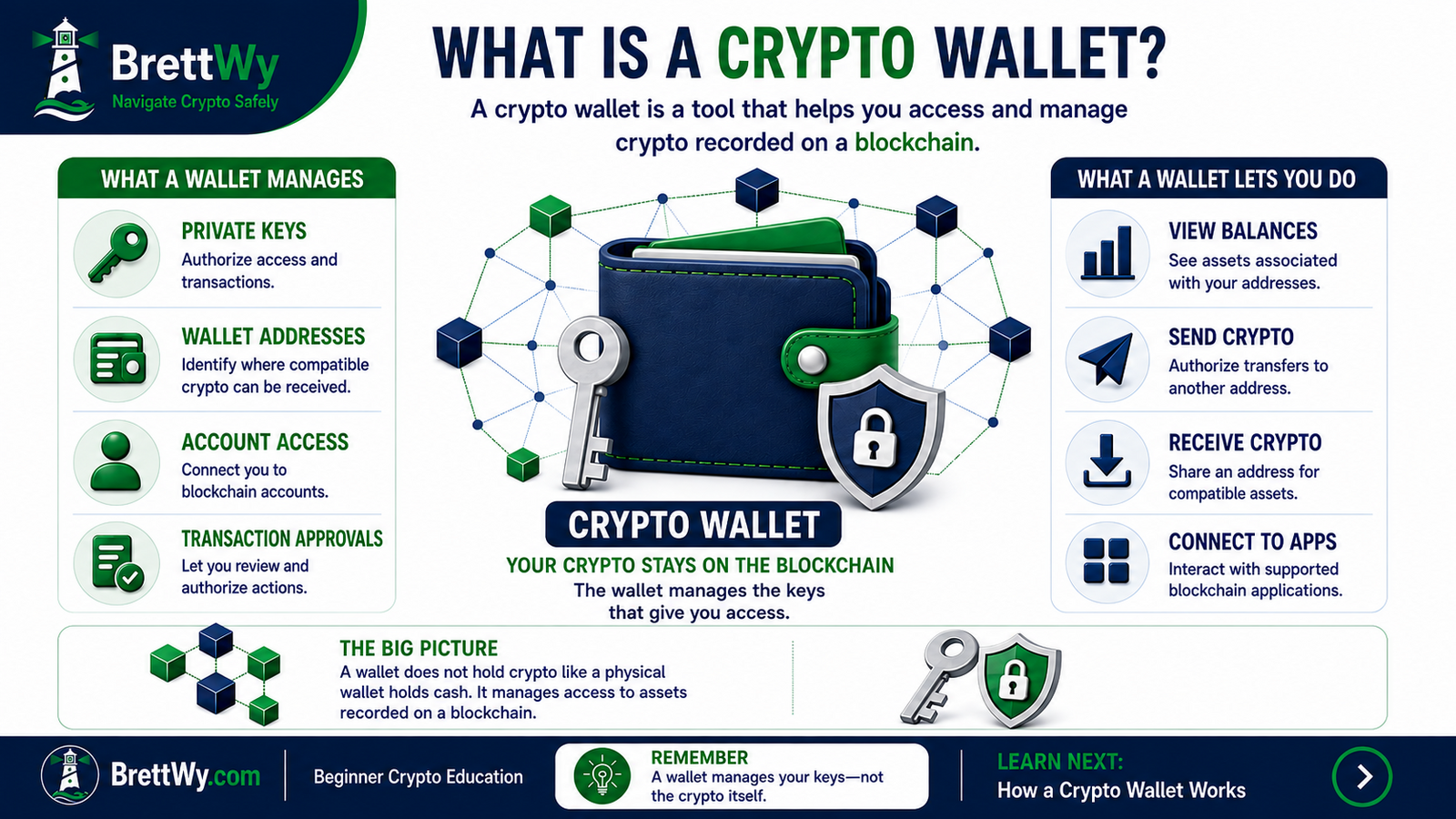
To begin with, a crypto wallet is one of the most important tools in cryptocurrency. It lets you view balances, receive digital assets, authorize transactions, and interact with blockchain applications. However, the word “wallet” creates a common misunderstanding: a crypto wallet does not normally hold cryptocurrency the way a physical wallet holds cash.
Instead, cryptocurrency remains recorded on its blockchain. The wallet manages the digital credentials that let you access and control the assets associated with a blockchain account or address. In simple terms, a crypto wallet works more like a keychain than a container.
In addition, this guide explains what wallets store, how transactions work, how the major wallet types compare, and which security responsibilities beginners need to understand. It is educational and does not recommend a particular product or guarantee that any wallet can remove every risk.
The BrettWy Wallet Framework
Use this five-part model to understand what a cryptocurrency wallet does and where responsibility sits:
- Access: The wallet creates or imports the credentials used to access compatible blockchain accounts.
- Address: A public wallet address allows compatible assets to be received and viewed on the blockchain.
- Authorization: Private keys or equivalent signing authority approve transactions and other wallet requests.
- Recovery: A recovery method may restore wallet access if a device or application is lost.
- Responsibility: The user or custodian must protect credentials, verify requests, and manage the risks of every interaction.
Table of Contents
What Is a Crypto Wallet?
A crypto wallet is an application, device, or service that helps you
interact with cryptocurrency associated with a blockchain account.
For example, depending on its design, it may show balances, generate receiving
addresses, approve transactions, connect to decentralized applications,
and manage supported tokens.
In other words, the blockchain maintains the transaction and ownership record. The
wallet reads that record and uses cryptographic credentials to authorize
changes. For instance, if someone sends bitcoin to your address, the bitcoin does not
enter a folder on your phone. The Bitcoin network updates its shared
record, and the wallet displays the result.
As a result, this distinction explains why a damaged device does not automatically
destroy the assets. Therefore, if valid recovery information remains available, a
compatible wallet may restore access. If every required self-custody
credential is permanently lost, however, the blockchain generally has no
administrator who can reset it.
How a Crypto Wallet Works
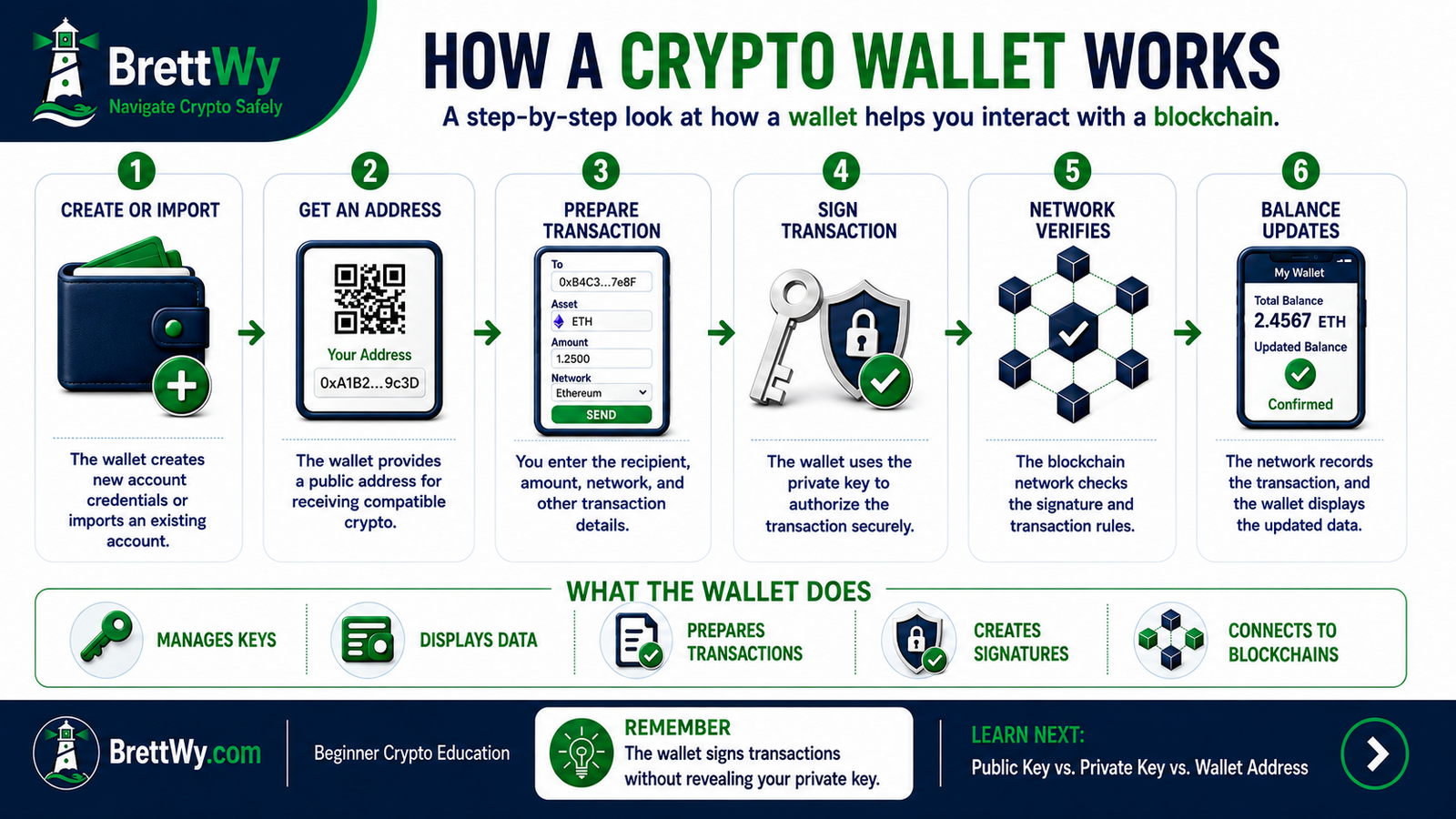
- The wallet creates or imports a blockchain account.
- It provides a public receiving address.
- A sender prepares a transaction using that address.
- The sending wallet signs the transaction with the appropriate private key.
- Afterward, the blockchain network verifies the signature and transaction
rules. - Once verified, the network records the valid transaction.
- Finally, the receiving wallet reads the updated blockchain data and
displays the balance.
Therefore, a digital signature proves authorization without revealing the
private key. Similarly, when you send crypto, the same basic process runs in
reverse: enter the destination, select the asset and network, review the
fee, verify the details, and approve the signature. Confirmed blockchain
transfers are generally difficult or impossible to reverse.
For an example of assets that use these networks, read about stablecoins and how they work, including their different designs and risks.
Public Keys, Private Keys, and Wallet Addresses
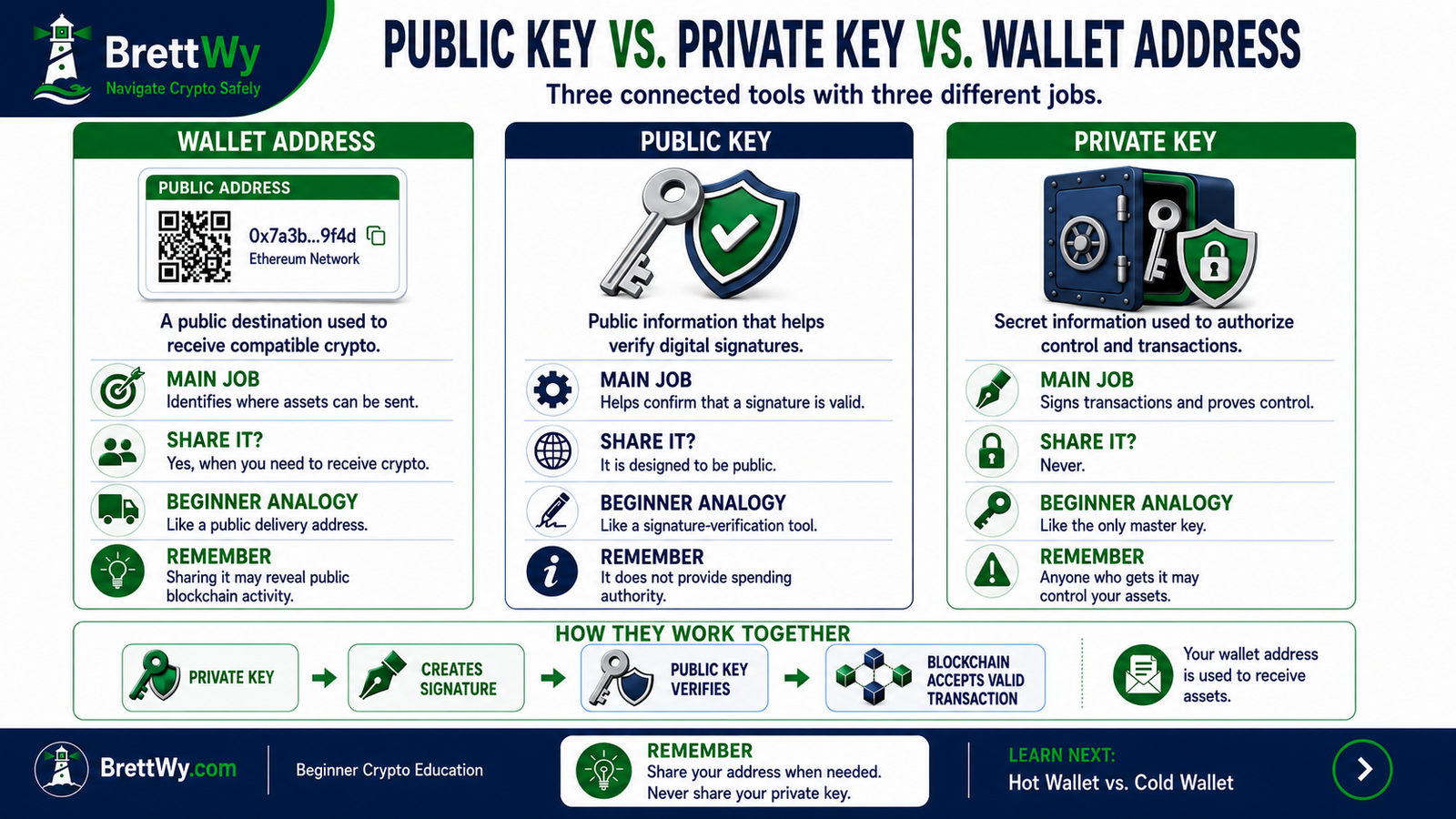
Wallet address
A wallet address is a public identifier used to receive compatible
cryptocurrency. For example, it can usually be shared when necessary, but public
blockchains may let others view its balance and activity. A public
address is therefore shareable, not necessarily private.
Private key
A private key is secret cryptographic information that authorizes
control and transactions. Consequently, anyone who obtains it may be able to move the
connected assets. Moreover, it cannot normally be reset by the blockchain and
should never be shared with support representatives, websites, friends,
or recovery services.
Public key
A public key is mathematically related to a private key and helps the
network verify signatures. In practice, the rule is simple: the private key
signs, the public key helps verify, and the private key must remain
secret.
What Is a Recovery Phrase?
A recovery phrase—also called a seed phrase or secret recovery
phrase—is an ordered sequence of words used by many self-custody wallets
to generate or restore wallet credentials. Moreover, it may restore multiple
accounts, making it more powerful than an ordinary application
password.
A wallet password usually protects one application or device. A
recovery phrase may recreate the wallet on another compatible device.
Therefore, changing the password does not make an exposed recovery phrase safe
again.
- Never share a recovery phrase or private key.
- Avoid photographing or screenshotting it.
- Likewise, never send it through email or messaging apps.
- In addition, never enter it into a site reached through an unsolicited
message or advertisement. - Keep the backup separate from the wallet device and protected
from theft, loss, fire, water, and accidental disposal. - No legitimate support representative needs it to inspect a public
transaction or provide ordinary help.
The Main Types of Crypto Wallets
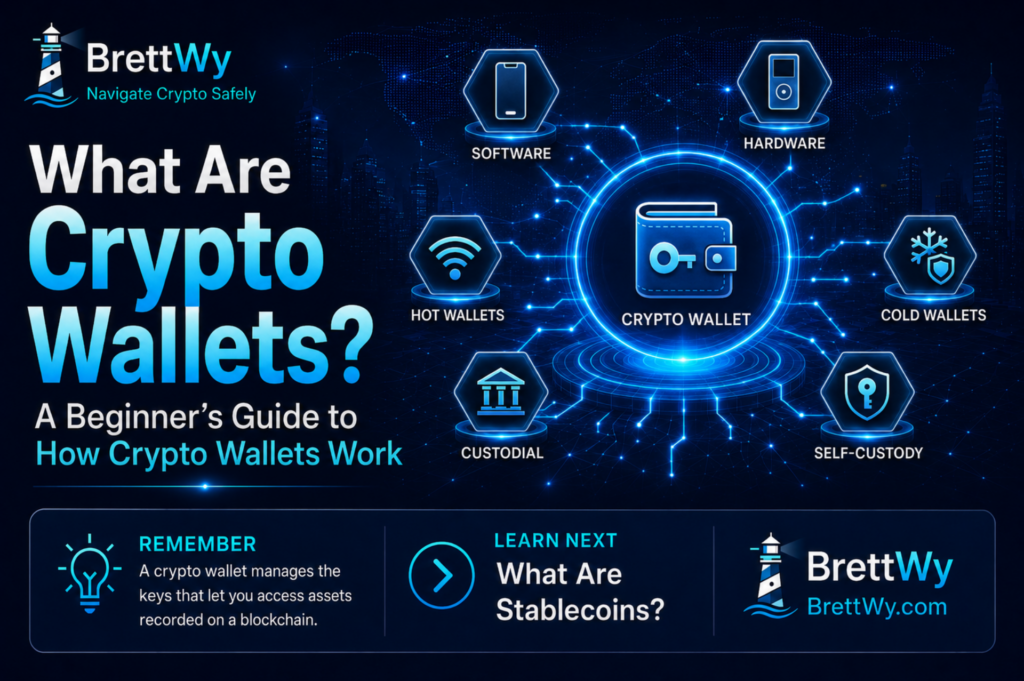
Importantly, wallet categories overlap. First, “software or hardware” describes form.
Second, “hot or cold” describes exposure to an online environment. “Custodial or
non-custodial” describes who controls the private keys.
Software wallets
For example, software wallets run on phones, computers, browsers, or websites.
For instance, they are convenient for frequent access and decentralized applications,
but their security depends partly on the connected device, operating
system, extensions, downloads, and user behavior.
Hardware wallets
By contrast, a hardware wallet is a separate device designed to keep private keys
isolated while signing transactions. As a result, it can reduce exposure to malware,
but it cannot prevent recovery-phrase theft, counterfeit devices,
harmful approvals, physical loss, or failure to verify the device
screen.
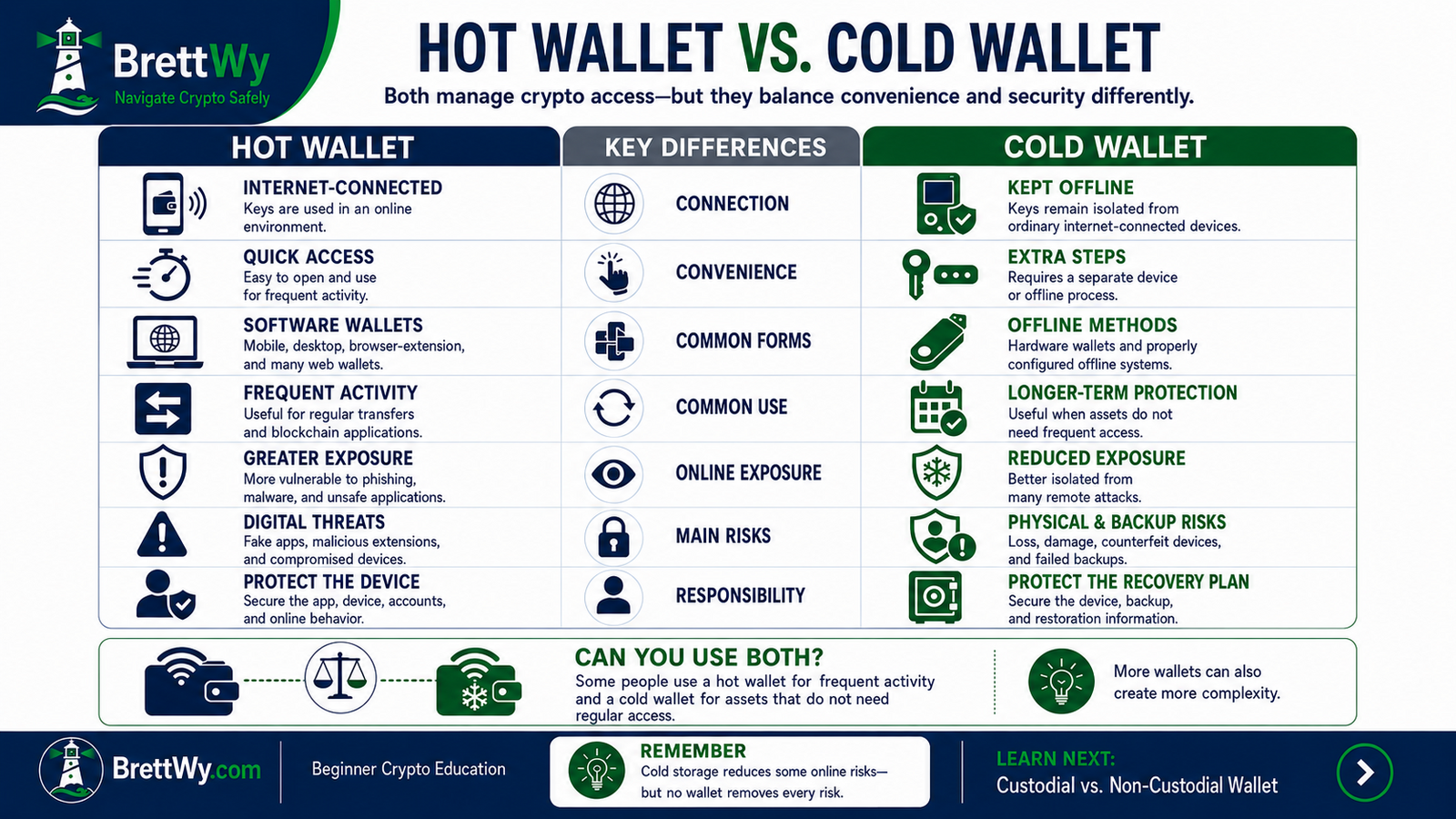
Hot wallets vs. cold wallets
On the one hand, a hot wallet uses keys in an internet-connected environment and
emphasizes convenience. On the other hand, a cold wallet keeps keys offline or isolated and
emphasizes reduced online exposure. Cold storage adds physical
protection and recovery responsibilities; it is not automatically
safe.
Custodial vs. Non-Custodial Wallets
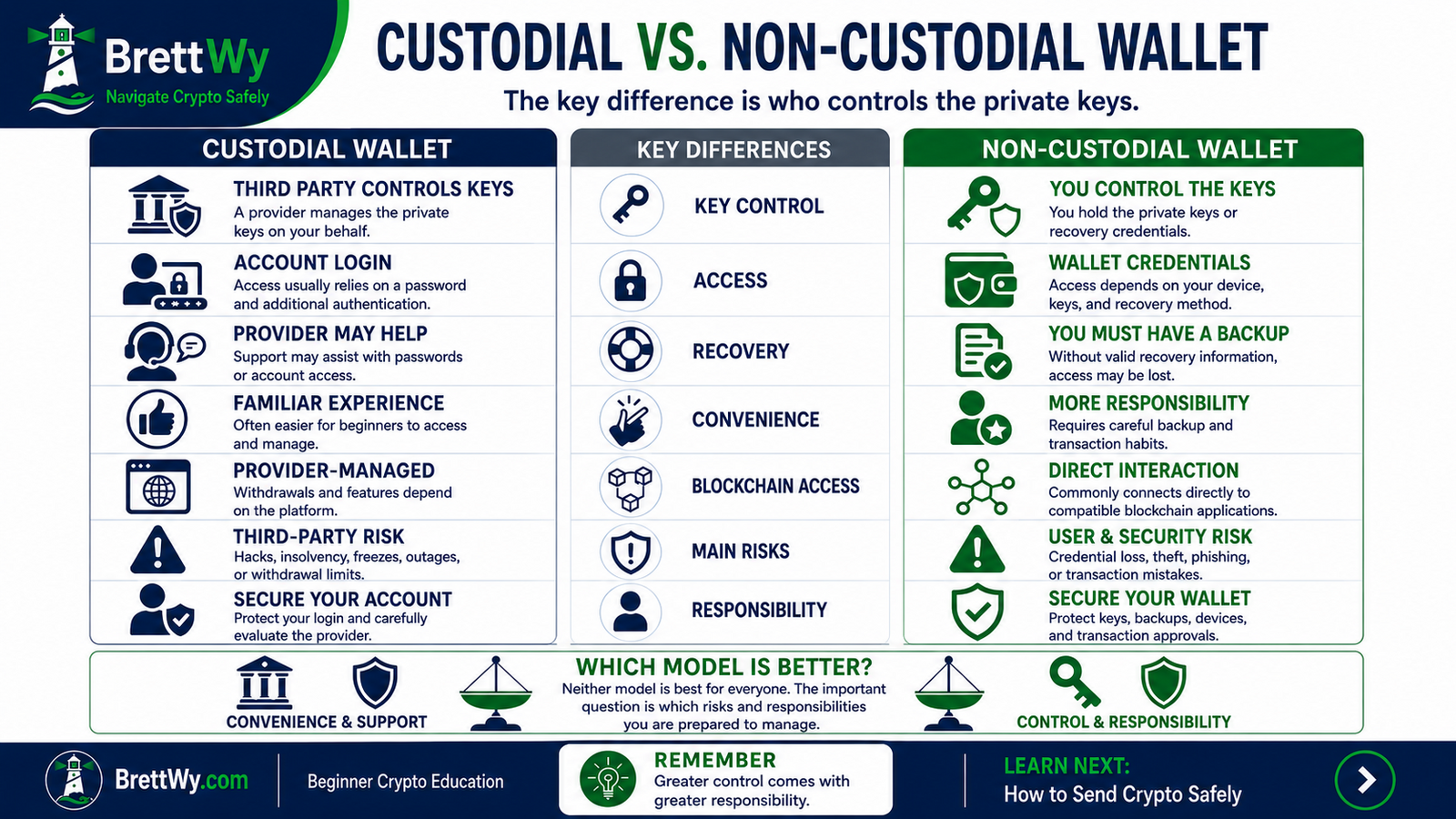
For example, a custodial provider controls keys on the user’s behalf and may offer
password recovery and support, but introduces provider, account,
withdrawal, and operational risks. In contrast, a non-custodial wallet gives the user
direct control and access to compatible blockchain applications, but
usually offers no central password reset or transaction reversal.
How to Send and Receive Crypto Safely
Receiving
- Select the correct asset and blockchain network.
- Open the wallet’s receive function.
- Copy the complete address or display its QR code.
- Confirm that sender and receiver selected the same compatible
network. - Wait for the network to process the transfer and verify its
status.
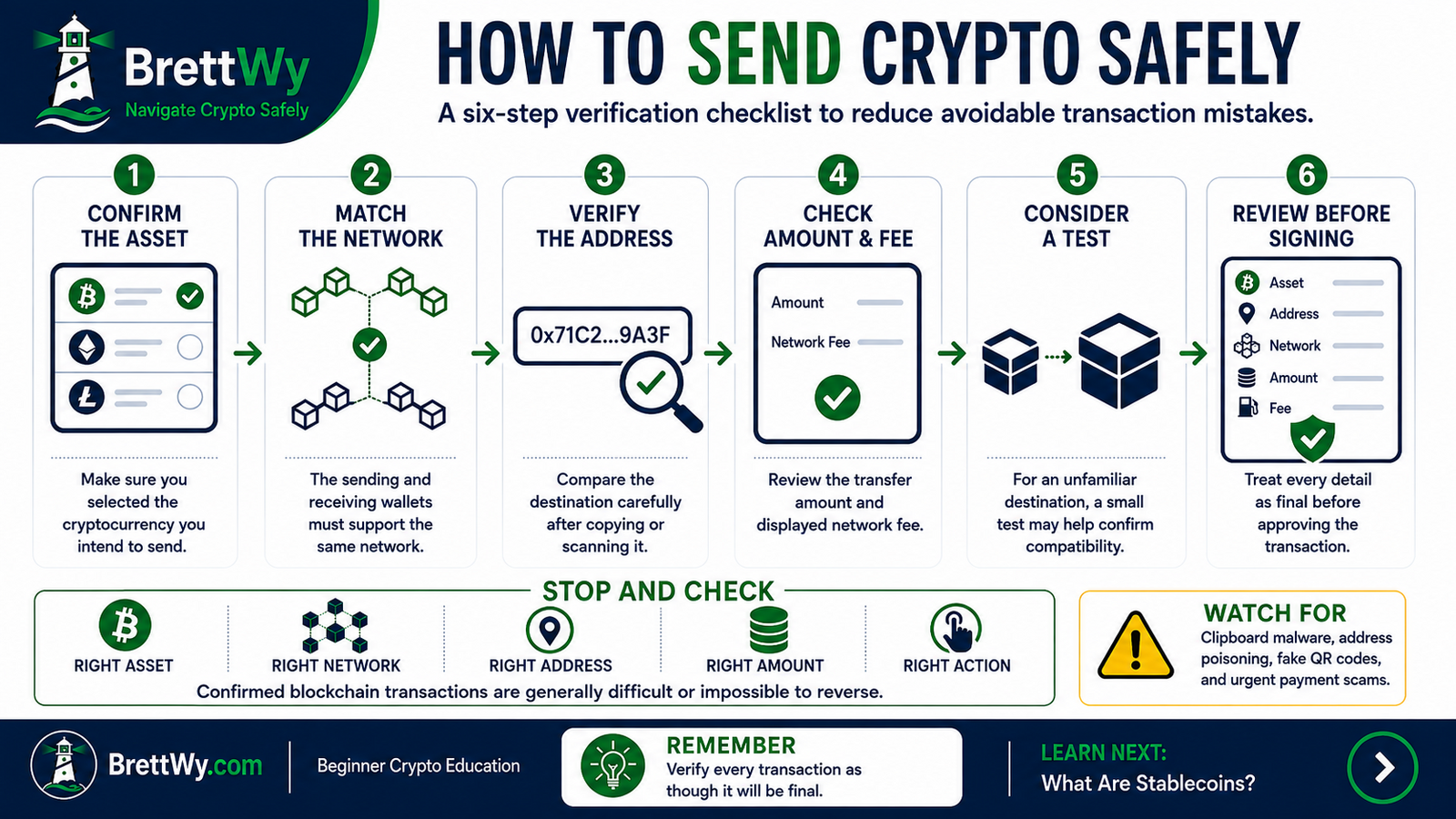
Sending
- Select the intended asset and network.
- Enter or scan the recipient’s verified address.
- Enter the amount and review the network fee.
- Next, confirm the asset, complete address, amount, network, fee, and
transaction type. - Approve the transaction and monitor confirmation status.
For example, a small test transfer can reduce risk with an unfamiliar destination,
but every later transaction still requires verification. Clipboard
malware may replace copied addresses, while address poisoning uses
look-alike addresses in transaction history. Do not copy a destination
blindly from history or rely only on its first and last characters.
Connecting a Wallet to Applications
First, connecting a wallet generally shares the selected public address with
an application. However, signing a message, signing a transaction, approving a
token, and sending crypto are separate actions with different
consequences. Nevertheless, a wallet may present an approval request, but the user
must decide whether it is legitimate and understandable.
In addition, some smart contracts request permission to interact with tokens.
For example, broad or unlimited approvals may remain active. Review the contract,
asset, amount, and permission before signing, and avoid blind
signing—approving data that the interface does not explain clearly.
For the broader context behind these connections, our beginner’s guide to Web3 explains how wallets, applications, and blockchain-based ownership fit together.
Are Crypto Wallets Safe?
In general, a wallet can provide strong security, but safety depends on the
complete system: wallet design, key protection, recovery method, device
security, software authenticity, connected applications, physical
backups, and user behavior.
- Phishing and fake support messages
- Fraudulent wallet apps and malicious browser extensions
- Recovery-phrase or private-key theft
- Compromised phones and computers
- Clipboard malware and address poisoning
- Harmful transaction or token approvals
- Lost or damaged devices and backups
- Custodian hacks, insolvency, freezes, or outages
Furthermore, multifactor authentication strengthens custodial accounts, email, and
other online services, but it does not replace recovery-phrase security.
However, someone with a valid self-custody recovery phrase may be able to restore
the wallet elsewhere without the original device.
How to Choose a Crypto Wallet
- Choose the custody model: decide who will control the
keys. - Confirm support for the intended assets, networks, and
applications. - Investigate the developer, operating history, documentation,
updates, and security disclosures. - Understand where keys are generated and how transactions are
displayed and approved. - Learn the recovery process before placing assets at
risk. - Evaluate whether the interface clearly shows the asset, network,
address, amount, fee, and permission. - Review hardware, network, provider, exchange-withdrawal, and
application costs. - Download software or purchase hardware only through verified
official sources.
Ultimately, the best wallet is not necessarily the most expensive or
feature-rich. It is one whose responsibilities the user understands and
can manage consistently. Influencer promotions and affiliate
recommendations should be treated only as research starting points.
Common Wallet Mistakes
- Believing the device contains the cryptocurrency
- Sharing or photographing a recovery phrase
- Keeping the only backup on the wallet device
- Downloading an impersonator application
- Using an unsupported network
- Failing to verify a pasted address
- Skipping a test transfer for an unfamiliar destination
- Treating hardware as automatic protection
- Signing an unclear transaction
- Confusing an exchange balance with self-custody
- Ignoring verified security updates
- Trusting unsolicited support or recovery offers
Beginner Wallet Safety Checklist
- Verify asset and network support.
- Know whether the wallet is custodial or non-custodial.
- Use verified official download sources.
- Protect devices with updates and strong access controls.
- Enable strong multifactor authentication where it
applies. - Never disclose a private key or recovery phrase.
- Maintain a private, durable recovery plan.
- Verify addresses after pasting.
- Review the asset, address, amount, network, fee, and action
before signing. - Ignore unsolicited support and guaranteed recovery
claims. - Periodically review connected applications and token
permissions.
For more on phishing, recovery information, and account protection, read the complete cryptocurrency security guide.
Key Takeaways
- Crypto remains recorded on the blockchain; the wallet manages
access. - Addresses receive assets, private keys authorize control, and
recovery phrases may restore many accounts. - Software/hardware, hot/cold, and custodial/non-custodial answer
different questions. - Self-custody increases control and personal
responsibility. - Hardware wallets reduce some online risks but do not remove user
error. - Confirmed transfers are usually irreversible, so every detail
must be checked.
Frequently Asked Questions
Does a wallet store cryptocurrency?
In short, not like a physical wallet. The blockchain maintains the ownership
record, while the wallet manages the credentials used to interact with
it.
Do I need a self-custody wallet?
Not necessarily. Custodial services manage keys for eligible users.
Self-custody is a separate choice with additional control and
responsibility.
Can someone steal crypto with only an address?
In general, an address alone does not normally provide spending authority, but it
may reveal public activity and enable targeted scams.
What happens if a wallet device breaks?
If valid recovery information remains safe, access may be restored
through a compatible wallet. Without required self-custody credentials,
recovery may be impossible.
Can a transaction be reversed?
A confirmed blockchain transfer is generally difficult or impossible
to reverse. Verify it as though it will be final.
Can one wallet support many cryptocurrencies?
Some do, but every asset and network must be explicitly supported.
Matching names do not guarantee compatibility.
Are wallets anonymous?
In practice, most public blockchain accounts are pseudonymous. Activity is public
and may become linked to a person.
Can support recover a private key?
A non-custodial provider normally cannot recreate credentials it
never controlled. Never give a recovery phrase to anyone offering
help.
Test Your Knowledge
- Where is cryptocurrency ownership recorded?
- Which wallet information should never be shared?
- What does non-custodial mean?
- What is the main difference between hot and cold wallets?
- What details should you verify before sending cryptocurrency?
Check your answers
- Cryptocurrency ownership and transaction history are recorded on the relevant blockchain.
- Never share a private key or recovery phrase. Either may provide control over the associated assets.
- Non-custodial means the user controls the private keys or equivalent signing authority instead of relying on a third-party custodian.
- Hot and cold wallets differ mainly in their relationship to internet-connected environments. Hot wallets prioritize convenient access, while cold wallets reduce certain forms of online exposure.
- Verify the asset, complete destination address, amount, blockchain network, fee, and transaction type before approving the transfer.
Official Resources
- Wallet overview — Ethereum.org
- Account documentation — Ethereum.org
- Security guidance — Ethereum.org
- Bitcoin Wallet Security
- Bitcoin Wallet Selection
- FTC Cryptocurrency Scam Guidance
- CISA Multifactor Authentication
Final Thoughts
Ultimately, a crypto wallet is where blockchain technology becomes personal. It can provide direct control, but that control comes with unfamiliar responsibilities: there may be no reset department, no authority that can reverse a confirmed mistake, and no safe reason to reveal a recovery phrase.
For that reason, beginners do not need the most advanced setup. They need a setup they understand, a recovery plan they can maintain, and habits they can follow consistently. Finally, share a wallet address only when necessary. Never share a private key or recovery phrase.
You’ve Completed the Crypto Wallet Foundation
Now that you understand what crypto wallets manage, how signing and recovery work, and why wallet type matters, you are ready to examine the digital assets designed to maintain a more stable reference value.
Recommended next reading: What Are Stablecoins?
- Why stablecoins exist
- How reserve-backed and crypto-collateralized designs differ
- How stablecoins attempt to maintain their intended value
- Why stablecoins can lose their peg
Crypto Fundamentals Path Progress: You have completed the cryptocurrency-wallet foundation. Next, learn how stablecoins are designed and how they function across cryptocurrency markets and applications.
LEARN NEXT
Learn why stablecoins exist, how different designs attempt to maintain value, and which reserve, collateral, market, and depegging risks beginners should understand.
Final BrettWy Lesson: A wallet can improve control and reduce some third-party exposure, but lasting security depends on protecting recovery information, verifying every request, and using a setup you can manage consistently.
About This Content
BrettWy creates beginner-friendly cryptocurrency education with a focus on clear explanations, practical security, and understanding risk. Content is developed with AI assistance, and relevant sources are linked so readers can explore the underlying information.
Crypto products, services, and technical guidance can change. Check current information with the original source before taking action.
Found an error or outdated information? Email info@brettwy.com with the article URL and the detail you believe needs attention. Never include passwords, private keys, or recovery phrases.
Educational and Risk Disclaimer
BrettWy provides this article for general educational and informational purposes only. It does not constitute financial, investment, legal, tax, accounting, cybersecurity, or other professional advice.
Cryptocurrency wallets, private keys, recovery phrases, self-custody, third-party custodians, applications, devices, and blockchain transactions involve significant risks, including credential theft, malicious software, fraudulent approvals, scams, provider failure, irreversible mistakes, and permanent financial loss.
No wallet, device, custodian, application, security method, or recovery process can eliminate every risk or guarantee the safety of digital assets. Verify current information through official sources and consult qualified professionals when appropriate.